
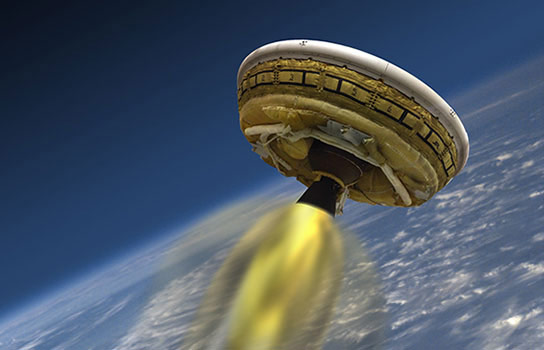
NASA’s flying saucer-shaped vehicle is ready for its first engineering test flight. The Low Density Supersonic Decelerator (LDSD) is designed to test landing technologies for future Mars missions.
NASA’s flying saucer-shaped test vehicle is ready to take to the skies from the U.S. Navy’s Pacific Missile Range Facility in Kauai, Hawaii, for its first engineering shakeout flight.
The first launch opportunity for the test vehicle is June 3, when the launch window opens at 8:30 a.m. HST. The test will be carried live on NASA TV and streamed on the Web. The Low Density Supersonic Decelerator (LDSD) will gather data about landing heavy payloads on Mars and other planetary surfaces.
“The agency is moving forward and getting ready for Mars as part of NASA’s Evolvable Mars campaign,” said Michael Gazarik, associate administrator for Space Technology at NASA Headquarters in Washington. “We fly, we learn, we fly again. We have two more vehicles in the works for next year.”
As NASA plans increasingly ambitious robotic missions to Mars, laying the groundwork for even more complex human science expeditions to come, accommodating extended stays for explorers on the Martian surface will require larger and heavier spacecraft.
The objective of the LDSD project is to see if the cutting-edge, rocket-powered test vehicle operates as it was designed – in near-space at high Mach numbers.
“After years of imagination, engineering, and hard work, we soon will get to see our Keiki o ka honua, our ‘boy from Earth,’ show us its stuff,” said Mark Adler, project manager for the Low Density Supersonic Decelerator at NASA’s Jet Propulsion Laboratory (JPL) in Pasadena, California. “The success of this experimental test flight will be measured by the success of the test vehicle to launch and fly its flight profile as advertised. If our flying saucer hits its speed and altitude targets, it will be a great day.”
The way NASA’s saucer climbs to test altitude is almost as distinctive as the test vehicle itself.
“We use a helium balloon – that, when fully inflated, would fit snugly into Pasadena’s Rose Bowl – to lift our vehicle to 120,000 feet (36,600 meters),” said Adler. “From there we drop it for about one and a half seconds. After that, it’s all about going higher and faster – and then it’s about putting on the brakes.”
A fraction of a second after dropping from the balloon, and a few feet below it, four small rocket motors will fire to spin up and gyroscopically stabilize the saucer. A half second later, a Star 48B long-nozzle, solid-fueled rocket engine will kick in with 17,500 pounds of thrust, sending the test vehicle to the edge of the stratosphere.
“Our goal is to get to an altitude and velocity which simulates the kind of environment one of our vehicles would encounter when it would fly in the Martian atmosphere,” said Ian Clark, principal investigator of the LDSD project at JPL. “We top out at about 180,000 feet (54,900 meters) and Mach 4. Then, as we slow down to Mach 3.8, we deploy the first of two new atmospheric braking systems.”
The project management team decided also to fly the two supersonic decelerator technologies that will be thoroughly tested during two LDSD flight tests next year.
If this year’s test vehicle flies as expected, the LDSD team may get a treasure-trove of data on how the 6-meter (20-foot) supersonic inflatable aerodynamic decelerator (SIAD-R) and the supersonic parachute operate a full year ahead of schedule.
The SIAD-R, essentially an inflatable doughnut that increases the vehicle’s size and, as a result, its drag, is deployed at about Mach 3.8. It will quickly slow the vehicle to Mach 2.5 where the parachute, the largest supersonic parachute ever flown, first hits the supersonic flow. About 45 minutes later, the saucer is expected to make a controlled landing onto the Pacific Ocean off Hawaii.
NASA TV will carry live images and commentary of LDSD engineering test. The test vehicle itself carries several onboard cameras. It is expected that video of selected portions of the test, including the rocket-powered ascent, will be downlinked during the commentary. Websites streaming live video of the test include: http://www.nasa.gov/nasatv and http://www.ustream.tv/nasajpl2.
Update: Due to weather conditions, there will be no launch of the LDSD test vehicle on Tuesday, June 3. Other potential launch dates include June 5, 7, 9, 11 and 14. Launch decision for Thursday, June 5 will be made on Wednesday, June 4.
Never miss a breakthrough: Join the SciTechDaily newsletter.
Follow us on Google and Google News.