
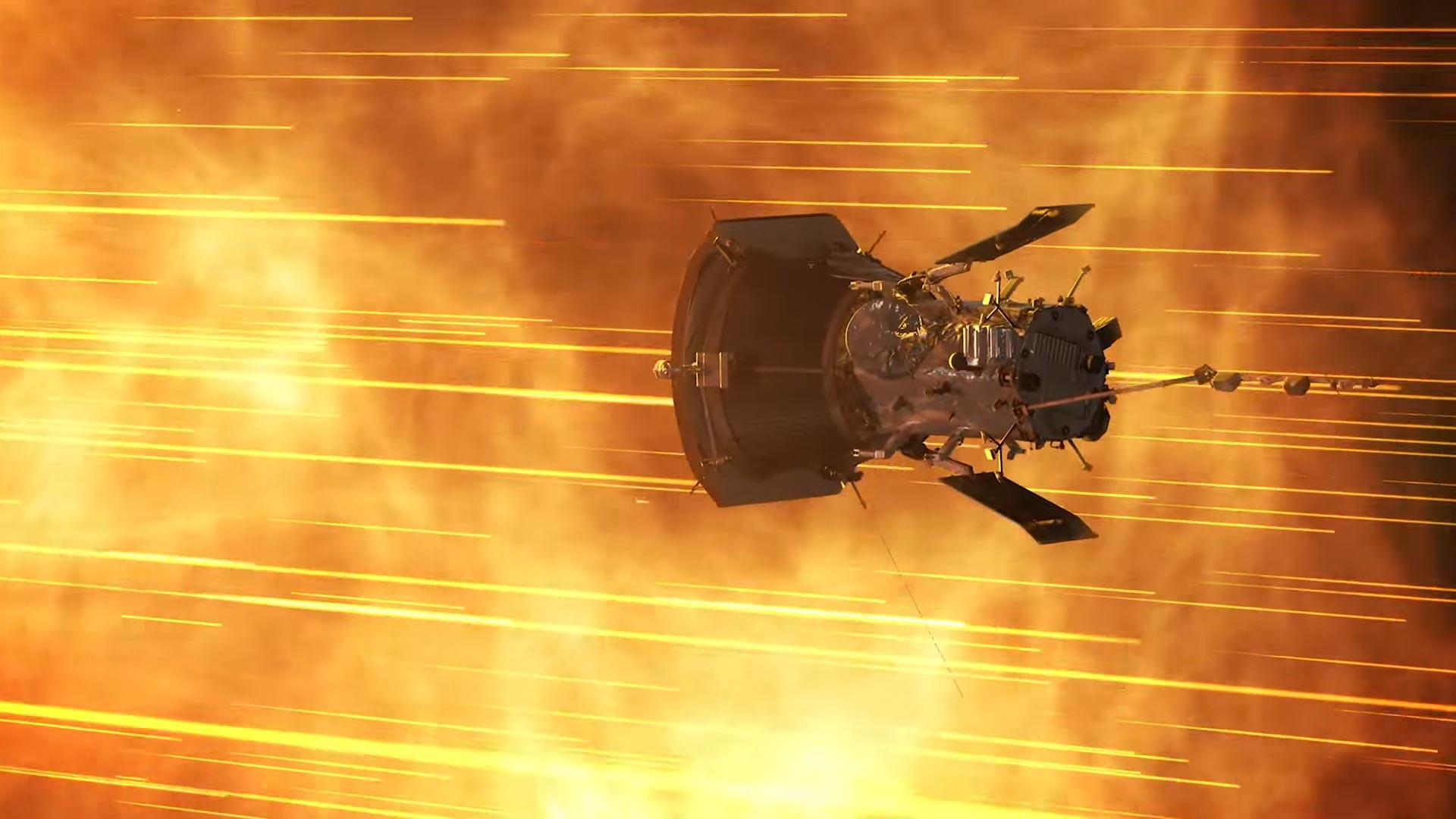
The ‘helicity barrier’ has been directly confirmed, offering new insights into the heating and formation of the solar wind.
Scientists have long been puzzled by an unusual solar mystery: the Sun’s outer atmosphere, called the corona, is vastly hotter than the surface below it. Adding to the intrigue, the solar wind, a continuous stream of charged particles and magnetic fields flowing out from the Sun, reaches extraordinary speeds as it moves into space. A process called turbulent dissipation, where mechanical energy is converted into heat, is thought to be central to both of these effects. However, near the Sun, the environment becomes nearly collisionless, making it difficult to understand exactly how this energy transfer occurs.
To investigate this mystery, researchers turned to data from NASA’s Parker Solar Probe, which now holds the record for the closest approach to the Sun by any spacecraft. By passing directly through the solar atmosphere, the probe has offered scientists an unprecedented look at the conditions surrounding our star, enabling direct examination of regions previously out of reach.
The Helicity Barrier
The findings from this study offer strong evidence for a previously proposed phenomenon known as the “helicity barrier.” This effect significantly changes how energy from turbulence is dissipated. Specifically, the helicity barrier interferes with the energy transfer at small scales, altering how fluctuations break down and how the surrounding plasma is ultimately heated.
Jack McIntyre, PhD student and the lead author of the study from Queen Mary University of London, commented: “This result is exciting because, by confirming the presence of the ‘helicity barrier,’ we can account for properties of the solar wind that were previously unexplained, including that its protons are typically hotter than its electrons. By improving our understanding of turbulent dissipation, it could also have important implications for other systems in astrophysics.”

The research team also identified the specific conditions under which this barrier occurs. They found that the helicity barrier becomes fully developed when the magnetic field strength becomes large compared to the pressure in the plasma and becomes increasingly prominent when the imbalance between the oppositely propagating plasma waves that make up the turbulence is greater. Critically, these conditions are frequently met in the solar wind close to the Sun, where Parker Solar Probe is now exploring, meaning that this effect should be widespread.
Solving Long-Standing Mysteries
Dr Christopher Chen, Reader in Space Plasma Physics at Queen Mary University of London and McIntyre’s supervisor, added: “This paper is important as it provides clear evidence for the presence of the helicity barrier, which answers some long-standing questions about coronal heating and solar wind acceleration, such as the temperature signatures seen in the solar atmosphere, and the variability of different solar wind streams. This allows us to better understand the fundamental physics of turbulent dissipation, the connection between small-scale physics and the global properties of the heliosphere, and make better predictions for space weather.”
The implications of this discovery extend beyond our own star, as many hot, diffuse astrophysical plasmas in the universe are also collisionless. Understanding how energy dissipates into heat in these environments has broad consequences for astrophysics. The direct observation of the helicity barrier in the solar wind provides a unique natural laboratory to study these complex processes.
Reference: “Evidence for the Helicity Barrier from Measurements of the Turbulence Transition Range in the Solar Wind” by J. R. McIntyre, C. H. K. Chen, J. Squire, R. Meyrand and P. A. Simon, 8 July 2025, Physical Review X.
DOI: 10.1103/PhysRevX.15.031008
Funding: Science and Technology Facilities Council, Royal Society, UK Research and Innovation
Never miss a breakthrough: Join the SciTechDaily newsletter.
Follow us on Google and Google News.
5 Comments
Fascinating photos of all this intense energy happening in our universe!!!! To me, it’s amazing that there aren’t more huge,messy blobs of energy wildly moving around!!
Helicity barrier,can be explained by two path methodology,in Quantum Compution using entropy added to Supercomputer;also,Einstein’s Special Theory of Relativity, can be formulated as a typical case.
Helicity barrier,can be explained by two path methodology,in Quantum Compution using entropy added to Supercomputer;also,Einstein’s Special Theory of Relativity, can be formulated as a typical case.So,result of the present experimentation,can,,thus applicable to stellar system in galaxy,other than milky way,accordingly.
There are more huge, messy blobs of energy wildly moving about.
Many stars are wilder and more unstable than our Sun.
Most stars come in systems with more than one stars – which should make for some intense interactions.
Supernova – the second most powerful explosions of the universe.
Big bang explosion – the biggest explosion that ever was.
Black holes are quiet themselves – but there’s chaos in the accretion disks.
Black hole mergers – no fireworks, but space itself is rocked
Black hole gobbling other stars.
Neutron stars crashing into each other.
Our Sun is a relatively well-behaved gentle-star living in a relatively staid part of the galaxy. Lucky us.
Do we know the energy levels being expended in these flux tubes?