
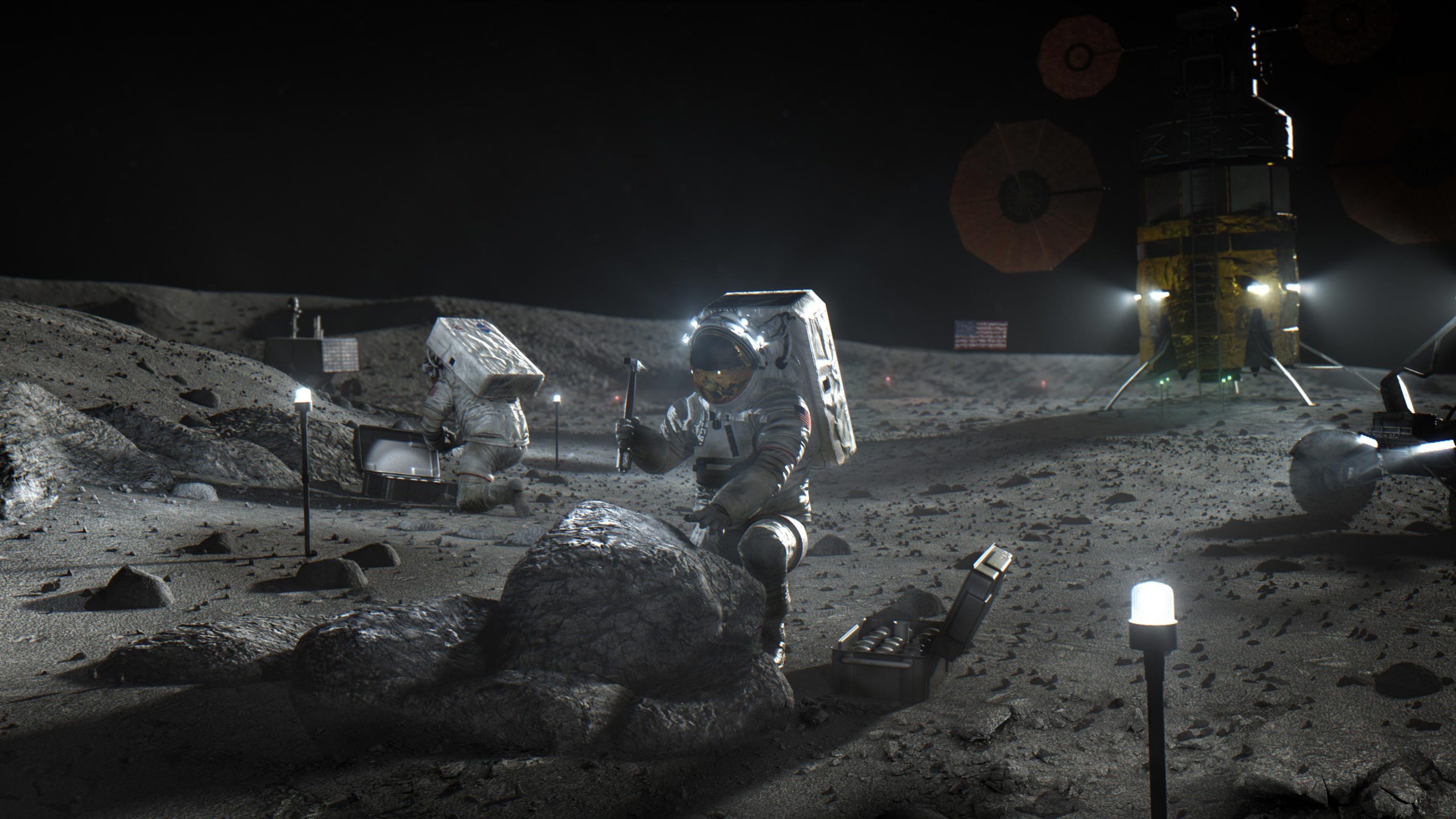
Ambitious plans for lunar bases and Martian habitats present unique challenges, especially in coordinating time across celestial bodies.
Researchers at NASA’s JPL propose a new system of lunar time to manage the complexities of interplanetary operations.
Human Ambitions in Space
NASA, other space agencies, and the commercial space sector are pursuing ambitious plans for humanity’s future beyond Earth. These initiatives aim to establish permanent infrastructure on and around the Moon, enabling a sustained human presence for research, science, and commercial activities. They also include the first crewed missions to Mars, followed by the construction of surface habitats to support future visits. However, these visionary plans come with significant challenges, from logistical and technical hurdles to ensuring health and safety.
Coordinating Time on the Moon
One critical challenge is synchronizing operations between the Moon, its orbit, and Earth, which requires a standardized time system. To address this, NASA researchers recently proposed a new lunar timekeeping system for all lunar and cis-lunar activities. This system is based on relativistic time transformations, commonly referred to as “time dilation.” By accounting for differences in gravitational forces and motion, this approach ensures accurate and reliable timekeeping, essential for coordinated operations on and around the Moon.
Relativistic Time Transformations Explained
The study was conducted by Slava G. Turyshev, James G. Williams, Dale H. Boggs, and Ryan S. Park, four research scientists from NASA’s Jet Propulsion Laboratory (JPL). The preprint of their paper, “Relativistic Time Transformations Between the Solar System Barycenter, Earth, and Moon,” recently appeared online and is currently being reviewed for publication in the journal Physical Review D.

Implications for Space Exploration
Relativistic time transformations (RTT), as predicted by Lorentz Transformations and Einstein’s Special Theory of Relativity (SR), describe how the passage of time slows for the observer as their reference frame accelerates. When Einstein extended SR to account for gravity with his theory of General Relativity (GR), he established how acceleration and gravity are essentially the same and that the flow of time changes depending on the strength of the gravitational field. This presents a challenge for space exploration, where spacecraft operating beyond Earth are subject to acceleration, microgravity, and lower gravity.
Establishing Lunar Time Scales
As Turyshev told Universe Today via email, RTT will become a major consideration as humans begin operating on the Moon for extended periods of time:
“[RTT] account for how time flows differently depending on gravitational potential and motion. For example, clocks on the Moon tick slightly faster than those on Earth due to the weaker gravitational pull experienced at the Moon’s surface. Though these differences are small—on the order of microseconds per day—they become significant when coordinating space missions, where even a tiny timing error can translate to large positional inaccuracies or communication delays. In space exploration, precise timing is critical. Various time scales serve different roles, depending on the frame of reference.”
Time Systems for Space
In their paper, the team identified three major timescales that come into play. They include:
- Terrestrial Time (TT): this timescale is used for Earth-based systems, representing time at mean sea level with corrections for Earth’s gravitational potential.
- Barycentric Coordinate Time (TCB): the time coordinate in the Barycentric Celestial Reference System (BCRS), centered at the Solar System barycenter. TCB accounts for relativistic effects due to both gravitational potentials and the motion of bodies relative to the barycenter, making it essential for high-precision modeling of celestial mechanics and dynamics.
- Barycentric Dynamical Time (TDB): derived from TCB but adjusted to run at the same average rate as Terrestrial Time (TT), this adjustment prevents a long-term secular drift relative to TT, ensuring that ephemerides remain consistent with Earth-based observations over long periods.
“Relativistic corrections link these time scales, ensuring consistent timekeeping for spacecraft navigation, planetary ephemerides, and communication,” added Turyshev. “Without such corrections, spacecraft trajectories and mission timings would quickly become unreliable, even at relatively short distances.”
Artemis Program and Global Collaboration
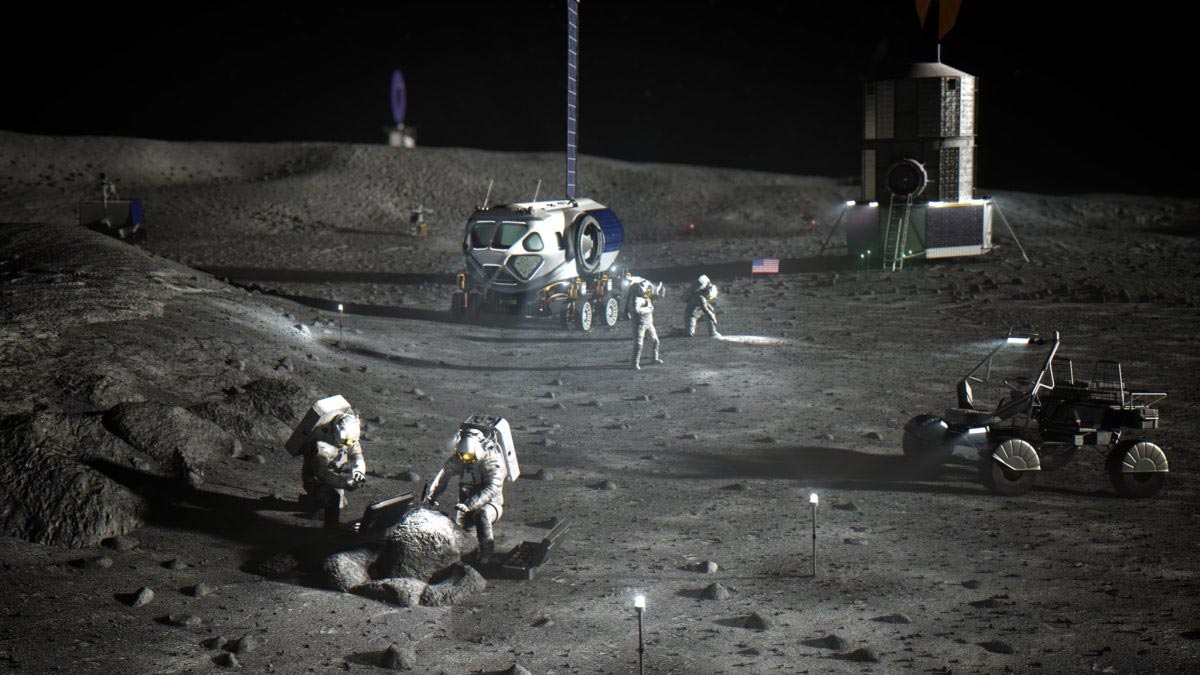
NASA’s Artemis Program includes multiple elements operating in cislunar space and on the lunar surface around the south pole region. These include the orbiting Lunar Gateway, multiple Human Landing Systems (HLSs), and the Artemis Base Camp – which will consist of the Lunar Terrain Vehicle (LTV), the Habitable Mobility Platform (HMP), and the Foundation Surface Habitat (FSH). In addition, the ESA plans to create its Moon Village, consisting of multiple transportation, power, and in-situ resource utilization (ISRU) elements.
China and Russia also have plans for a lunar habitat around the Moon’s south pole region, known as the International Lunar Research Station (ILRS). Based on multiple statements, this station could include a surface element (possibly in a lava tube), an orbital element, and other elements similar to the Artemis Base Camp and Moon Village. These will be followed and paralleled by commercial space interests, which could include harvesting, mining, and even tourism. And, of course, these operations must remain in contact with mission control as the Moon orbits the Earth.
The Importance of Accurate Lunar Timekeeping
As lunar exploration accelerates, says Turyshev, defining a dedicated Lunar Time (LT) scale and a Luni-centric Coordinate Reference System (LCRS) becomes increasingly important. Hence, he and his colleagues developed a TL scale to ensure precise timekeeping for activities on and around the Moon. Their approach involves applying relativistic principles used for Earth and adapting them to the Moon’s environment, including:
- Weaker gravity on the Moon leads to a faster tick rate for lunar clocks than Earth clocks.
- The Moon’s motion around Earth and the Sun introduces periodic time variations.
- Local gravitational anomalies, known as mascons, subtly influence the Moon’s gravitational field and, thus, the flow of time.

Precision Timekeeping for Lunar Missions
“Our results show that lunar time drifts ahead of Earth time by about 56 microseconds per day, with additional periodic variations caused by the Moon’s orbit,” said Turyshev. “These periodic oscillations have an amplitude of around 0.47 microseconds, occurring over a period of approximately 27.55 days.”
To derive these transformations, Turyshev and his team relied on high-precision data from NASA’s Gravity Recovery and Interior Laboratory (GRAIL) mission, twin satellites that studied the Moon between 2011 and 2021. In addition to mapping the lunar surface, the twin satellites also mapped the Moon’s gravitational field in fine detail. This was combined with measurements made by Lunar Laser Ranging (LLR) experiments, which measure the Earth-Moon distance with millimeter-level precision. Said Turyshev:
“Using this data, we modeled the Moon’s gravitational potential and orbital dynamics, ensuring sub-nanosecond accuracy in the resulting time transformations. Key constants were introduced to describe the transformations, analogous to those used for Earth-based time systems. The most critical of these constraints are:
- LL, which represents the average rate of time transformation between the Moon’s center and its surface, compensating for the combined gravitational and rotational potential at the selenoid level.
- LM, analogous to LB for Earth, compensates for the average rate in time transformation between Barycentric Coordinate Time (TCB) and Lunar Time (TL).
- LH, representing the long-time average of the Moon’s total orbital energy in its motion around the solar system barycenter. It defines the rate difference between TCB and the luni-centric coordinate system time (TCL) and includes contributions from gravitational interactions with the Sun and planets.
- LEM, which represents the long-time average of the Moon’s total orbital energy in its motion around Earth, as observed from the Geocentric Celestial Reference System (GCRS).
- PEM, which accounts for periodic relativistic corrections arising from the Moon’s elliptical orbit and gravitational perturbations by the Sun and planets, resulting in time-dependent oscillations.
“These transformations form the basis of our highly accurate lunar timekeeping system, which is crucial for future mission planning and operations.”

As Turyshev and his colleagues establish in their paper, there are many reasons why creating a unified lunar time system is essential for mission success. These include:
- Precision Navigation and Landing: With numerous missions targeting the lunar surface, from orbiters to landers and rovers, synchronized timekeeping will ensure precise positioning and reduce the risk of errors during critical mission phases.
- Seamless Communication: Coordinating activities between Earth, orbiters, and lunar bases requires consistent time synchronization to avoid communication delays and ensure the correct ordering of data transmission.
- Collaborative Science: A common time standard enables multiple missions—conducted by different space agencies and organizations—to share and compare data accurately, supporting large-scale studies of lunar geology, seismic activity, and gravitational anomalies.
- Autonomous Operations: As lunar missions grow in complexity and duration, a dedicated lunar time system will allow bases and spacecraft to operate independently from Earth, reducing dependence on Earth-based timekeeping during periods when Earth is not visible.
Future of Interplanetary Timekeeping
New systems of timekeeping are one of many adaptations that humanity must make to become an interplanetary species. A coordinated system of lunar time will become increasingly important as humanity’s presence on the Moon grows and becomes permanent in this century. Similar measures will need to be taken once regular crewed missions to Mars begin, and those efforts have already begun in earnest! Check out Mars Coordinated Time (MCT) and the Darian Calendar to learn more.
Adapted from an article originally published on Universe Today.
Reference: “Relativistic Time Transformations Between the Solar System Barycenter, Earth, and Moon” by Slava G. Turyshev, James G. Williams, Dale H. Boggs and Ryan S. Park, Under Review, Physical Review D.
arXiv:2406.16147
Never miss a breakthrough: Join the SciTechDaily newsletter.
Follow us on Google and Google News.
1 Comment
The assumption that “time dilation” is only possible if one uses Relativity theory is erroneous. Laplace and Newton both clearly stated force is not described by r^2 of acceleration. But rather by r. In other words they both stated that what is now called gravitational potential must be used to describe force Ie weight. Seperately then and now we know resonating systems will respond to more or less force on them by increasing or decreasing their resonant frequencies. And seeing as atoms are resonant systems it follows that an atom at ground level on the geoid of earth will resonate (tick) at a different rate than the sam atom on the moon or in orbit. So the big surprise to relativists who ignore the history of physics is…that Newton and Laplace predicted atoms Ie clocks will tick at different rates at different potentials. No relativistic time travel needed.