
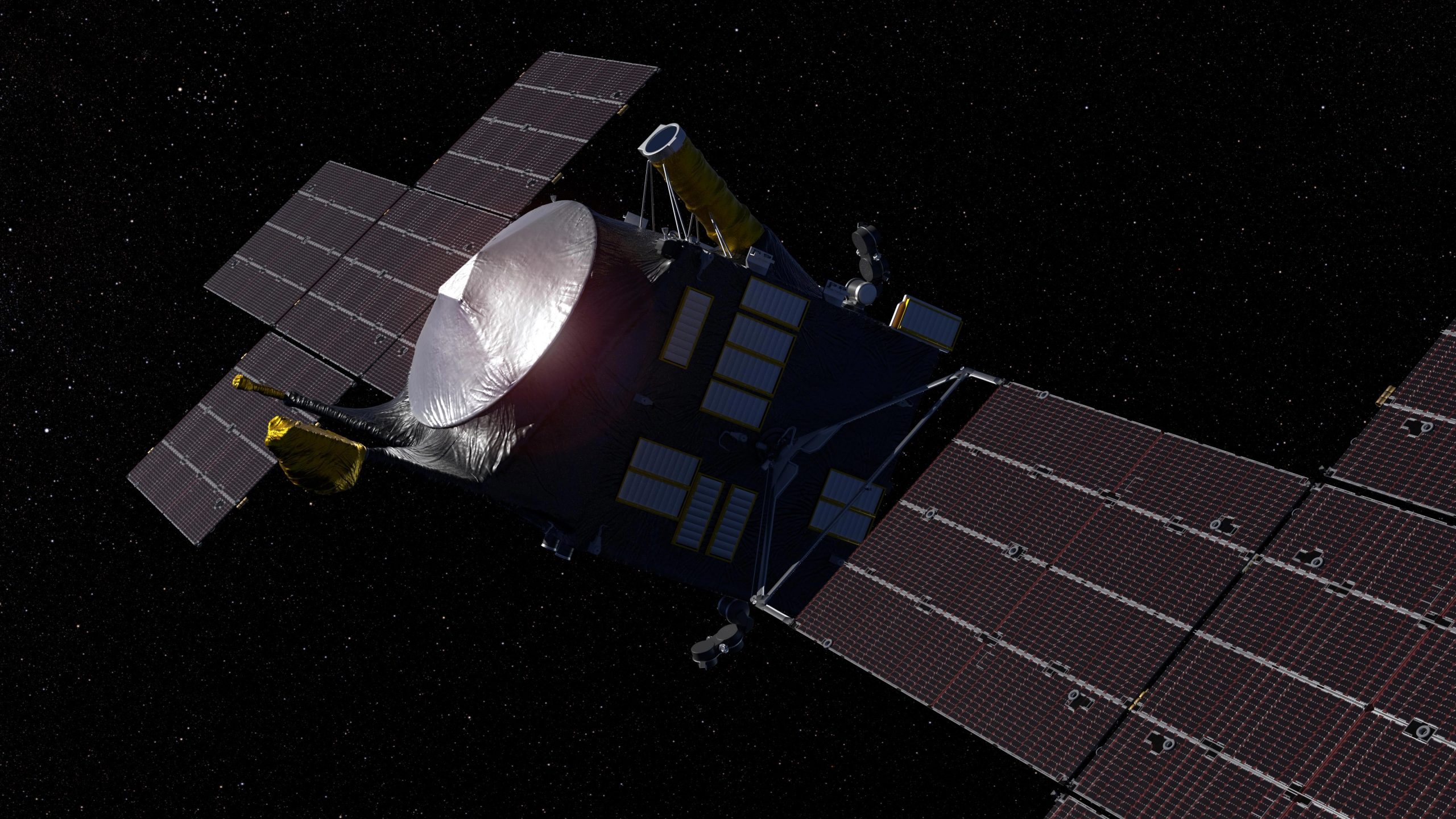
NASA’s Psyche spacecraft is on course to explore an asteroid by 2029, using innovative solar-powered electric thrusters for deep space travel. It is already beyond the distance of Mars and is using ion propulsion to accelerate toward a metal-rich asteroid, where it will orbit and collect science data.
NASA’s Psyche spacecraft passed its six-month checkup with a clean bill of health, and there’s no holding back now. Navigators are firing its futuristic-looking electric thrusters, which emit a blue glow, nearly nonstop as the orbiter zips farther into deep space.
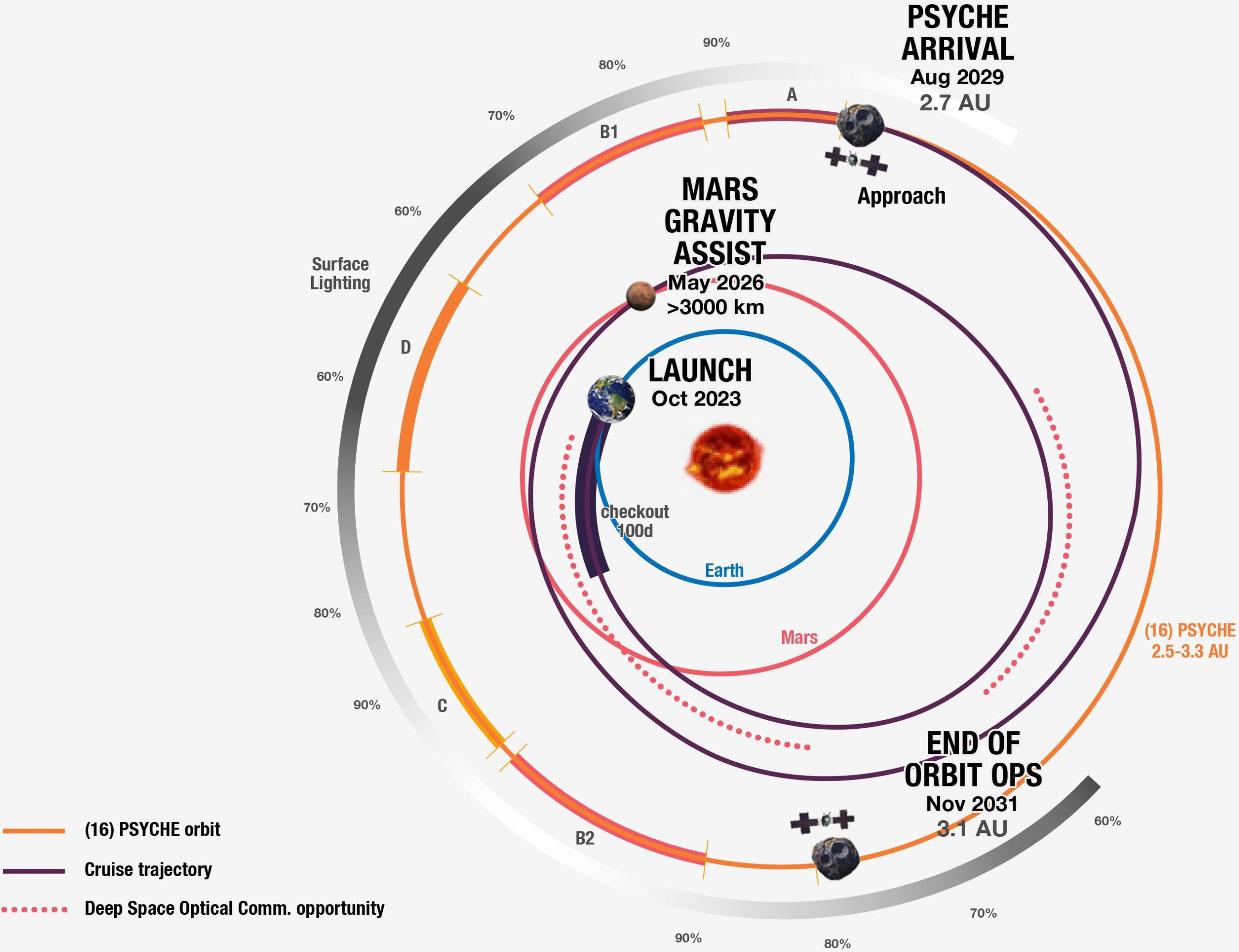
The spacecraft launched from NASA’s Kennedy Space Center in Florida atop a SpaceX Falcon Heavy on October 13, 2023. After leaving our atmosphere, Psyche made the most of its rocket boost and coasted beyond the orbit of Mars.
“Full Cruise” Mode Activated
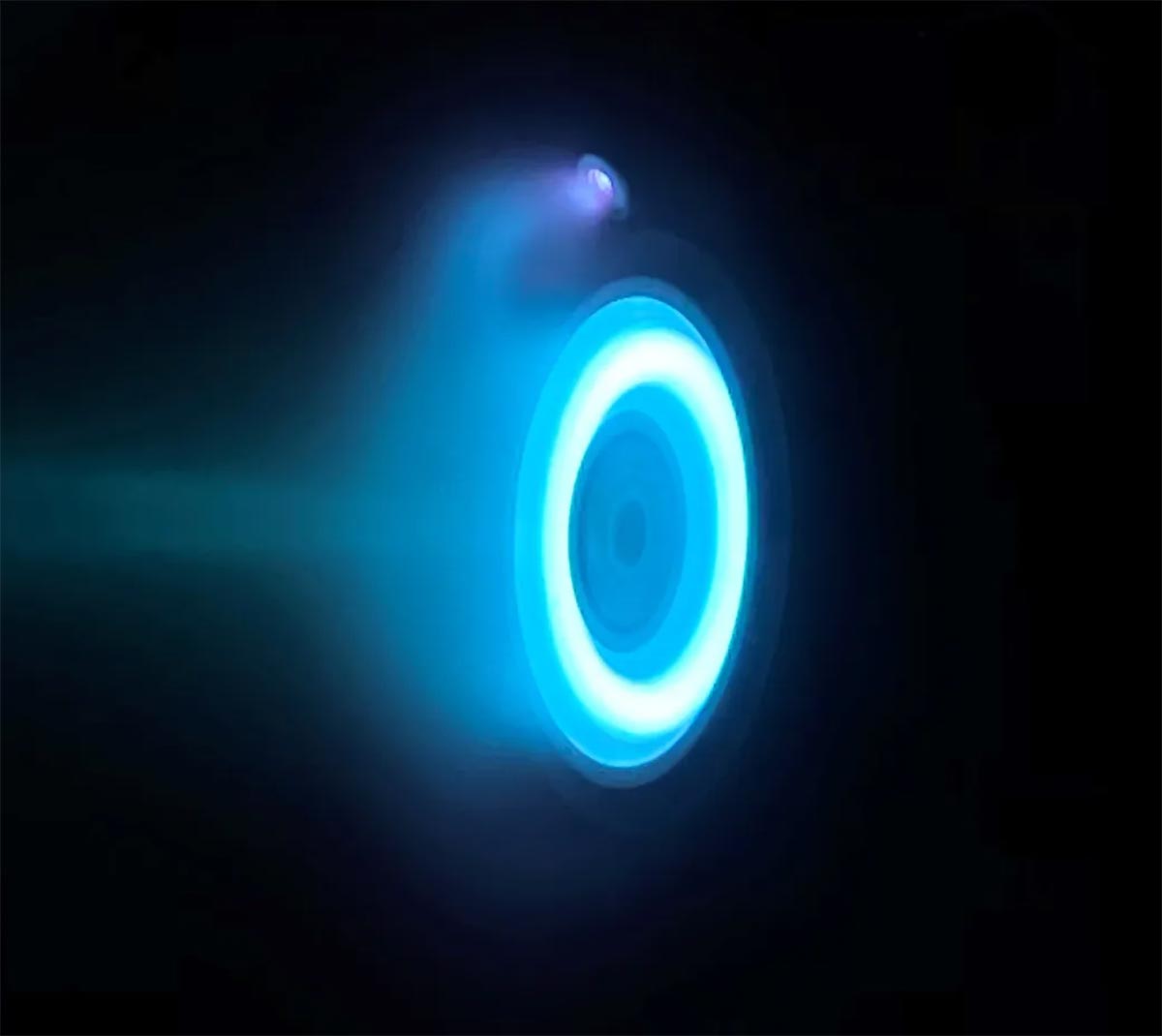
For the next year, the spacecraft will be in what mission planners call “full cruise” mode, when its electric thrusters take over and propel the orbiter toward the asteroid belt. The thrusters work by expelling charged atoms, or ions, of xenon, emitting a brilliant blue glow that trails behind the spacecraft.
They are part of Psyche’s incredibly efficient solar electric propulsion system, which is powered by sunlight. The thrust created by the ionized xenon is gentle, but it does the job. Even in full cruise mode, the pressure exerted by the thrusters is about what you’d feel holding three quarters in your hand.
Impressive Speeds and Destination
The orbiter is now more than 190 million miles (300 million kilometers) away and moving at a clip of 23 miles per second (37 kilometers per second), relative to Earth. That’s about 84,000 mph (135,000 kph). Over time, with no atmospheric drag to slow it down, Psyche will accelerate to speeds of up to 124,000 mph (200,000 kph).
The spacecraft will arrive at the metal-rich asteroid Psyche in 2029 and will make observations from orbit for about two years. The data it collects will help scientists better understand the formation of rocky planets with metallic cores, including Earth. Scientists have evidence that the asteroid, which is about 173 miles (280 kilometers) across at its widest point, may be the partial core of a planetesimal, the building block of an early planet.
Systems Check and Scientific Instruments
The flight team used Psyche’s first 100 days in space to conduct a full checkout of all spacecraft systems. All of the engineering systems are working just as expected, and the three science instruments have been operating without a hitch. The magnetometer is working so well that it was able to detect an eruption of charged particles from the Sun, as did the gamma-ray and neutron spectrometer. And this past December, the twin cameras on the imaging instrument captured their first images.
“Until this point, we have been powering on and checking out the various pieces of equipment needed to complete the mission, and we can report they are working beautifully,” said Henry Stone, Psyche project manager at NASA’s Jet Propulsion Laboratory in Southern California, which manages the mission. “Now we are on our way and looking forward to an upcoming close flyby of Mars.”
Exciting Future Encounters
That’s because the spacecraft’s trajectory will bring it back toward the Red Planet in the spring of 2026. The spacecraft will power down the thrusters as it coasts toward Mars, using the planet’s gravity to slingshot itself out. From there, the thrusters return to full cruise mode. Next stop: the asteroid Psyche.
In the meantime, the Deep Space Optical Communications technology demonstration aboard the spacecraft will keep on testing its mettle. The experiment already surpassed expectations when, in April, it transmitted test data from over 140 million miles (226 million kilometers) away at a rate of 267 megabits per second to a downlink station on Earth — a bit rate comparable to broadband internet download speeds.
Mission Management and Contributions
The Psyche mission is led by Arizona State University. JPL, a division of Caltech in Pasadena, is responsible for the mission’s overall management, system engineering, integration and test, and mission operations. Maxar Technologies in Palo Alto, California, provided the high-power solar electric propulsion spacecraft chassis.
JPL manages DSOC for the Technology Demonstration Missions program within NASA’s Space Technology Mission Directorate and the Space Communications and Navigation program within the Space Operations Mission Directorate.
Psyche is the 14th mission selected as part of NASA’s Discovery Program, which is managed by the agency’s Marshall Space Flight Center in Huntsville, Alabama. NASA’s Launch Services Program, based at Kennedy, managed the launch service.
Never miss a breakthrough: Join the SciTechDaily newsletter.
Follow us on Google and Google News.
1 Comment
Science trumps religion… again.