

NASA’s SPHEREx space telescope has officially begun its journey of cosmic exploration after successfully ejecting its dust cover in orbit.
Now cooling to ultra-cold temperatures, this washing machine-sized observatory will soon begin scanning the entire sky in infrared light, unlocking clues about distant galaxies, cosmic history, and the very structure of the universe.
SPHEREx Opens Its Eyes to the Cosmos
NASA’s SPHEREx space observatory, which launched into low Earth orbit on March 11, has now opened its view to the sky. On March 18, mission engineers instructed the spacecraft to eject its protective dust cover, the lid that shielded the telescope’s opening during launch.
This marks an important step toward SPHEREx’s main mission: to scan the entire sky in infrared light and help answer big questions about the origins and evolution of the universe. SPHEREx, short for Spectro-Photometer for the History of the Universe, Epoch of Reionization, and Ices Explorer, is expected to begin science operations in a few weeks.
A Delicate Unveiling in Space
The dust cover, measuring about 25 by 16 inches (64 by 40 centimeters), protected key components such as the telescope’s three mirrors from moisture and debris. To release it, engineers at NASA’s Jet Propulsion Laboratory (JPL) in Southern California triggered two mechanical latches. Springs then pushed the cover away from the spacecraft, allowing it to drift off into space. It will eventually reenter Earth’s atmosphere and burn up.
Confirming a Cold, Cosmic Milestone
The mission won’t power on the spacecraft’s camera until it has cooled to its operating temperature, which is colder than minus 300 degrees Fahrenheit (about minus 190 degrees Celsius). So to confirm the cover’s removal, team members observed a change in SPHEREx’s orientation — essentially, a slight jiggle of the observatory after each mechanism release. Shortly after the second jiggle, the telescope’s temperature began to drop, indicating it was exposed to the cold of space as planned.
Compact Size, Cosmic Vision
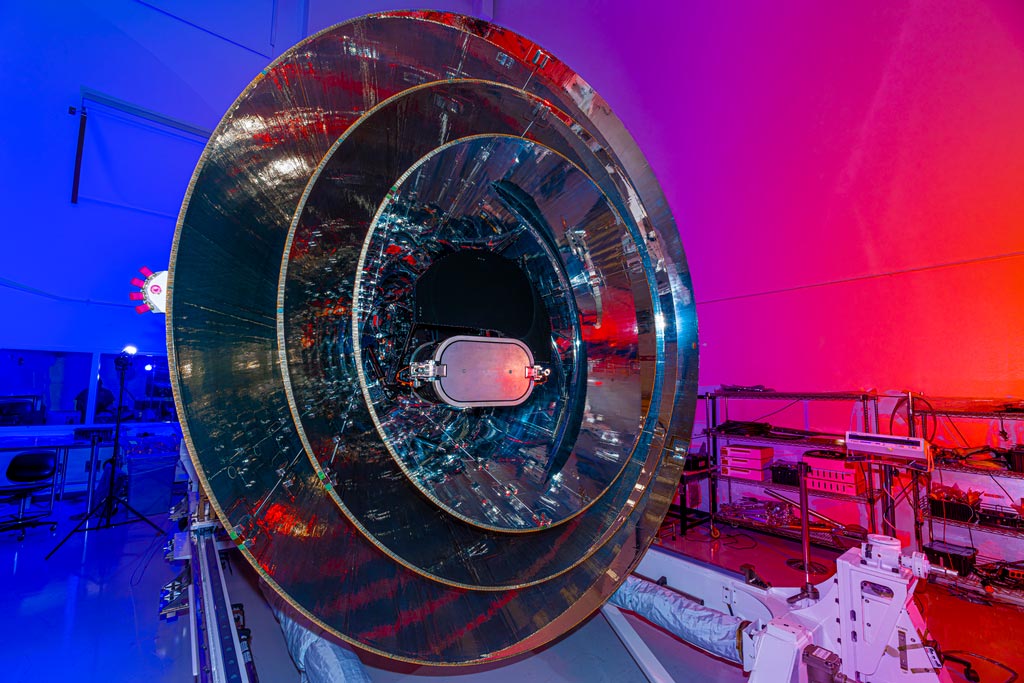
The SPHEREx spacecraft is about the size of a subcompact car. The telescope is the portion of the observatory that collects light from distant stars and galaxies. Only about the size of a washing machine, it is nestled inside three cone-shaped photon shields that protect the instrument from light and heat from the Sun and Earth.
Mapping the Universe in Infrared
During its two-year prime mission, the observatory will use a technique called spectroscopy to create four all-sky maps featuring 102 wavelengths, or colors, of infrared light. This information can help scientists measure the distance to faraway galaxies, identify chemicals and molecules in cosmic gas clouds, and more.
Never miss a breakthrough: Join the SciTechDaily newsletter.
Follow us on Google and Google News.