
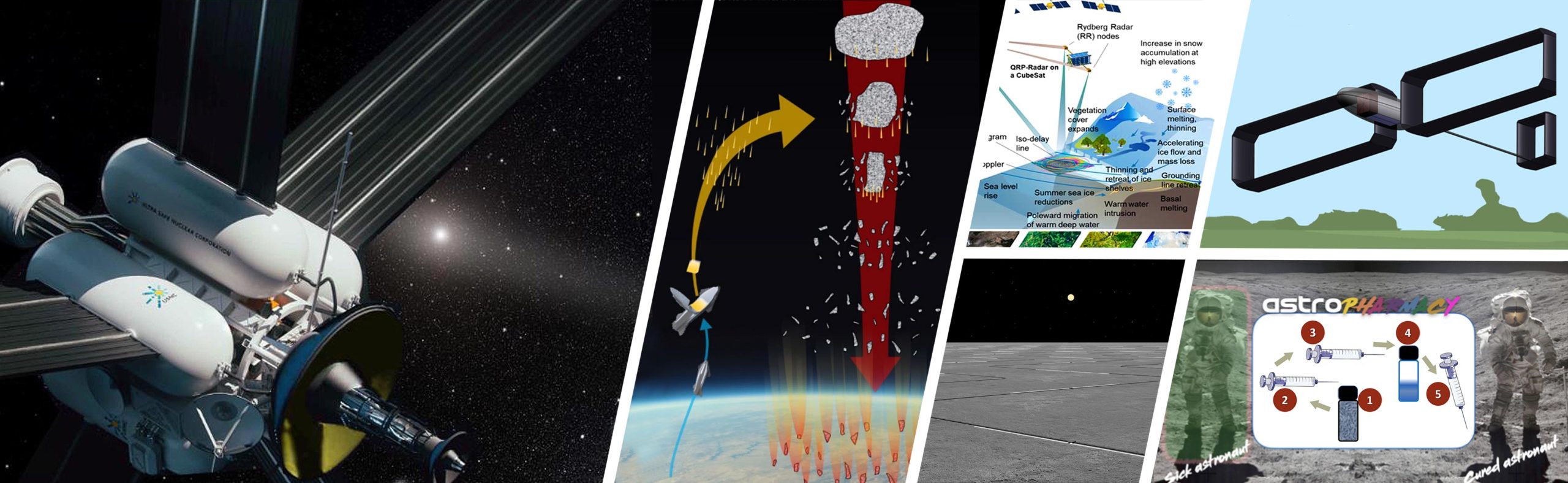
Recipients include a concept from NASA’s JPL that would use next-generation radar technology to improve how we study Earth and other worlds.
Six researchers have been awarded funding under NASA’s NIAC program to develop revolutionary concepts for air and space travel. These include next-gen radar technology, silent aircraft propulsion, asteroid impact mitigation, high-speed spacecraft propulsion, a Moon-based radio telescope, and bacteria-based drug production for space missions.
Technology in development today could radically change the future of air and space exploration. Nearly silent electric aircraft could ferry people and packages around cities, a sprawling radio telescope array on the far side of the Moon could reveal new secrets about the universe, and astronauts on long-duration missions could grow their own medicines to protect their health.
These concepts are among six selected for continued study under the NASA Innovative Advanced Concepts (NIAC) program. The new round of Phase II awards fund six researchers to continue work on futuristic concepts designed to shape air and space travel decades in the future.
“NASA’s story is one of barriers broken and technologies transformed to support our missions and benefit all of humanity,” said NASA Administrator Bill Nelson. “The concepts selected under NASA’s Innovative Advanced Concepts program will help empower researchers to usher in new technologies that could revolutionize exploration in the heavens and improve daily life here on Earth.”
NIAC nurtures visionary ideas that could transform future NASA missions by funding early-stage technology concept studies. The Phase II awards continue work on concept studies initiated under Phase I NIAC awards. During Phase II, fellows continue to develop their concepts and explore potential infusion options within and beyond NASA.
“These new awards showcase the breadth of how NIAC-supported concepts can change exploration,” said Jim Reuter, associate administrator for NASA’s Space Technology Mission Directorate (STMD). “From revolutionary propulsion systems for deep-space missions to advances in aviation to change how we travel here on Earth, these technologies would radically expand our capabilities in air and space.”
Each of the six fellows will receive up to $600,000 over two years to develop their concepts. The researchers selected to receive NIAC Phase II grants in 2023 are:
Darmindra Arumugam, NASA’s Jet Propulsion Laboratory in Southern California: Quantum Rydberg Radar for Surface, Topography, and Vegetation
This concept would use next-generation dynamically tunable quantum radar technology to improve remote sensing studies of Earth and other worlds, using reflected ground signals from other orbiting spacecraft to eliminate the need for large antenna deployments.
Steven Barrett, Massachusetts Institute of Technology in Cambridge, Massachusetts: Silent, Solid-State Propulsion for Advanced Air Mobility Vehicles
This concept aims to develop nearly silent electroaerodynamic thrusters for vertical takeoff and landing aircraft that could be used to transport cargo and eventually passengers over short distances in urban areas.
Philip Lubin, University of California, Santa Barbara, California: PI – Planetary Defense
This concept could provide Earth with a rapid response capability to mitigate a disastrous impact from an asteroid or comet by pulverizing the object into pieces small enough to burn up in Earth’s atmosphere.
Christopher Morrison, Ultra Safe Nuclear Corporation in Seattle: The Nyx Mission to Observe the Universe from Deep Space – Enabled by EmberCore, a High Specific Power Radioisotope Electric Propulsion System
This concept would use the nuclear decay of a radioactive material in a radioisotope electric propulsion system to propel a spacecraft to extremely high speeds, enabling the intercept and study of distant and fast-moving objects in the solar system on relatively short timeframes.
Ronald Polidan, Lunar Resources, Inc. in Houston: FarView Observatory – A Large, In-Situ Manufactured, Lunar Far Side Radio Array
This concept would create a massive radio telescope array on the Moon’s far side – autonomously constructed using resources extracted from the Moon’s regolith – that could make unprecedented observations of the early universe.
Lynn Rothschild, NASA’s Ames Research Center in California’s Silicon Valley: A Flexible, Personalized, On-Demand Astropharmacy
This concept would use bacteria to create medical drugs on demand during extended spaceflight missions, including a class of drugs that could be used to treat radiation exposure or help protect astronauts’ bone health in space.
The NIAC program is funded by STMD, which develops new cross-cutting technologies and capabilities for NASA’s current and future missions.
Never miss a breakthrough: Join the SciTechDaily newsletter.
Follow us on Google and Google News.