
Close Menu
    Facebook X (Twitter) Instagram
    SciTechDaily
    • Biology
    • Chemistry
    • Earth
    • Health
    • Physics
    • Science
    • Space
    • Technology
    Facebook X (Twitter) Pinterest YouTube RSS
    SciTechDaily
    Home»Technology»NASA’s Webb Telescope Edges Closer to Liftoff
    Technology

    NASA’s Webb Telescope Edges Closer to Liftoff

    By Lynn Chandler, NASA's Goddard Space Flight CenterJanuary 17, 2013No Comments3 Mins Read
    Facebook Twitter Pinterest Telegram LinkedIn WhatsApp Email Reddit
    Share
    Facebook Twitter LinkedIn Pinterest Telegram Email Reddit
    Webb-Telescope
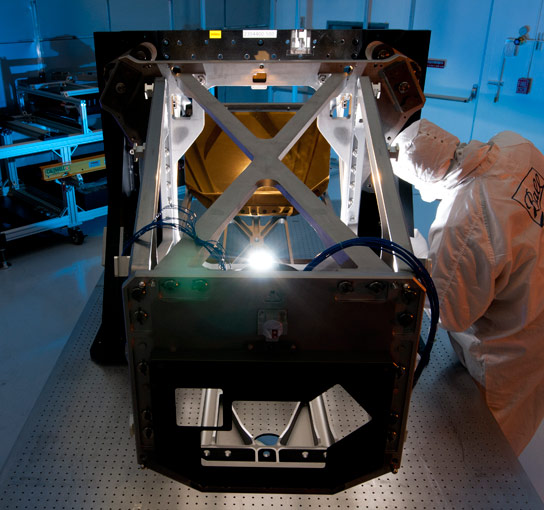
    Ball Aerospace Technician Robin Russell inspects the Webb Telescope Aft Optics Subsystem during mirror integration activities. The Aft Optics bench, made of lightweight beryllium like the mirrors, holds Webb’s tertiary and fine steering mirrors. The installed, gold-coated tertiary mirror can be seen in the background. Credit: Ball Aerospace

    The most powerful space telescope ever built, NASA’s James Webb Space Telescope is still on track for an October 2018 liftoff as it met another milestone recently. The Webb Telescope is a joint project between NASA, the European Space Agency, and the Canadian Space Agency and will be the successor to the Hubble Space Telescope.

    Engineers working on NASA’s James Webb Space Telescope met another milestone recently when they completed performance testing on the observatory’s aft-optics subsystem at Ball Aerospace & Technologies Corp’s facilities in Boulder, Colorado. Ball is the principal subcontractor to Northrop Grumman for the optical technology and lightweight mirror system.

    “Completing Aft Optics System performance testing is significant because it means all of the telescope’s mirror systems are ready for integration and testing,” said Lee Feinberg, NASA Optical Telescope Element Manager for the James Webb Space Telescope at the Goddard Space Flight Center in Greenbelt, Maryland.
    artist-conception-of-NASA's-James-Webb-Space-Telescope
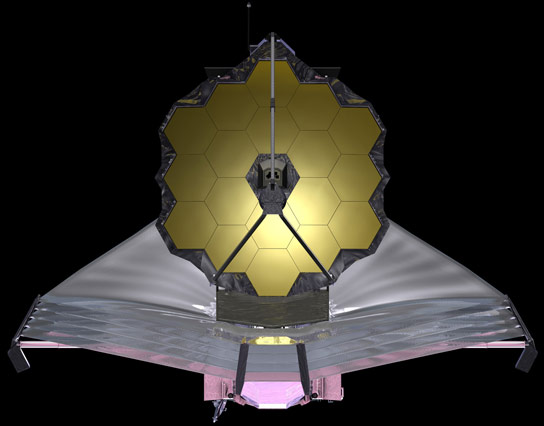
    September 2009 artist conception of NASA’s James Webb Space Telescope. Credit: NASA

    Since last May, the AOS has undergone a series of thermal, vibration, and cryogenic tests to demonstrate that it can withstand the rigorous vibration environment of the rocket launch and remain precisely aligned in order to function at the extremely cold temperatures in space. The AOS will remain at Ball Aerospace to be used in integrated testing with the flight actuator drive unit and AOS source plate assembly. The AOS is the final optical subsystem in the Webb’s Optical Telescope Element to complete integration and test activities at Ball Aerospace.

    “Each optical element that Ball Aerospace builds for the Webb is extremely sophisticated,” said David L. Taylor, Ball Aerospace’s president and chief executive officer. “The successful completion of another milestone brings us one day closer to the launch of NASA’s next major space observatory.”

    The AOS is a precision beryllium rectangular optical bench that houses the tertiary and the fine steering mirror installed at the center of Webb’s primary mirror. The AOS is surrounded by a shroud that eliminates stray light, and two large radiator panels that keep the assembly cold. This subsystem collects and focuses the light from the secondary mirror and feeds it into the science instruments.

    In September 2012, Ball began the process of shipping the finished Webb primary mirrors to NASA Goddard. The remaining mirrors will arrive at Goddard in 2013, awaiting telescope integration in 2015. The Webb is on track for an October 2018 liftoff.

    The James Webb Space Telescope is the world’s next-generation space observatory and successor to the Hubble Space Telescope. The most powerful space telescope ever built, Webb will observe the most distant objects in the universe, provide images of the very first galaxies ever formed and see unexplored planets around distant stars. The Webb Telescope is a joint project of NASA, the European Space Agency, and the Canadian Space Agency.

    Never miss a breakthrough: Join the SciTechDaily newsletter.
    Follow us on Google and Google News.

    Astronomy James Webb Space Telescope NASA Telescope
    Share. Facebook Twitter Pinterest LinkedIn Email Reddit

    Related Articles

    Comparing the Hubble and James Webb Space Telescopes: From Ultraviolet to Infrared

    Alternative Earths – Secrets of Sustaining Life

    NASA’s New Star-Watching Technology Has Thousands of Tiny Shutters

    NASA’s Webb Telescope Will Penetrate Space Dust to Reveal Milky Way’s Center

    Scientists Complete Primary Mirror for NASA’s James Webb Space Telescope

    Q & A – Why Build the James Webb Space Telescope

    Fermi Detects the Highest-Energy Light Ever Associated With an Eruption on the Sun

    New Technique Leads to the Discovery of 5 New Pulsars

    Superconducting Detectors Could Help Find Gravitational Waves and Extrasolar Planets

    Leave A Reply Cancel Reply

    • Facebook
    • Twitter
    • Pinterest
    • YouTube

    Don't Miss a Discovery

    Subscribe for the Latest in Science & Tech!

    Trending News

    Millions Take These IBS Drugs, But a New Study Finds Serious Risks

    Scientists Unlock Hidden Secrets of 2,300-Year-Old Mummies Using Cutting-Edge CT Scanner

    Bread Might Be Making You Gain Weight Even Without Eating More Calories

    Scientists Discover Massive Magma Reservoir Beneath Tuscany

    Europe’s Most Active Volcano Just Got Stranger – Here’s Why Scientists Are Rethinking It

    Alzheimer’s Symptoms May Start Outside the Brain, Study Finds

    Millions Take This Popular Supplement – Scientists Discover a Concerning Link to Heart Failure

    The Universe Is Expanding Too Fast and Scientists Can’t Explain Why

    Follow SciTechDaily
    • Facebook
    • Twitter
    • YouTube
    • Pinterest
    • Newsletter
    • RSS
    SciTech News
    • Biology News
    • Chemistry News
    • Earth News
    • Health News
    • Physics News
    • Science News
    • Space News
    • Technology News
    Recent Posts
    • Doctors Surprised by the Power of a Simple Drug Against Colon Cancer
    • Why Popular Diabetes Drugs Like Ozempic Don’t Work for Everyone: The “Genetic Glitch”
    • Scientists Create Improved Insulin Cells That Reverse Diabetes in Mice
    • Scientists Stunned After Finding Plant Thought Extinct for 60 Years
    • A Common Diabetes Drug May Hold the Key to Stopping HIV From Coming Back
    Copyright © 1998 - 2026 SciTechDaily. All Rights Reserved.
    • Science News
    • About
    • Contact
    • Editorial Board
    • Privacy Policy
    • Terms of Use

    Type above and press Enter to search. Press Esc to cancel.