
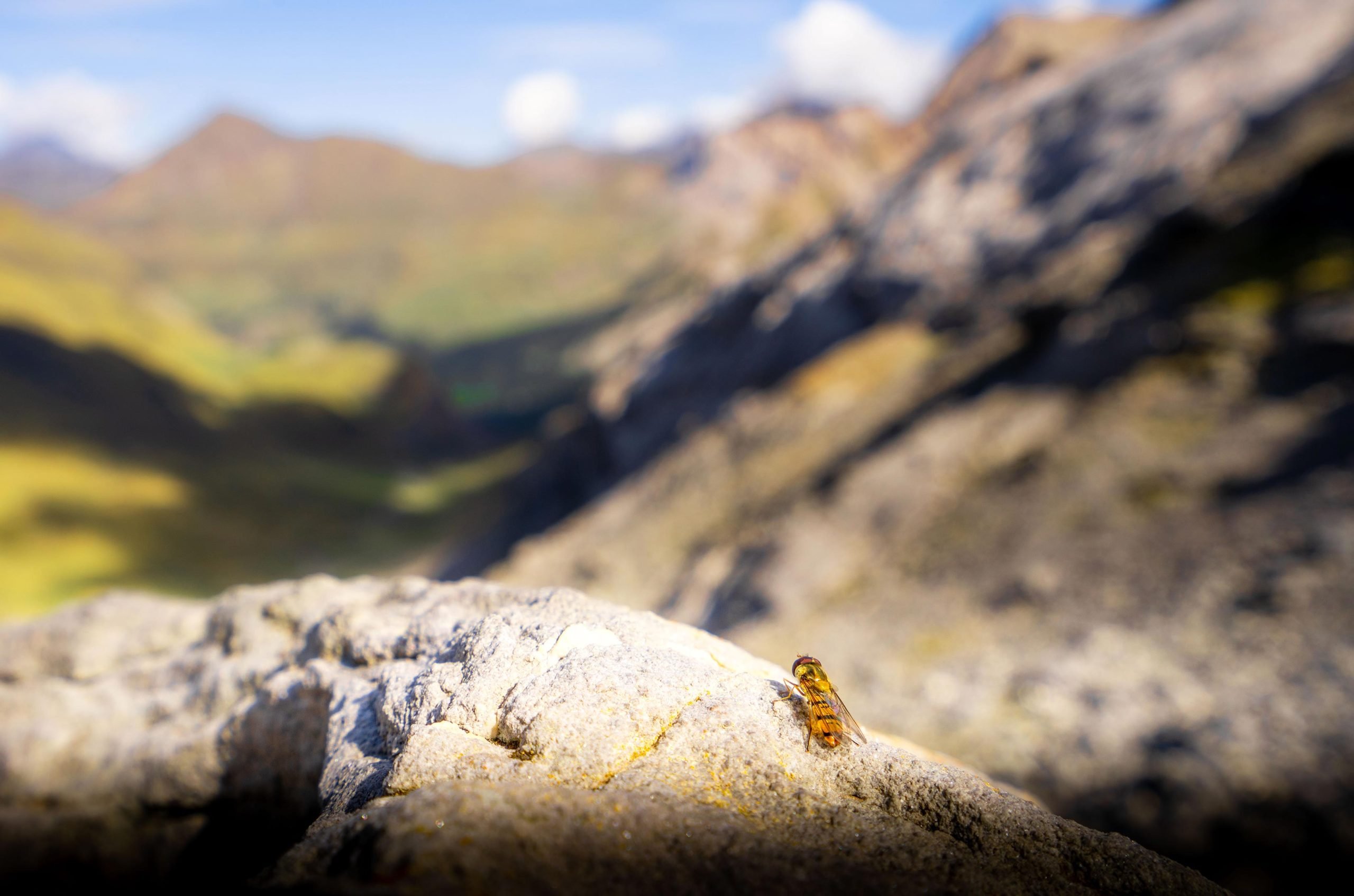
An annual migration of over 17 million insects through the Pyrenees has been documented, showcasing the vital ecological roles these insects play and the need for their conservation.
New research from the University of Exeter reveals that over 17 million insects migrate each year through a single mountain pass on the border between France and Spain. In their study, recently published in the journal Proceedings of the Royal Society B, the scientists studied migrating insects in the Pass of Bujaruelo, a 30-meter gap between two high peaks in the Pyrenees. For four years, the team visited the pass each autumn, monitoring the vast number and variety of day-flying insects heading south.
Historic Observations and Modern Discoveries
The findings for this single pass suggest that billions of insects cross the Pyrenees each year, making it a key location for many migrating species. The migrating insects begin these journeys further north in Europe, including the UK.
“More than 70 years ago, two ornithologists – Elizabeth and David Lack – chanced upon an incredible spectacle of insect migration at the Pass of Bujaruelo,” said Will Hawkes, from the Centre for Ecology and Conservation on Exeter’s Penryn Campus in Cornwall.
“They witnessed remarkable numbers of marmalade hoverflies migrating through the mountains, the first recorded instance of fly migration in Europe.
“In 2018, we went to the same pass to see if this migration still occurred, and to record the numbers, species, weather conditions, and ecological roles and impacts of the migrants.”

Methodology and Phenomenal Findings
The researchers used a video camera to count the small insects, visual counts to quantify the butterflies, and a flight intercept trap to identify the species migrating.
“What we found was truly remarkable,” Hawkes said. “Not only were vast numbers of marmalade hoverflies still migrating through the pass, but far more besides.
“These insects would have begun their journeys further north in Europe and continued south into Spain and perhaps beyond for the winter.
“There were some days when the number of flies was well over 3,000 individuals per meter, per minute.”
Team leader Dr. Karl Wotton said: “To see so many insects all moving purposefully in the same direction at the same time is truly one of the great wonders of nature.”
Insect numbers peaked when conditions were warm, sunny, and dry, with low windspeed and a headwind to keep the insects low over the pass so they could be counted.
Dr. Wotton continued: “The combination of high-altitude mountains and wind patterns render what is normally an invisible high-altitude migration into a this incredibly rare spectacle observable at ground level.”
Ecological Significance and Conservation Efforts
A range of insects were seen, but flies made up 90% of the total. Although butterflies and dragonflies are well-known migratory insects, they comprised less than 2% of the total.
Many of the migrants were well-known garden inhabitants such as the cabbage white butterfly (Pieris rapae), the house fly (Musca autumnalis), and even minuscule grass flies (Chloropidae), barely 3mm long.
Hawkes added: “It was magical. I would sweep my net through seemingly empty air and it would be full of the tiniest of flies, all journeying on this unbelievably huge migration.”
These migratory insects, especially the flies, are hugely important for our planet. Nearly 90% of the insects were pollinators and, by migrating, move genetic material great distances between plant populations, improving plant health.
Some of the insects were pest species but many were pest controllers, including the marmalade and pied hoverflies that eat aphids during their larval stage. Many play a role in decomposition, and all transport nutrients such as phosphorous and nitrogen large distances, which could be important for soil health and plant growth.
Due to the climate crisis and habitat loss, these vital insect migrants are thought to be declining.
“By spreading the knowledge of these remarkable migrants, we can spread interest and determination to protect their habitats. Insects are resilient and can bounce back quickly. Together, we can protect these most remarkable migrants of all,” Hawkes concluded.
Reference: “The most remarkable migrants—systematic analysis of the Western European insect flyway at a Pyrenean mountain pass” by Will L. Hawkes, Toby Doyle, Richard Massy, Scarlett T. Weston, Kelsey Davies, Elliott Cornelius, Connor Collier, Jason W. Chapman, Don R. Reynolds and Karl R. Wotton, 12 June 2024, Proceedings of the Royal Society B.
DOI: 10.1098/rspb.2023.2831
Never miss a breakthrough: Join the SciTechDaily newsletter.
Follow us on Google and Google News.