
Close Menu
    Facebook X (Twitter) Instagram
    SciTechDaily
    • Biology
    • Chemistry
    • Earth
    • Health
    • Physics
    • Science
    • Space
    • Technology
    Facebook X (Twitter) Pinterest YouTube RSS
    SciTechDaily
    Home»Space»Nearest Exoplanet to Our Solar System: Jupiter-Mass Planet Orbiting Epsilon Eridani
    Space

    Nearest Exoplanet to Our Solar System: Jupiter-Mass Planet Orbiting Epsilon Eridani

    By NASAApril 14, 2021No Comments2 Mins Read
    Facebook Twitter Pinterest Telegram LinkedIn WhatsApp Email Reddit
    Share
    Facebook Twitter LinkedIn Pinterest Telegram Email Reddit
    Nearest Exoplanet
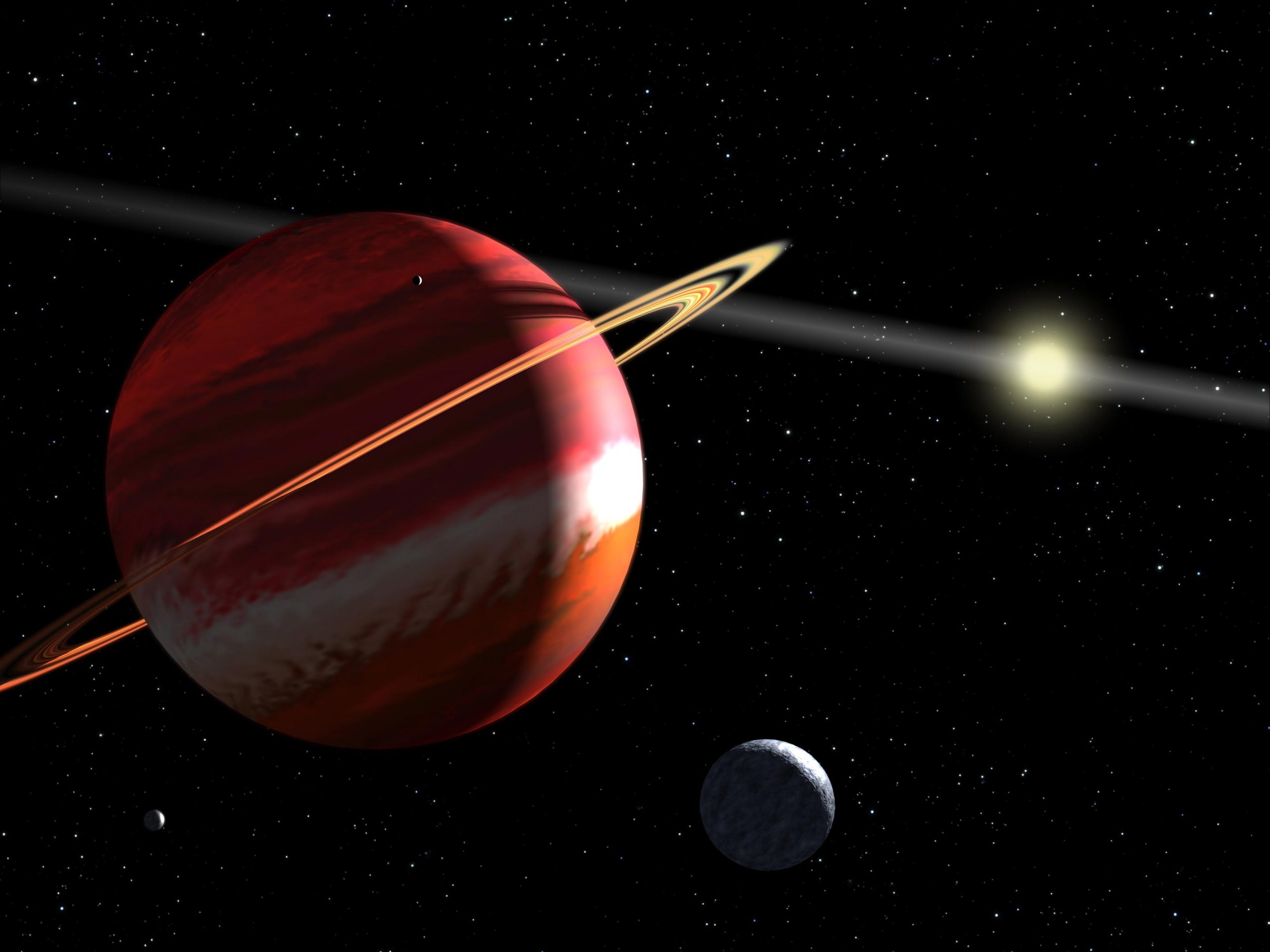
    This is an artist’s concept of a Jupiter-mass planet orbiting the nearby star Epsilon Eridani. Located 10.5 light-years away, it is the closest known exoplanet to our solar system. The planet is in an elliptical orbit that carries it as close to the star as Earth is from the Sun, and as far from the star as Jupiter is from the Sun. Credit: NASA, ESA, and G. Bacon (STScI)

    A nearby exoplanet orbiting Epsilon Eridani may be uninhabitable itself, but its moons could offer conditions for life.

    This artist’s concept is of a Jupiter-mass planet orbiting the nearby star Epsilon Eridani. Located 10.5 light-years away, it was the closest known exoplanet to our solar system when it was discovered in 2007. The planet is in an elliptical orbit that carries it as close to the star as Earth is from the Sun, and as far from the star as Jupiter is from the Sun.

    Epsilon Eridandi is a young star, only 800 million years old. It is still surrounded by a disk of dust that extends 20 billion miles from the star. The disk appears as a linear sheet of reflecting dust in this view because it is seen edge-on from the exoplanet’s orbit, which is in the same plane as the dust disk.

    The planet’s rings and satellites are purely hypothetical in this view, but plausible. As a gas giant, the planet is uninhabitable for life as we know it. However, any moons might have conditions suitable for life.

    Astronomers determined the planet’s mass and orbital tilt in 2006 by using Hubble to measure the unseen planet’s gravitational pull on the star as it slowly moved across the sky. Evidence for the planet first appeared in 2000 when astronomers measured a telltale wobble in the star.

    Never miss a breakthrough: Join the SciTechDaily newsletter.
    Follow us on Google and Google News.

    Astronomy Exoplanet NASA
    Share. Facebook Twitter Pinterest LinkedIn Email Reddit

    Related Articles

    A Century-Old Cosmic Mystery Solved – Four Hidden Planets Found Near Earth

    Red Dwarf Fury: How Wolf 359’s Radiation May Fry Alien Atmospheres

    NASA Spots a Star and Planet Racing at 1.2 Million MPH – A Record-Breaking Discovery

    X-Ray Flares Turn Alien Worlds Into Cosmic Battlefields

    NASA’s Pandora Set To Unveil the Secrets of Alien Atmospheres

    Astronomers Unveil the Mysterious 350,000-Mile Tail of Exoplanet WASP-69 b

    How a Warped Disk Exposed a Hidden Baby Planet

    In the “Hot Neptune Desert,” a Rare Planet Offers Clues to Cosmic Mysteries

    Uncovering New Worlds With Amateur Planet-Chasers – Join the Hunt for Alien Worlds From Home

    Leave A Reply Cancel Reply

    • Facebook
    • Twitter
    • Pinterest
    • YouTube

    Don't Miss a Discovery

    Subscribe for the Latest in Science & Tech!

    Trending News

    Scientists Discover Gut Signal That Turns Off Sugar Cravings

    Scientists Discover Rogue Gene That Could Unlock New Cancer Treatments

    Constantly Tired? Scientists Say These Vitamin Deficiencies May Be Why

    A Surprising Discovery Inside Fish Could Change What We Know About the Ocean

    Scientists May Have Finally Solved the Mystery of the Strange Hum Heard Around the World

    A Cannibal Star Finally Solves One of Astronomy’s Biggest Mysteries

    Scientists Finally Uncover How a “Forever Chemical” Causes Birth Defects

    Scientists Uncover the Earliest Brain Changes That May Predict Alzheimer’s Decades Before Symptoms

    Follow SciTechDaily
    • Facebook
    • Twitter
    • YouTube
    • Pinterest
    • Newsletter
    • RSS
    SciTech News
    • Biology News
    • Chemistry News
    • Earth News
    • Health News
    • Physics News
    • Science News
    • Space News
    • Technology News
    Recent Posts
    • NASA’s New Technology Lets Spacecraft Switch Between Networks
    • Magnetic Fields May Solve a Longstanding Binary Star Mystery
    • NASA’s Latest Update on International Space Station Leak
    • The Probiotic Breakthrough for Natural Anxiety Relief and Better Mental Health
    • Animal vs. Plant Protein: Scientists Found a Surprising Nutritional Difference
    Copyright © 1998 - 2026 SciTechDaily. All Rights Reserved.
    • Science News
    • About
    • Contact
    • Editorial Board
    • Privacy Policy
    • Terms of Use

    Type above and press Enter to search. Press Esc to cancel.