
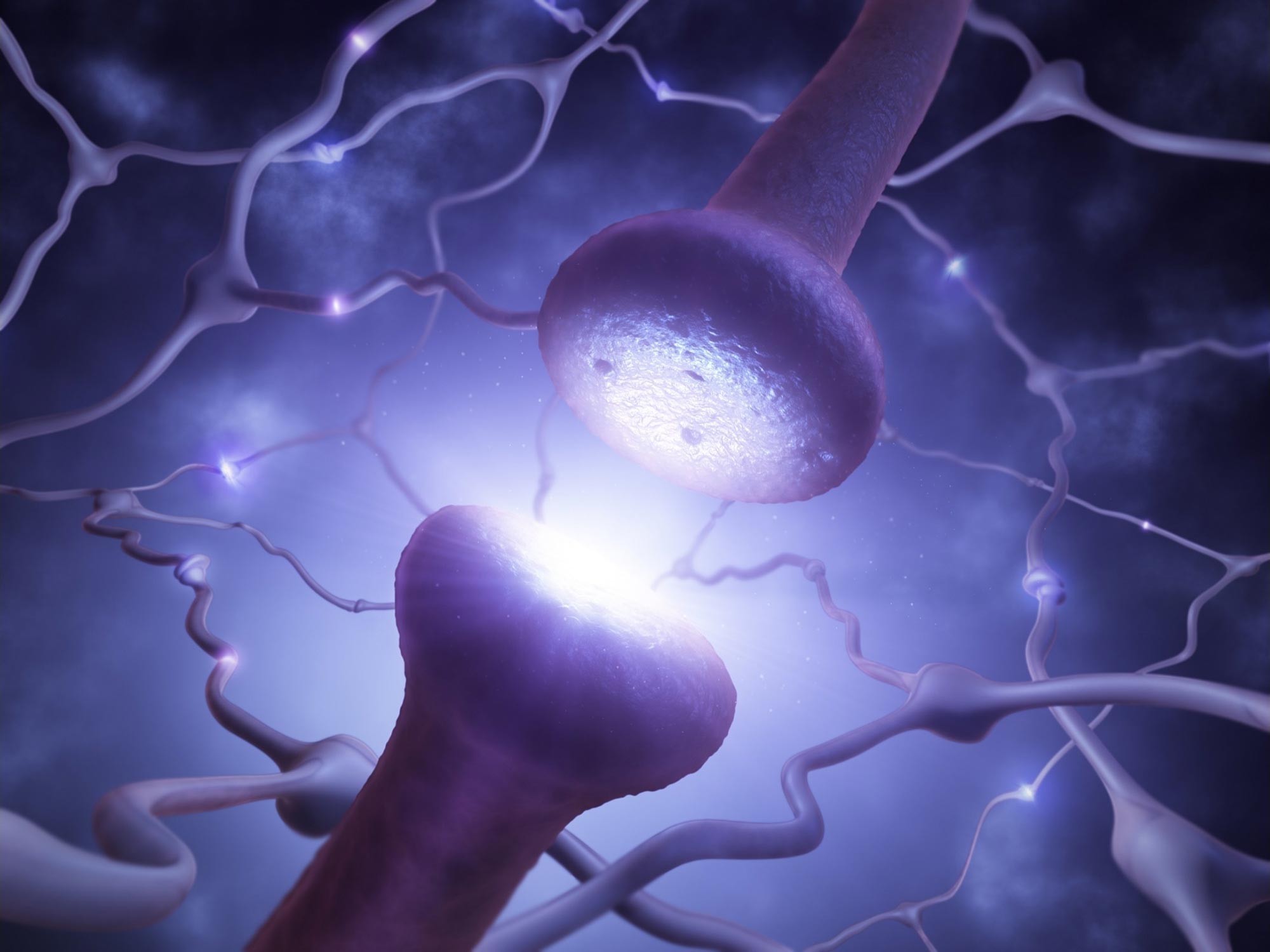
Scientists discovered that the molecule CaMKII helps neurons encode information over seconds, a key process in learning. This challenges previous beliefs about how CaMKII influences synapse-specific plasticity.
A recent study from the Max Planck Florida Institute for Neuroscience, published in Nature, has uncovered a crucial step in how neurons encode information on timescales aligned with the process of learning.
A timing mismatch
Learning takes seconds to minutes. However, the best-understood mechanisms of how the brain encodes information happen at speeds closer to neural activity—around 1000 times faster.
These mechanisms, known as Hebbian plasticity, suggest that if two connected neurons are both active within a hundredth of a second, then the connection between the two neurons is strengthened. In this way, information arriving at connected neurons within this short time window can be linked.
However, during behavior, information that needs to be encoded together is often separated by seconds to minutes. How, then, can neurons integrate information on timescales relevant to learning?
A new model of learning
Recently, a new neural model of information encoding called behavioral timescale synaptic plasticity (BTSP) addressed this discrepancy by demonstrating that neurons can integrate information over seconds, a timescale consistent with behavior. Indeed, during behaviors such as navigation, neurons encode specific locations through BTSP. However, the molecular mechanisms of how neurons implement BTSP were unknown.
This week, a research team led by Dr. Anant Jain, Dr. Yoshihisa Nakahata, and Scientific Director Dr. Ryohei Yasuda identified key aspects of how BTSP works in neurons, reporting their years-long study into this critical model of plasticity.
Dr. Yasuda describes the team’s motivation for the project, “Understanding the precise molecules and mechanisms that neurons use to encode information is critical for understanding brain function and health. Research in this area has primarily focused on traditional plasticity models, which may be less relevant to learning during experience. It is critical to explore the molecular mechanisms that underlie new plasticity models, such as BTSP.”
The team’s first hurdle was modeling BTSP in isolated brain tissue, where they could precisely measure the resulting neuronal changes. The researchers were able to trigger BTSP by inputs separated by ~1 second, confirming the extended integration time of information storage.
The team also found that BTSP occurs at single synapses, a property critical for specificity in information coding. By combining electrophysiological measurements of neuronal activity with specialized microscopy and biosensors, the team could visualize real-time molecular changes that occurred during BTSP to determine their role.
CaMKII: Same player, different role
The research team focused on a molecule called CaMKII, which is well-known for its critical role in many types of plasticity in neurons.
“We hypothesized that CaMKII would be critical for BTSP. This molecule is activated at synapses and can remain active for many seconds. It seemed the perfect candidate to be the key player in extending the time window of information integration in neurons,” described Dr. Jain. “Well, it turns out that we were right – CaMKII was critical for BTSP, but we were completely wrong about its role.”
When the research team disrupted the function of CaMKII, BTSP was disrupted. Wanting to visualize the CaMKII activity in neurons during the BTSP process, the group optimized a biosensor to report when CAMKII was active. Using this newly optimized sensor, with nearly two-fold improved sensitivity over previous tools, the scientists could measure CAMKII activity during BTSP. However, they didn’t find what they expected.
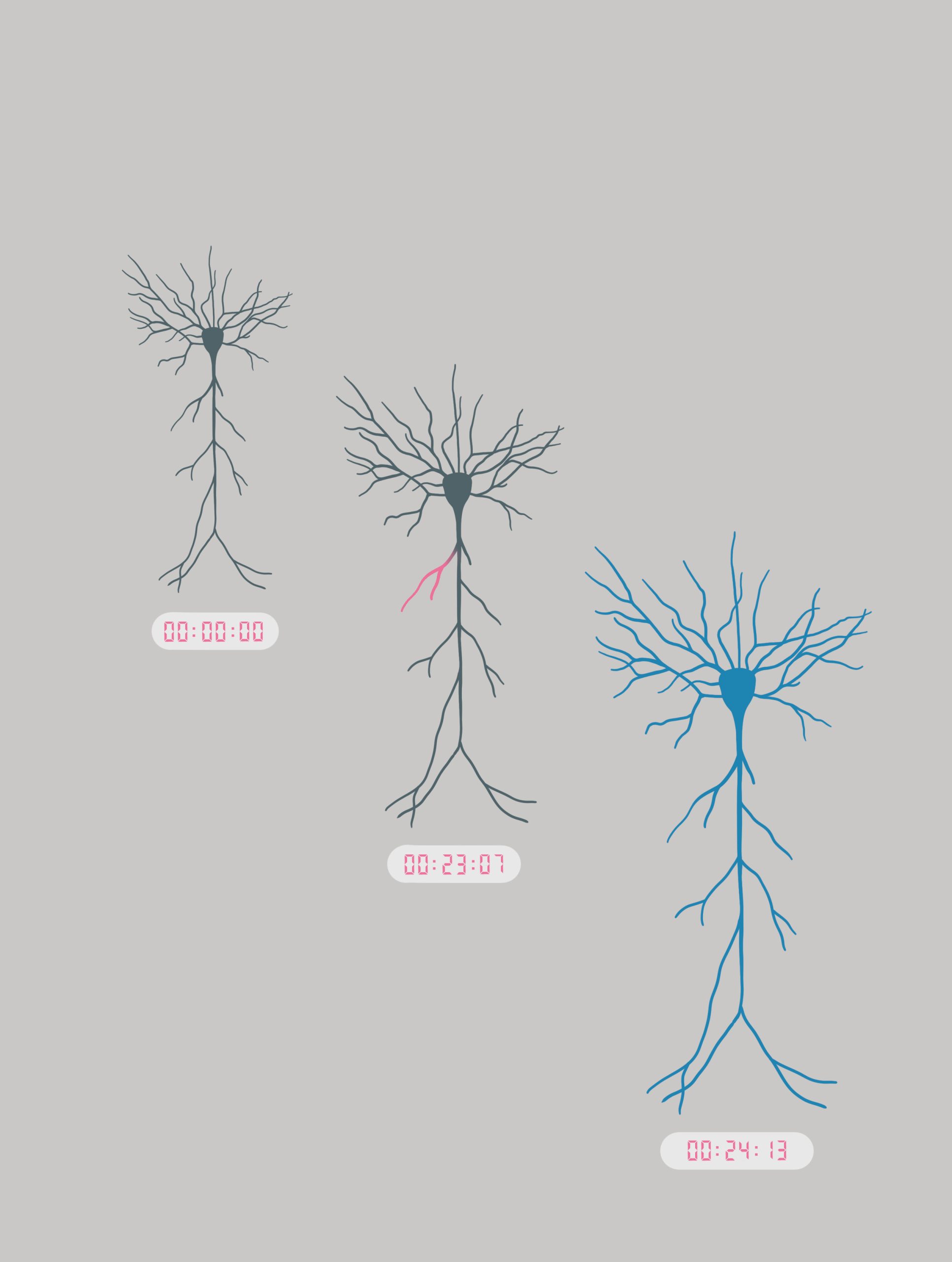
Contrary to their hypothesis, they found no detectable CaMKII activation during BTSP induction. Instead, a delayed and stochastic activation of CaMKII occurred tens of seconds after initiating BTSP. In addition, while the plasticity was happening at a specific synapse, CaMKII was active in a much larger area of the neuron. The research revealed that CaMKII is an instructive signal for BTSP but does not define the synapse specificity of plasticity. It suggests a broad time window for synaptic plasticity and a new model of how synapse-specific and instructive signals can integrate over tens of seconds.
“This is a paradigm shift in our view of CaMKII function and our understanding of plasticity mechanisms. The activity of CaMKII throughout the dendrite reveals that it does not define synapse specificity of plasticity, but rather is involved in dendritic information processing. Our results have opened many more questions for further investigation, including what defines the specificity of information coding at single synapses or the time-delay in CAMKII activation,” describes Dr. Jain. “The surprising findings underscore the importance of behaviorally relevant models of information encoding in the brain to reach our ultimate goal of linking molecular activity to memory formation and preventing neurological disorders involving learning and memory dysfunction.”
Reference: “Dendritic, delayed, stochastic CaMKII activation in behavioural time scale plasticity” by Anant Jain, Yoshihisa Nakahata, Tristano Pancani, Tetsuya Watabe, Polina Rusina, Kelly South, Kengo Adachi, Long Yan, Noriko Simorowski, Hiro Furukawa and Ryohei Yasuda, 9 October 2024, Nature.
DOI: 10.1038/s41586-024-08021-8
The study was funded by the National Institutes of Health.
Never miss a breakthrough: Join the SciTechDaily newsletter.
Follow us on Google and Google News.