
Close Menu
    Facebook X (Twitter) Instagram
    SciTechDaily
    • Biology
    • Chemistry
    • Earth
    • Health
    • Physics
    • Science
    • Space
    • Technology
    Facebook X (Twitter) Pinterest YouTube RSS
    SciTechDaily
    Home»Technology»New Blended Solar Cells With Increased Power Efficiencies and Electricity Generation
    Technology

    New Blended Solar Cells With Increased Power Efficiencies and Electricity Generation

    By Hiroshima UniversityDecember 19, 20201 Comment3 Mins Read
    Facebook Twitter Pinterest Telegram LinkedIn WhatsApp Email Reddit
    Share
    Facebook Twitter LinkedIn Pinterest Telegram Email Reddit
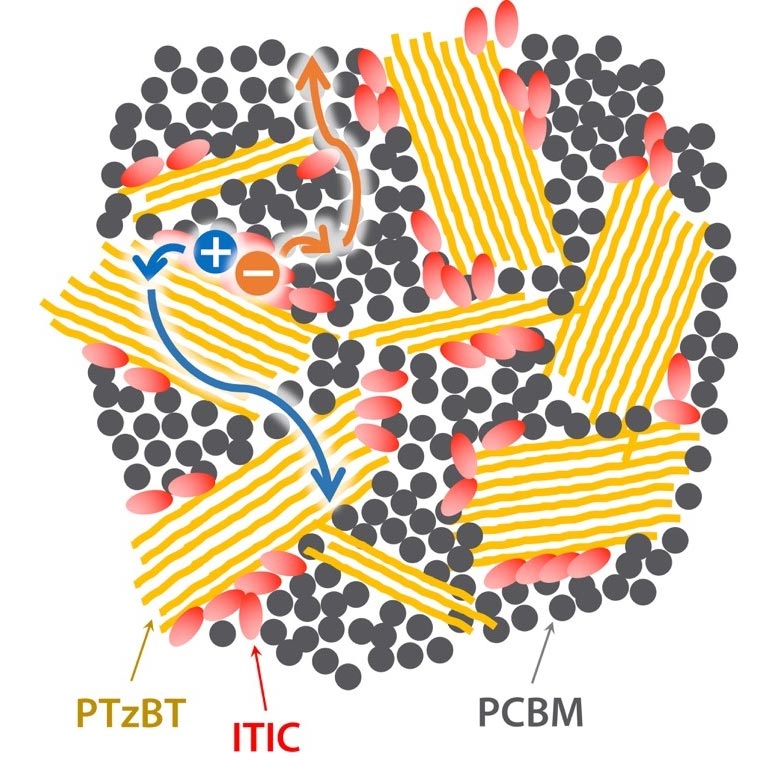
    OPV Cell Schematic Illustration
    ITIC is selectively located at the interface of PTzBT and PCBM domains, which leads to an efficient charge carrier (photocurrent) generation. Credit: Itaru Osaka, Hiroshima University

    Researchers at Hiroshima University in Japan have blended together various polymer and molecular semiconductors as photo-absorbers to create a solar cell with increased power efficiencies and electricity generation. These types of solar cells, known as organic photovoltaics (OPV), are devices that generate electricity when light is incident upon their photo-absorbers. The efficiency of a solar cell is determined by comparing how much electricity is generated to how much light is incident upon the cell. This is referred to as “photon harvest,” or how many particles of light are converted into electrical current. The more efficient the solar cell, the more cost-effective and pragmatic the cell is for commercial use.

    The team at the Graduate School of Advanced Science and Engineering added only a small amount of a compound that absorbs long wavelengths of light resulting in an OPV that was 1.5 times more efficient than the version without the compound. The compound was able to enhance the absorption intensity due to the optical interference effect within the device. The group went on to show that how they are distributed is key to further improved power generation efficiency.
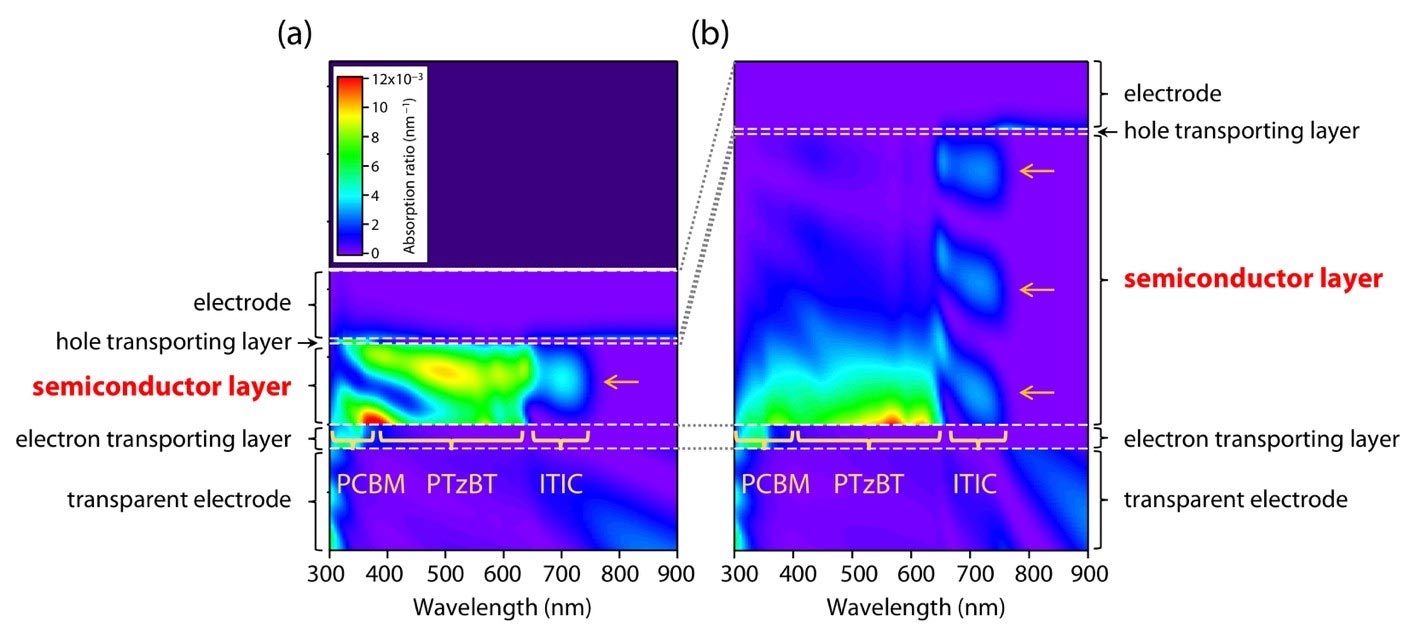
    Simulated Absorption Distribution OPV Cells
    (a) ~100 nm thickness, (b) ~400 nm thickness. ITIC has three “absorption spots” when the semiconductor layer (PTzBT/PCBM/ITIC) is thick while it has only one when the layer is thin. This originates in the enhanced optical interference. Credit: Itaru Osaka, Hiroshima University

    “The addition of a very small amount of a sensitizer material to an OPV cell, which consists of a semiconducting polymer that we developed previously and along with other materials,” said Itaru Osaka, corresponding author of the paper, published November 2020 in Macromolecules.

    “This leads to a significant increase in the photocurrent and thereby the power conversion efficiency due to the amplified photon absorption that originates in the optical interference effect. A key is to use a very specific polymer, one that allows us to have a very thick semiconductor layer for OPV cells, which significantly enhances optical interference effect compared to a thin layer.”
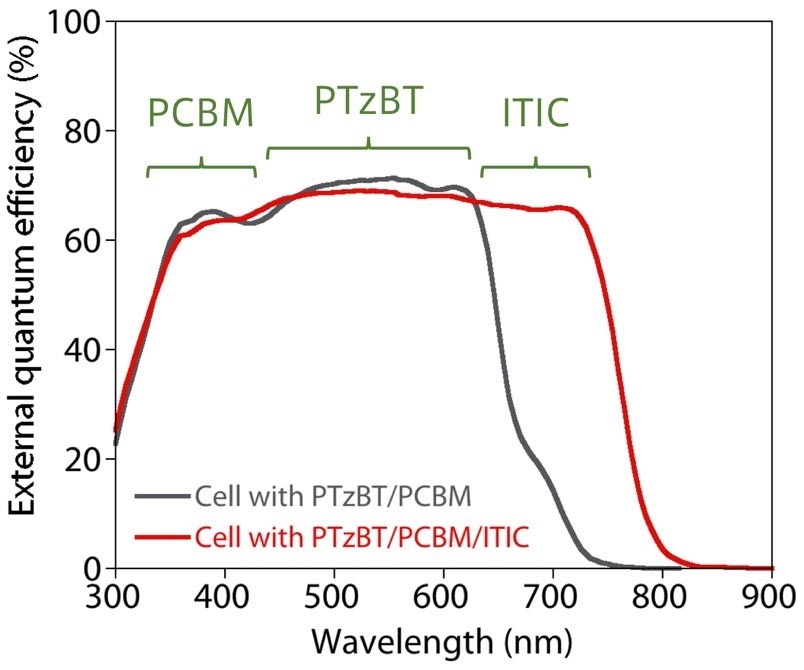
    Photoresponse Spectra OPV Cells
    ITIC as a sensitizer showed the external quantum efficiency that is similar to the host polymer PTzBT despite the fact that only 6wt% of ITIC was added to the PTzBT/PCBM host materials. Credit: Itaru Osaka, Hiroshima University

    As for future work, Osaka has his eyes set on pushing the boundaries of state-of-the-art solar cells.

    “Our next step is to develop better semiconducting polymers as the host material for this type of OPV and better sensitizer materials that can absorb more photons in the longer wavelength regions. This would lead to the realization of the world’s highest efficiency in OPV cells.”

    Reference: “Significantly Sensitized Ternary Blend Polymer Solar Cells with a Very Small Content of the Narrow-Band Gap Third Component That Utilizes Optical Interference” by Masahiko Saito, Yasunari Tamai, Hiroyuki Ichikawa, Hiroyuki Yoshida, Daisuke Yokoyama, Hideo Ohkita and Itaru Osaka, 25 November 2020, Macromolecules.
    DOI: 10.1021/acs.macromol.0c01787

    Funding: Japan Science and Technology Agency, Japan Society for the Promotion of Science

    Never miss a breakthrough: Join the SciTechDaily newsletter.
    Follow us on Google and Google News.

    Energy Green Energy Hiroshima University Polymers Solar Cells
    Share. Facebook Twitter Pinterest LinkedIn Email Reddit

    Related Articles

    Discovery Unlocks ‘Hot’ Electrons for More Efficient Solar Panels

    Most Cost Effective Solar Power Systems: Double-Sided Panels That Follow the Sun

    Cheap Renewable Energy a Step Closer As Next-Generation Solar Cells Pass Strict International Tests

    Breakthrough Self-Assembly Innovation Enables Cheaper Solar Energy Production

    New Efficiency Record Set by Novel Multi-Material Solar Cells

    Solar Technology Breakthrough: World Record Quantum Dot Solar Cell Efficiency

    New Technology Reduces the Cost of High-Efficiency Solar Cells

    New Organic Solar Cells Set Efficiency World Record

    New High-Performance Photovoltaic Solar Cells That Work Indoors

    1 Comment

    1. Jimmy dean on December 20, 2020 11:02 pm

      Sure it will be more efficient but it will cost 3 times as much, but the stupid environmentalists will claim its a break through and we can get rid of oil. They will be wrong again due to cost.

      Reply
    Leave A Reply Cancel Reply

    • Facebook
    • Twitter
    • Pinterest
    • YouTube

    Don't Miss a Discovery

    Subscribe for the Latest in Science & Tech!

    Trending News

    Millions Take These IBS Drugs, But a New Study Finds Serious Risks

    Scientists Unlock Hidden Secrets of 2,300-Year-Old Mummies Using Cutting-Edge CT Scanner

    Bread Might Be Making You Gain Weight Even Without Eating More Calories

    Scientists Discover Massive Magma Reservoir Beneath Tuscany

    Europe’s Most Active Volcano Just Got Stranger – Here’s Why Scientists Are Rethinking It

    Alzheimer’s Symptoms May Start Outside the Brain, Study Finds

    Millions Take This Popular Supplement – Scientists Discover a Concerning Link to Heart Failure

    The Universe Is Expanding Too Fast and Scientists Can’t Explain Why

    Follow SciTechDaily
    • Facebook
    • Twitter
    • YouTube
    • Pinterest
    • Newsletter
    • RSS
    SciTech News
    • Biology News
    • Chemistry News
    • Earth News
    • Health News
    • Physics News
    • Science News
    • Space News
    • Technology News
    Recent Posts
    • Simple Blood Test May Predict Alzheimer’s Years Before Brain Scans Show Signs
    • Scientists Say Adding This Unusual Seafood to Your Diet Could Reverse Signs of Aging
    • U.S. Waste Holds $5.7 Billion Worth of Crop Nutrients
    • Scientists Say a Hidden Structure May Exist Inside Earth’s Core
    • Doctors Surprised by the Power of a Simple Drug Against Colon Cancer
    Copyright © 1998 - 2026 SciTechDaily. All Rights Reserved.
    • Science News
    • About
    • Contact
    • Editorial Board
    • Privacy Policy
    • Terms of Use

    Type above and press Enter to search. Press Esc to cancel.