

Quantum science, cellular biology, and high-definition television technology converge in the development of new biosensors.
Using hypersensitive quantum sensors inside living cells offers a promising way to track cell growth and diagnose diseases, including cancers, at very early stages.
Some of the most advanced and powerful quantum sensors can be made from tiny pieces of diamond. However, this presents a major challenge: inserting a diamond into a cell and getting it to function properly is extremely difficult.
“All kinds of those processes that you really need to probe on a molecular level, you cannot use something very big. You have to go inside the cell. For that, we need nanoparticles,” said University of Chicago Pritzker School of Molecular Engineering PhD candidate Uri Zvi. “People have used diamond nanocrystals as biosensors before, but they discovered that they perform worse than what we would expect. Significantly worse.”
Zvi is the lead author of a paper published in Proceedings of the National Academy of Sciences that addresses this challenge. Working with researchers from UChicago PME and the University of Iowa, Zvi combined knowledge from cellular biology, quantum computing, traditional semiconductors, and high-definition television technology to develop a groundbreaking quantum biosensor. In the process, the team also helped resolve a long-standing question in the study of quantum materials.
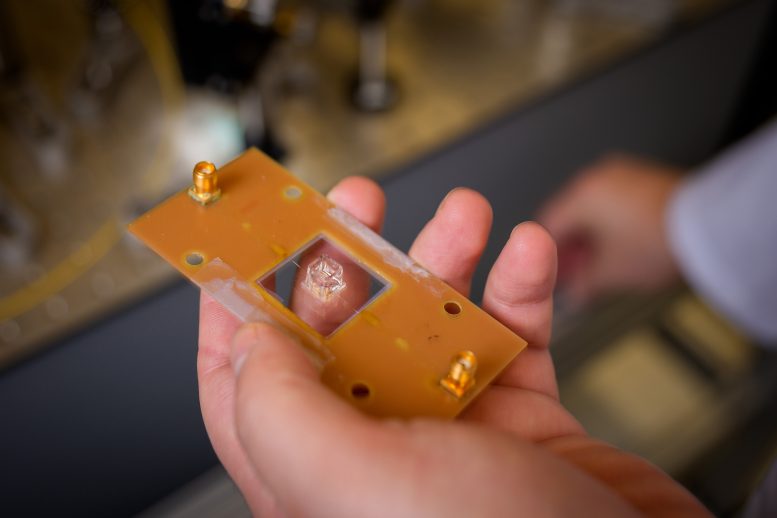
By coating a diamond nanoparticle with a specially engineered shell—a method inspired by QLED television displays—the researchers created a quantum biosensor well-suited for use inside living cells. This approach also revealed a new understanding of how modifying a material’s surface can improve its quantum behavior.
“It’s already one of the most sensitive things on earth, and now they’ve figured out a way to enhance that further in a number of different environments,” said Zvi’s principal investigator, UChicago PME Prof. Aaron Esser-Kahn, a co-author of the paper.
A cell full of diamonds
Qubits embedded in diamond nanocrystals can maintain quantum coherence even when the particles are small enough to be absorbed by a living cell—a helpful comparison is a cell swallowing and processing them without rejecting them. However, as the diamond particles get smaller, the strength of the quantum signal decreases.
“It excited people for a while that these quantum sensors can be brought into living cells and, in principle, be useful as a sensor,” said UChicago PME Asst. Prof. Peter Maurer, a co-author of the paper. “However, while these kind of quantum sensors inside of a big piece of bulk diamond have really good quantum properties, when they are in nano diamonds, the coherent properties, the quantum properties, are actually significantly reduced.”
Here, Zvi turned to an unlikely source for inspiration—quantum dot LED televisions. QLED TVs use vibrant fluorescent quantum dots to broadcast in rich, full colors. In the early days, the colors were bright but unstable, prone to suddenly blinking off.
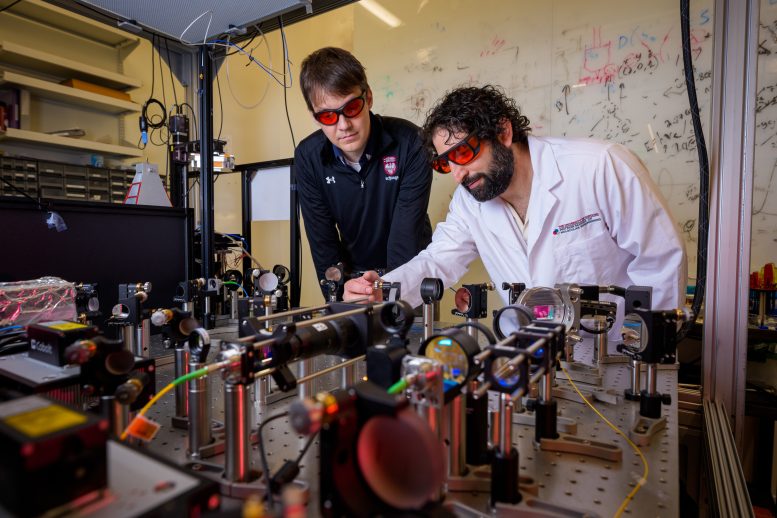
“Researchers found that surrounding the quantum dots with carefully designed shells suppresses detrimental surface effects and increase their emission,” Zvi said. “And today you can use a previously unstable quantum dot as part of your TV.”
Working with UChicago PME and Chemistry Department quantum dot expert Prof. Dmitri Talapin, a co-author of the paper, Zvi reasoned that since both sets of issues—the quantum dots’ fluorescence and the nanodiamond weakened signal—originated with the surface state, a similar approach might work.
But since the sensor is meant to go within a living body, not every shell would work. An immunoengineering expert, Esser-Kahn helped develop a silicon-oxygen (siloxane) shell that would both enhance the quantum properties and not tip off the immune system that something is awry.
“The surface properties of most of these materials are sticky and disordered in a way that the immune cells can tell it’s not supposed to be there. They look like a foreign object to an immune cell,” Esser-Kahn said. “Siloxane-coated things look like a big, smooth blob of water. And so the body is much more happy to engulf and then chew on a particle like that.”

Previous efforts to improve the quantum properties of diamond nanocrystals through surface engineering had shown limited success. As a result, the team expected only modest gains. Instead, they saw up to fourfold improvements in spin coherence.
That increase—as well as a 1.8-fold increase in fluorescence and separate significant increases to charge stability—was a riddle both baffling and enthralling.
Better and better
“I would try to go to bed at night but stay up thinking ‘What’s happening there? The spin coherence is getting better—but why?” said University of Iowa Asst. Prof. Denis Candido, second author of the new paper. “I’d think ‘What if we do this experiment? What if we do this calculation?’ It was very, very exciting, and in the end, we found the underlying reason for the improvement of the coherence.”
The interdisciplinary team—bioengineer-turned-quantum-scientist Zvi, immunoengineer Esser-Kahn and quantum engineers Maurer and Talapin—brought Candido and University of Iowa Physics and Astronomy Prof. Michael Flatté in to provide some of the theoretical framework for the research.
“What I found really exciting about this is that some old ideas that were critical for semiconductor electronic technology turned out to be really important for these new quantum systems,” Flatté said.
They found that adding the silica shell didn’t just protect the diamond surface. It fundamentally altered the quantum behavior inside. The material interface was driving electron transfer from the diamond into the shell. Depleting electrons from the atoms and molecules that normally reduce the quantum coherence made a more sensitive and stable way to read signals from living cells.
This enabled the team to identify the specific surface sites that degrade coherence and make quantum devices less effective—solving a long-standing mystery in the quantum sensing field and opening new doors for both engineering innovation and fundamental research.
“The end impact is not just a better sensor, but a new, quantitative framework for engineering coherence and charge stability in quantum nanomaterials,” Zvi said.
Reference: “Engineering spin coherence in core-shell diamond nanocrystals” by Uri Zvi, Denis R. Candido, Adam M. Weiss, Aidan R. Jones, Lingjie Chen, Iryna Golovina, Xiaofei Yu, Stella Wang, Dmitri V. Talapin, Michael E. Flatté, Aaron P. Esser-Kahn and Peter C. Maurer, 21 May 2025, Proceedings of the National Academy of Sciences.
DOI: 10.1073/pnas.2422542122
Never miss a breakthrough: Join the SciTechDaily newsletter.
Follow us on Google and Google News.
2 Comments
New Diamond Sensor Solves Old Quantum Riddle.
VERY GOOD!
Please ask researchers to think deeply:
1. Is the Quantum Riddle really a Riddle?
2. Can we understand the world described by quantum mechanics from a topological perspective?
3. Is physical reality an evolution of geometric shapes or mathematical code?
4. What is the difference between mathematical code and physical reality?
Today’s physics has constructed a more shameless pseudoscientific framework than the geocentric model, using “two sets of artificially counter rotating cobalt-60 objects that are mirror images of each other, whether symmetrical or not”. The initiator is Physics Review. The so-called peer-reviewed publications, including Physical Review Letters, Science, Nature, Proceedings of the National Academy of Sciences, Science Bulletin, Innovation, etc., vigorously uphold this pseudo scientific framework. They collude together, cite each other, mass produce pseudoscientific papers, and deceive the public and artificial intelligence (AI) with so-called impact factors (IF). Let us continue to witness the dirtiest and ugliest era in the history of science and humanities with facts.
If researchers are interested in science, please browse https://zhuanlan.zhihu.com/p/1915292792520966679. We miss honest scientists.
Yes I am very interested in science.. I love to learn more about all the new things about all things in science and medical technology and biology.