
Close Menu
    Facebook X (Twitter) Instagram
    SciTechDaily
    • Biology
    • Chemistry
    • Earth
    • Health
    • Physics
    • Science
    • Space
    • Technology
    Facebook X (Twitter) Pinterest YouTube RSS
    SciTechDaily
    Home»Biology»New Discovery Preserves mRNA To Combat Cancer and Aging
    Biology

    New Discovery Preserves mRNA To Combat Cancer and Aging

    By Max Planck Institute of Molecular PhysiologyOctober 22, 2024No Comments3 Mins Read
    Facebook Twitter Pinterest Telegram LinkedIn WhatsApp Email Reddit
    Share
    Facebook Twitter LinkedIn Pinterest Telegram Email Reddit
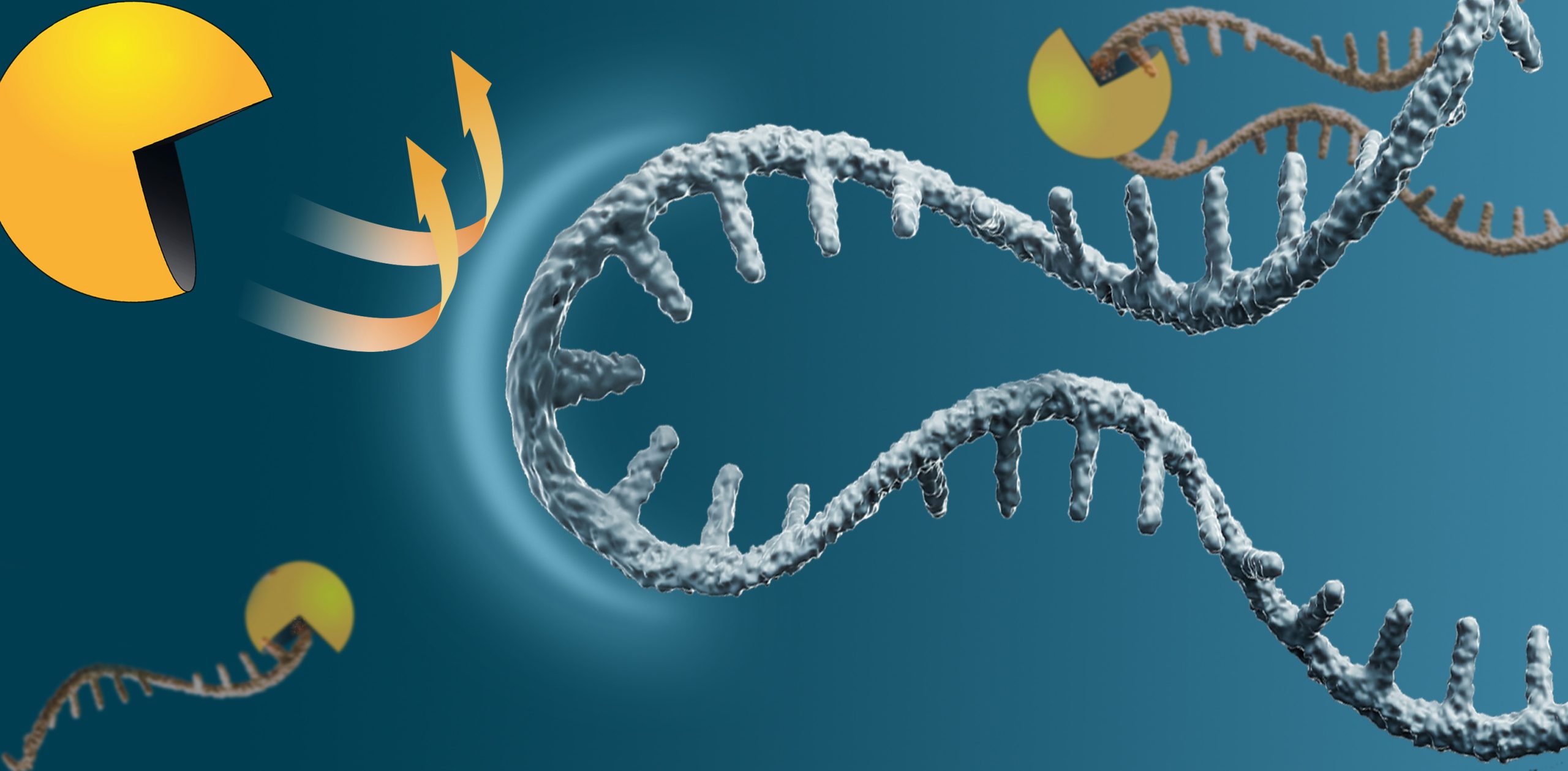
    mRNA Pacman Degradation
    Messenger RNA (blue) is protected from degradation (yellow). Credit: MPI MOPH

    The discovery of the first mRNA-stabilizing substance could pave the way for groundbreaking advancements in the development of innovative mRNA therapies.

    mRNA carries the most valuable cellular information — the chemical blueprint for protein production—from the nucleus to the cytoplasm. Once it delivers its message to the protein-producing machinery in the cytoplasm, it is no longer required and is broken down by exonucleases.

    Depending on how long the mRNA remains in the cytoplasm, more or less of a protein is produced – be it health-promoting or disease-causing. The regulation of mRNA levels is one of the most promising strategies in the emerging field of RNA-based therapeutics.

    How to protect the messenger

    The team around Peter ‘t Hart has now developed a new strategy to extend the lifespan of mRNA by protecting it from its dismantling. Interestingly, mRNA is not particularly stable by nature and would be degraded prematurely without molecular caps protecting the two mRNA ends.

    At its so-called 3’ end mRNA is equipped with a polyadenine tail with an average length of 200 nucleotides. But even this shield does not last long – the average half-life of mRNA is only 7 hours. In a process called deadenylation, the target mRNA is recruited by RNA-binding proteins to the protein complex CCR4-NOT, which removes one adenine after the other.
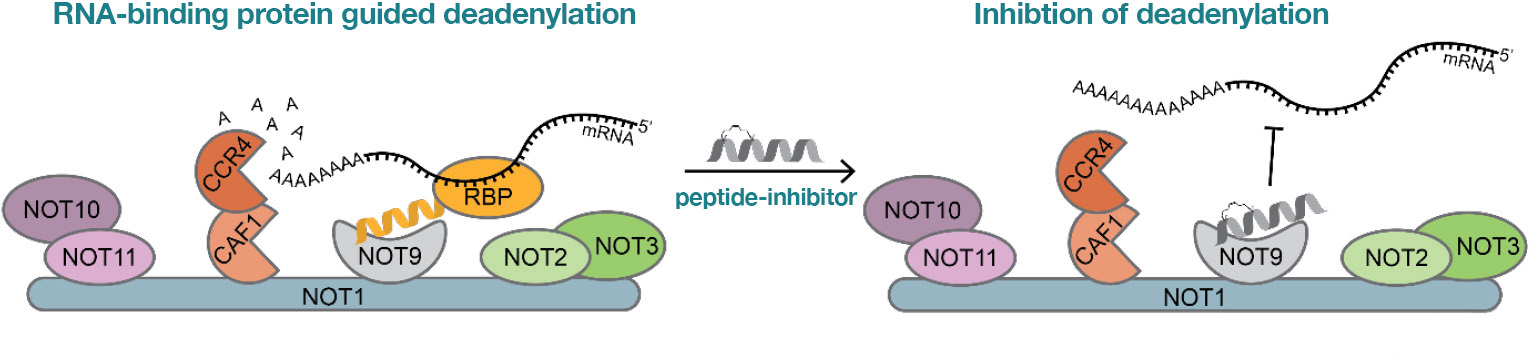
    Regulation of Deadenylation by the NOT9 Subunit of the CCR4 NOT Complex
    Regulation of deadenylation by the NOT9 subunit of the CCR4-NOT complex. Credit: MPI MOPH

    And this is precisely where the scientists’ new strategy comes in. Based on the structure of the mRNA-binding protein, they have developed a large peptide, that can block the interaction of the CCR4-NOT complex with the target mRNA. Large peptides, however, have problems overcoming (crossing) cellular barriers, what they have to do if they are to be used as drugs.

    By revealing the 3D-structure of the peptide-inhibitor bound to the target the chemists were able to make modifications, that improved the cell permeability of the peptide.

    Increasing the stability of potentially health-promoting proteins

    The scientists were able to take their work even one step further and demonstrate the potential of their strategy in cellular assays. Treating cells with the peptide stabilized the polyadenine tails of two potential health-promoting proteins: a tumor suppressor, which could have beneficial effects in cancer, and a nuclear receptor, whose increasing levels could help to treat various aging-related diseases.

    “The concept of stabilizing beneficial mRNAs by blocking their deadenylation has not yet been explored. Since almost all mRNAs undergo this process, blocking them can be used to develop new drugs that offer a new way to treat diseases where other strategies have failed,” says ‘t Hart. His group is currently working on the development of further inhibitors against other components of the deadenylation machinery.

    Reference: “Stapled Peptides as Inhibitors of mRNA Deadenylation” by Sunit Pal, Ilja Gordijenko, Stefan Schmeing, Somarghya Biswas, Yasemin Akbulut, Raphael Gasper and Peter ‘t Hart, 25 September 2024, Angewandte Chemie International Edition.
    DOI: 10.1002/anie.202413911

    Never miss a breakthrough: Join the SciTechDaily newsletter.
    Follow us on Google and Google News.

    Drugs Max Planck Institute MRNA
    Share. Facebook Twitter Pinterest LinkedIn Email Reddit

    Related Articles

    GlycoSHIELD: New Software Revolutionizes Drug Development

    New Research Reveals the Biochemical “Rings of Power”

    Catch Me if You Can: Scientists Discover How mRNA Therapeutics Are Delivered Into Cells

    Insight on the Evolution of Cocaine Biosynthesis

    DNA Jumps Directly From the Cell’s Chloroplasts Into Its Nucleus

    Researchers Record Detailed Live Images Inside the Brain of a Living Mouse

    Researchers Discover Chloroplast Genomes Transfer from Plant to Plant

    Scientists Use Tasar Silkworm to Help Grow Artificial Cardiac Tissue

    Synchronized Brain Oscillations Crucial for Short-Term Memory

    Leave A Reply Cancel Reply

    • Facebook
    • Twitter
    • Pinterest
    • YouTube

    Don't Miss a Discovery

    Subscribe for the Latest in Science & Tech!

    Trending News

    Scientists Warn That This Common Pet Fish Can Wreck Entire Ecosystems

    Scientists Make Breakthrough in Turning Plastic Trash Into Clean Fuel Using Sunlight

    This Popular Supplement May Interfere With Cancer Treatment, Scientists Warn

    Scientists Finally Solved One of Water’s Biggest Mysteries

    Could This New Weight-Loss Pill Disrupt the Entire Market? Here’s What You Should Know About Orforglipron

    Earth’s Crust Is Tearing Open in Africa, and It Could Form a New Ocean

    Breakthrough Bowel Cancer Trial Leaves Patients Cancer-Free for Nearly 3 Years

    Natural Compound Shows Powerful Potential Against Rheumatoid Arthritis

    Follow SciTechDaily
    • Facebook
    • Twitter
    • YouTube
    • Pinterest
    • Newsletter
    • RSS
    SciTech News
    • Biology News
    • Chemistry News
    • Earth News
    • Health News
    • Physics News
    • Science News
    • Space News
    • Technology News
    Recent Posts
    • Kratom Use Explodes in the US, With Life-Changing Consequences
    • Scientists Uncover Fatal Weakness in “Zombie Cells” Linked to Cancer
    • World-First Study Reveals Human Hearts Can Regenerate After a Heart Attack
    • Why Your Dreams Feel So Real Sometimes and So Strange Other Times
    • Scientists Debunk 100-Year-Old Belief About Brain Cells, Rewriting Textbooks
    Copyright © 1998 - 2026 SciTechDaily. All Rights Reserved.
    • Science News
    • About
    • Contact
    • Editorial Board
    • Privacy Policy
    • Terms of Use

    Type above and press Enter to search. Press Esc to cancel.