

A Cheap and Chemically Durable Catalyst To Synthesize Ammonia
The Haber-Bosch process, which is often used to synthesize ammonia (NH3)—the foundation for synthetic nitrogen fertilizers—by combining hydrogen (H2) and nitrogen (N2) over catalysts at high pressures and temperatures, is one of the most significant scientific breakthroughs that has helped enhance crop yields and raise food production worldwide.
However, owing to the process’s high temperature and pressure requirements, large fossil fuel energy inputs are required. The hydrogen utilized in this method is derived from natural gas (mainly methane). This hydrogen-production process consumes a lot of energy and emits a lot of CO2. To address these issues, several catalysts have been created to allow the reaction to take place at gentler circumstances utilizing hydrogen produced by water electrolysis using renewable energy. Among them are nitride-based catalysts that contain active metal nanoparticles like nickel and cobalt (Ni, Co) loaded on lanthanum nitride (LaN) supports.
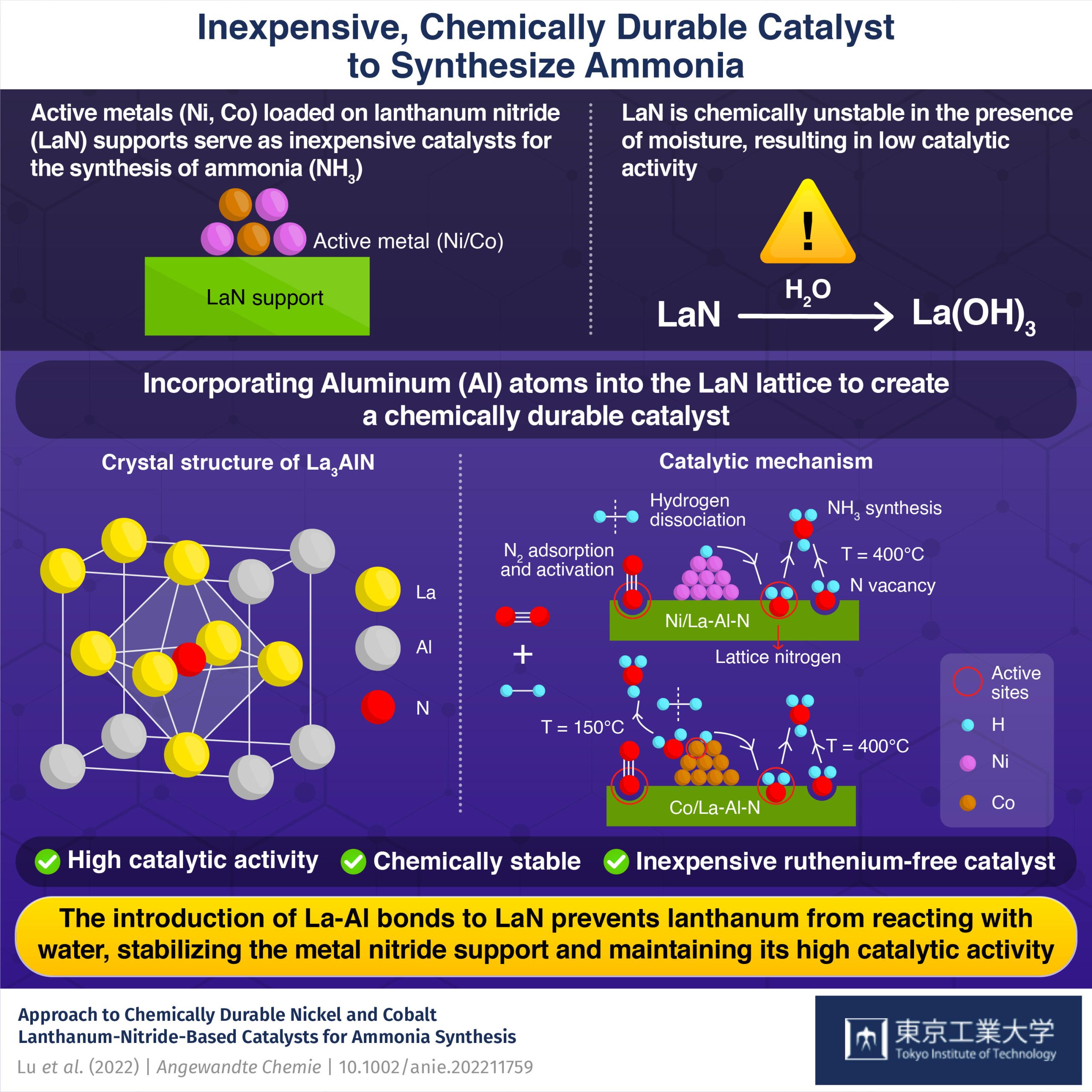
Both the support and the active metal are involved in the formation of NH3 in these catalysts. The active metal splits the H2, whilst the LaN support’s crystal structure contains nitrogen vacancies and nitrogen atoms that adsorb and activate nitrogen (N2). While these catalysts are cheap (since they don’t need ruthenium, which is expensive), their catalytic performance suffers when exposed to moisture, with the LaN support transforming into lanthanum hydroxide (La(OH)3).
A Moisture-Stable Breakthrough
Now, in a new study published in Angewandte Chemie, researchers from China and Japan led by Professor Hideo Hosono from the Tokyo Institute of Technology (Tokyo Tech), Japan, have developed a chemically stable catalyst that is stable in the presence of moisture. Taking inspiration from stable rare-earth compounds containing chemical bonds between a rare-earth metal (in this case, La) and a metal, they incorporated aluminum atoms into the LaN structure and synthesized a chemically stable La3AlN support containing La-Al bonds that prevent lanthanum atoms from reacting with moisture.
The La-Al-N support along with the active metals, such as nickel and cobalt (Ni, Co), was able to produce NH3 at rates similar to that with conventional metal nitride catalysts and could maintain a stable production when fed with nitrogen gas-containing moisture. “The Ni- or Co-loaded La-Al-N catalysts showed no distinct degradation following exposure to 3.5% moisture,” says Prof. Hosono.
While the Al atoms stabilized the support, the lattice nitrogen and nitrogen defects present in the doped support enabled the synthesis of ammonia in a manner similar to the conventional active metal/rare-earth metal nitride catalysts. “Lattice nitrogen, as well as nitrogen vacancy in La-Al-N, play a key role in N2 adsorption, with the La-Al-N support and the active metal Ni being responsible for N2 and H2 absorption and activation, respectively,” explains Prof. Hosono.
The Haber-Bosch process is an energy-intensive chemical reaction, accounting for about 1 % of global annual carbon dioxide emissions. While alternative environmentally friendly approaches for NH3 production are being investigated, introducing inexpensive catalysts could provide immediate benefits by allowing the process to operate under milder conditions.
Reference: “Approach to Chemically Durable Nickel and Cobalt Lanthanum-Nitride-Based Catalysts for Ammonia Synthesis” by Prof. Yangfan Lu, Prof. Tian-Nan Ye, Dr. Jiang Li, Zichuang Li, Haotian Guan, Dr. Masato Sasase, Dr. Yasuhiro Niwa, Prof. Hitoshi Abe, Prof. Qian Li, Prof. Fushen Pan, Prof. Masaaki Kitano and Prof. Hideo Hosono, 26 September 2022, Angewandte Chemie International Edition.
DOI: 10.1002/anie.202211759
The study was funded by the Minister of Education, Culture, Sports, Science and Technology, the Japan Society for the Promotion of Science, the Japan Science and Technology Agency, Chongqing University, the Chongqing Municipality Key Research and Development Program of China, the National Natural Science Foundation of China, the Science and Technology Commission of Shanghai Municipality, and the Shaoxing Research Institute of Renewable Energy and Molecular Engineering.
Never miss a breakthrough: Join the SciTechDaily newsletter.
Follow us on Google and Google News.