

Close Menu
    Facebook X (Twitter) Instagram
    SciTechDaily
    • Biology
    • Chemistry
    • Earth
    • Health
    • Physics
    • Science
    • Space
    • Technology
    Facebook X (Twitter) Pinterest YouTube RSS
    SciTechDaily
    Home»Technology»New Engine Taps the Freezing Void of Space To Generate Power at Night
    Technology

    New Engine Taps the Freezing Void of Space To Generate Power at Night

    By University of California - DavisNovember 16, 20252 Comments4 Mins Read
    Facebook Twitter Pinterest Telegram LinkedIn WhatsApp Email Reddit
    Share
    Facebook Twitter LinkedIn Pinterest Telegram Email Reddit
    Stirling Engine Electricity
    Researchers have demonstrated a way to generate nighttime power by exploiting an often-overlooked temperature difference between Earth and the sky. Their approach uses a specialized engine to tap into this subtle energy flow, revealing possibilities that don’t depend on sunlight or conventional fuels. (Artist’s concept). Credit: SciTechDaily.com

    Researchers have created a device that generates mechanical power at night by harnessing the natural temperature difference between warm ground and the cold of outer space.

    Engineers at the University of California, Davis, have created a device capable of producing mechanical energy at night by taking advantage of the warmth near the ground and the extreme cold of outer space. This approach could support practical uses such as moving air through greenhouses or other structures. The research was recently published in the journal Science Advances.

    The device is based on a Stirling engine, a type of machine that operates using temperature differences. According to Jeremy Munday, professor of electrical and computer engineering at UC Davis and co-author of the study, many engines, including internal combustion engines, require a large temperature gap to generate power. A Stirling engine, however, can run with only a small temperature contrast, similar to the difference between a hot cup of coffee and the surrounding air.

    “These engines are very efficient when only small temperature differences exist, whereas other types of engines work better with larger temperature differences and can produce more power,” Munday said.

    Linking Ground Heat to the Cold of Space

    Normally, a Stirling engine functions by placing one side in contact with a heat source while the opposite side is connected to a cooler environment.

    “If you just set it on the table, it’s not going to produce any power on its own because all sides are the same temperature,” Munday said.
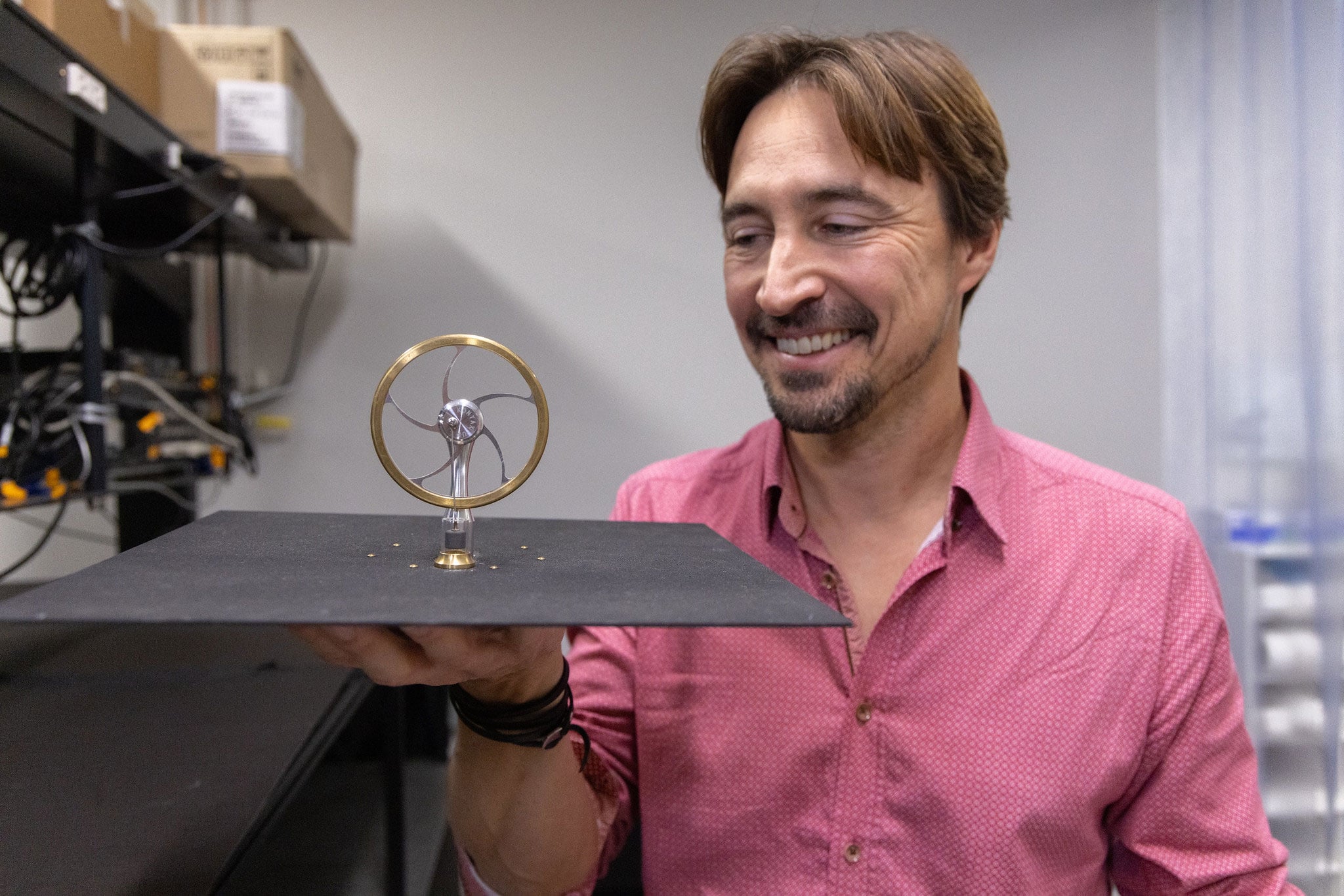
    Jeremy Munday Stirling Engine
    UC Davis engineering professor Jeremy Munday has developed an experimental engine that can generate mechanical power from the temperature difference between the Earth and deep space when placed outdoors at night. The device, a type of machine called a Stirling engine, could be used for example to ventilate buildings or run fans in a greenhouse at night. Credit: Mario Rodriguez/UC Davis

    One way to generate a temperature difference, of course, is to heat up one side by burning fuel. Munday and graduate student researcher Tristan Deppe wondered if instead they could connect the cold side to something very, very cold but also very far away: deep space.

    “It doesn’t actually have to touch space physically, it can just interact radiatively with space,” Munday said. It’s like standing outside on a cold, clear night: Your head will quickly start to feel cold as heat radiates away.

    Testing the Radiative Cooling Concept

    Deppe and Munday’s idea was to take a simple Stirling engine (essentially a piston driving a flywheel), put it on a panel that acts as a heat-radiating antenna and sit the whole thing on the ground outdoors at night. The ground acts as the warm side of the engine and the antenna channels the cold of space.

    A year of night time experiments shows that the small device can indeed generate at least 400 milliwatts of mechanical power per square meter. The researchers used the device experimentally to directly power a fan and also coupled it to a small electrical motor to generate current.

    The experiments show that it is possible to generate useful amounts of power from the night sky. The potential is greatest in areas where humidity is low and night skies are usually clear, Munday said. The principle could be used, for example, to ventilate greenhouses or residential buildings.

    Reference: “Mechanical power generation using Earth’s ambient radiation” by Tristan J. Deppe and Jeremy N. Munday, 12 November 2025, Science Advances.
    DOI: 10.1126/sciadv.adw6833

    UC Davis has filed a provisional patent related to the work.

    Never miss a breakthrough: Join the SciTechDaily newsletter.
    Follow us on Google and Google News.

    Energy Engineering Renewable Energy UC Davis
    Share. Facebook Twitter Pinterest LinkedIn Email Reddit

    Related Articles

    Scientists Develop Floating Device That Harvests Energy From Raindrops

    Game-Changing 3D Smart Energy Device Could Greatly Cut Global Energy Consumption

    No More Blackouts? New Framework Guarantees the Stability of Microgrids

    Thermal-Imaging Quickly Tracks Energy Leaks in Homes and Buildings

    New On-Site Fabrication Process Makes Taller Wind Turbines More Feasible

    Power Conserving Chip May Increase Smartphone Battery Life

    Engineers Develop Water Splitting Solar-Thermal System to Produce Hydrogen Fuel

    Cyanobacteria Engineered to Make Raw Materials for Fuels From Sunlight

    Waste to Energy Technology Commercially Available in the US

    2 Comments

    1. Greennovator on November 17, 2025 4:55 pm

      And this is why folks have lost faith in ‘higher institutions.
      I published about this over 20 years ago.
      Here’s a hint: take one of those IR ‘laser’ thermometers (which you can buy for $20) at a clear and non-cloidy patch of sky — even in the summer. Then point it at the ground. Figure it out !!
      🙄🤦

      Reply
    2. SquirrelTech on November 18, 2025 9:25 am

      How much does the hardware for that 400 mW/m^2 cost? You’d likely do much better with solar cells.

      Reply
    Leave A Reply Cancel Reply

    • Facebook
    • Twitter
    • Pinterest
    • YouTube

    Don't Miss a Discovery

    Subscribe for the Latest in Science & Tech!

    Trending News

    Why Popular Diabetes Drugs Like Ozempic Don’t Work for Everyone: The “Genetic Glitch”

    Scientists Stunned After Finding Plant Thought Extinct for 60 Years

    Scientists Discover Tiny New Spider That Hunts Prey 6x Its Size

    Natural Component From Licorice Shows Promise for Treating Inflammatory Bowel Disease

    Scientists Warn: Popular Sweetener Linked to Dangerous Metabolic Effects

    Monster Storms on Jupiter Unleash Lightning Beyond Anything on Earth

    Scientists Create “Liquid Gears” That Spin Without Touching

    The Simple Habit That Could Help Prevent Cancer

    Follow SciTechDaily
    • Facebook
    • Twitter
    • YouTube
    • Pinterest
    • Newsletter
    • RSS
    SciTech News
    • Biology News
    • Chemistry News
    • Earth News
    • Health News
    • Physics News
    • Science News
    • Space News
    • Technology News
    Recent Posts
    • 100,000-Year-Old Neanderthal Fossils in Poland Reveal Unexpected Genetic Connections
    • Unexpected Hormone Discovery Could Change How We Treat Arthritis
    • Scientists Supercharge “Natural Killer” Cells To Break Through Cancer’s Defenses
    • Simple “Gut Reset” May Prevent Weight Gain After Ozempic or Wegovy
    • 2.8 Days to Disaster: Scientists Warn Low Earth Orbit Could Suddenly Collapse
    Copyright © 1998 - 2026 SciTechDaily. All Rights Reserved.
    • Science News
    • About
    • Contact
    • Editorial Board
    • Privacy Policy
    • Terms of Use

    Type above and press Enter to search. Press Esc to cancel.