
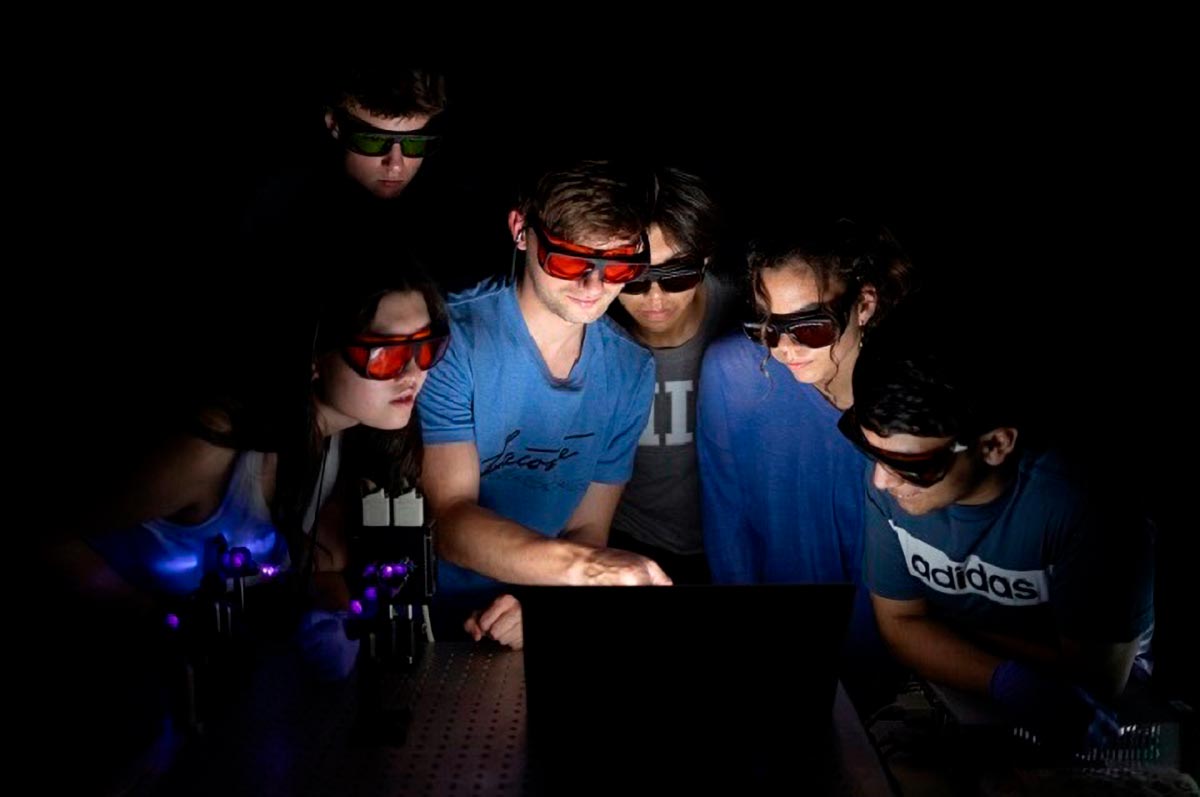
The quantum revolution is advancing technology, and new experimental equipment from the University of Barcelona helps students understand key quantum concepts.
Quantum physics is undergoing a second revolution, poised to drive exponential advancements in computing, the internet, telecommunications, cybersecurity, and biomedicine. This surge in quantum technologies is attracting a growing number of students eager to explore subatomic concepts such as quantum entanglement and superposition, unlocking the transformative potential of quantum science.
However, grasping the counterintuitive principles of quantum mechanics and understanding their impact on technological progress remain key challenges in 2025—a year UNESCO has designated as the International Year of Quantum Science and Technology.
In response to this need, a research team from the Faculty of Physics at the University of Barcelona has developed innovative experimental equipment designed to help students engage with complex quantum physics concepts. Their setup—versatile, cost-effective, and adaptable for various classroom applications—is already in use at the university’s Advanced Quantum Laboratory. Moreover, its accessibility makes it a viable resource for institutions with less specialized facilities, broadening opportunities for hands-on quantum education.
This innovation is presented in an article in the journal EPJ Quantum Technology, which results from a collaboration between professors Bruno Juliá, from the Department of Quantum Physics and Astrophysics and the UB Institute of Cosmos Sciences (ICCUB); Martí Duocastella, from the Department of Applied Physics and the UB Institute of Nanoscience and Nanotechnology (IN2UB), and José M. Gómez, from the Department of Electronic and Biomedical Engineering. It is based on the result of Raúl Lahoz’s master’s final project, with the participation of experts Lidia Lozano and Adrià Brú.
Study of phenomena unique to quantum mechanics
Quantum mechanics makes it possible to create so-called entangled systems — for example, with two particles or two photons — that behave in a non-intuitive way. In 1964, the physicist John S. Bell experimentally proved that the predictions of quantum mechanics were totally incompatible with a classical description of physics — a hypothesis that had been advocated by Albert Einstein — and consolidated the probabilistic nature of quantum mechanics. In 2022, scientists Alain Aspect, John F. Clauser, and Anton Zeilinger were awarded the Nobel Prize in Physics for pioneering experiments in quantum information on entangled photons and the experimental demonstration of the violation of Bell’s inequalities.
Quantum entanglement is today one of the fundamental resources to drive the development of quantum technologies (quantum computers, data encryption, etc.). “The study of Bell inequalities — in particular, observing violations of the inequalities — is fundamental to characterizing quantum entangled systems. It is important to be able to perform these experiments in a teaching laboratory to understand Bell’s inequalities, quantum entanglement, and the probabilistic nature of quantum mechanics,” says Bruno Juliá.
Martí Duocastella explains in the article that they have designed “new experimental equipment capable of providing students with direct measurements of quantum entanglement.” “From our perspective, — says the researcher — we believe that allowing students to make these measurements will greatly facilitate their understanding of this unintuitive phenomenon.”
Introducing students to advanced tools
The system designed by the UB team makes it possible to study Bell inequalities and also to perform full two-photon state tomography. With a simple operation, it can prepare different quantum entangled states.
Compared to previous proposals, “the new equipment has improved the photon-capture process: it uses detectors assembled to optical fibers, one of the key innovations to simplify the experiment, which facilitates the alignment of the system and increases the efficiency of the detection. Thus, a complete measurement of the Bell inequalities can be performed during a practical laboratory session (between one and two hours),” say Juliá and Duocastella.
The results reveal successful manipulation of the quantum state of photons the achievement of high-fidelity entangled states and significant violations of Bell inequalities. Also, the elements of the system are widely used in current quantum technologies, facilitating students’ contact with advanced instrumentation.
This innovation, which has already been implemented in bachelor’s and master’s degree courses, has received highly positive feedback from all students. In the bachelor’s degree program in Physics, it enables experimental demonstrations to complement the subjects of Classical and Quantum Information Theory and Quantum Mechanics. In the master’s degree program, it is one of the four experiments in the Advanced Quantum Laboratory of the Master’s program in Quantum Science and Technologies.
Reference: “Undergraduate setup for measuring the Bell inequalities and performing quantum state tomography” by Raul Lahoz Sanz, Lidia Lozano Martín, Adrià Brú i Cortés, Martí Duocastella, Jose M. Gomez and Bruno Juliá-Díaz, 19 December 2024, EPJ Quantum Technology.
DOI: 10.1140/epjqt/s40507-024-00298-y
This study has received funding from both the Spanish Ministry of Science, Innovation and Universities and the European Union’s Next Generation EU funds.
Never miss a breakthrough: Join the SciTechDaily newsletter.
Follow us on Google and Google News.
1 Comment
Quantum mechanics makes it possible to create so-called entangled systems — for example, with two particles or two photons — that behave in a non-intuitive way.
GOOD.
Ask the researchers:
1. What is the physical reality of quantum?
2. What is the non-intuitive way?
3. Is quantum algebra, formula, or fraction?
4. How do you understand quantum physics?
5. Is quantum mechanics mathematics or physical reality?
6. How does mathematics relate to physical reality?
7. How do you use mathematics to explain physical phenomena?
What one researcher see or touch about an elephant will be different, and what different researchers see or touch will be even more different. It is a scientific phenomenon, not the essence of nature. Scientific research guided by correct theories can enable researchers to think more.
According to the Topological Vortex Theory (TVT), spins create everything, spins shape the world. There are substantial distinctions between Topological Vortex Theory (TVT) and traditional physical theories. Grounded in the inviscid and absolutely incompressible spaces, TVT introduces the concept of topological phase transitions and employs topological principles to elucidate the formation and evolution of matter in the universe, as well as the impact of interactions between topological vortices and anti-vortices on spacetime dynamics and thermodynamics.
Within TVT, low-dimensional spacetime matter serves as the foundation for high-dimensional spacetime matter, and the hierarchical structure of matter and its interaction mechanisms challenge conventional macroscopic and microscopic interpretations. The conflict between Quantum Physics and Classical Physics can be attributed to their differing focuses: Quantum Physics emphasizes low-dimensional spacetime matter, whereas Classical Physics centers on high-dimensional spacetime matter.
Subatomic particles in the quantum world often defy the familiar rules of the physical world. The fact repeatedly suggests that the familiar rules of the physical world are pseudoscience. In the familiar rules of the physical world, two sets of cobalt-60 can form the mirror image of each other by rotating in opposite directions, and can receive heavy rewards.
Please witness the grand performance of some so-called academic publications (including PRL, Nature, Science, etc.). https://scitechdaily.com/microscope-spacecrafts-most-precise-test-of-key-component-of-the-theory-of-general-relativity/#comment-854286. Some so-called academic publications (including PRL, Nature, Science, etc.) are addicted to their own small circles and have long deviated from science. They hardly know what ashamed is.
If the researchers are truly interested in science, please read: The Application of Inviscid and Absolutely Incompressible Spaces in Engineering Simulation (https://scitechdaily.com/microscope-spacecrafts-most-precise-test-of-key-component-of-the-theory-of-general-relativity/#comment-870077).