
Close Menu
    Facebook X (Twitter) Instagram
    SciTechDaily
    • Biology
    • Chemistry
    • Earth
    • Health
    • Physics
    • Science
    • Space
    • Technology
    Facebook X (Twitter) Pinterest YouTube RSS
    SciTechDaily
    Home»Health»New Findings Shed Light on the Progression of Atherosclerosis
    Health

    New Findings Shed Light on the Progression of Atherosclerosis

    By Ziba Kashef, Yale UniversityMay 25, 2018No Comments2 Mins Read
    Facebook Twitter Pinterest Telegram LinkedIn WhatsApp Email Reddit
    Share
    Facebook Twitter LinkedIn Pinterest Telegram Email Reddit
    New Findings Shed Light Atherosclerosis
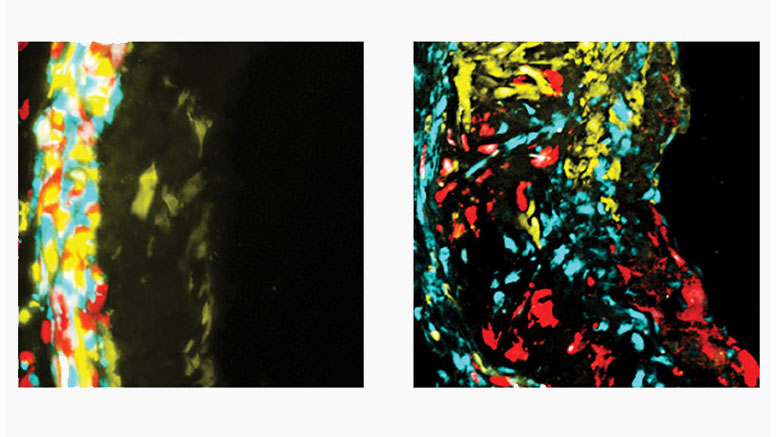
    Induction of atherosclerosis in mice models results in plaques (on the right side of each panel) with marked smooth muscle-derived cells of a single color (yellow in left panel) or multiple colors (right panel). These plaques are from mice transplanted with bone marrow that is normal (left panel) or lacking integrin beta3 (right panel).

    The accumulation of cholesterol plaques in artery walls can lead to atherosclerosis, or the hardening of arteries that contributes to heart attacks and strokes. In a new study, Yale researchers investigate how plaque cells develop at the molecular level, and their findings could help produce targeted treatments for the disease.

    Smooth muscle cells, the dominant type of cell found in artery walls, are known to be involved in plaque build-up, but it has not been clear how this occurs. The research team, led by senior study author Daniel Greif, used mice models and primary human cells to study smooth muscle cells and their contribution to atherosclerotic plaques.

    They discovered that a single smooth muscle cell gives rise, through a process of clonal expansion, to the majority of cells found in the plaque. Additionally, they learned that a gene known as integrin beta3 regulates the migration of a single smooth muscle cell progenitor from the artery wall into plaque. Once inside the plaque, the progenitor cell reproduces and changes into other cell types. Further, the researchers determined that the gene’s role in plaque development occurs in smooth muscle cells as well as in bone marrow-derived cells.

    Together, the findings shed light on the complex mechanisms behind the progression of atherosclerosis, and suggests potential targets for future therapies, the researchers note.

    Reference: “Integrin beta3 regulates clonality and fate of smooth muscle-derived atherosclerotic plaque cells” by Ashish Misra, Zhonghui Feng, Rachana R. Chandran, Inamul Kabir, Noemi Rotllan, Binod Aryal, Abdul Q. Sheikh, Ling Ding, Lingfeng Qin, Carlos Fernández-Hernando, George Tellides and Daniel M. Greif, 25 May 2018, Nature Communications.
    DOI:10.1038/s41467-018-04447-7

    Never miss a breakthrough: Join the SciTechDaily newsletter.
    Follow us on Google and Google News.

    Atherosclerosis Disease Molecular Biology Yale University
    Share. Facebook Twitter Pinterest LinkedIn Email Reddit

    Related Articles

    Yale Researchers Develop Method to Attack Cancer at Its Source

    New Design Makes Previously Inaccessible Proteins Vulnerable to Drugs

    New Class of Proteins Inhibit HIV Infection in Cell Cultures

    Immune Response to Heart Attack Can Worsen Atherosclerosis

    Role of the SMN Gene in Spinal Muscular Atrophy

    New Antibody Drug Boosts the Immune System’s Capacity to Fight Cancer

    Intensive Glycemic Control Does Not Definitively Reduce the Risk of Impaired Kidney Function

    Obese Children with Genetic Variants Susceptible to Fatty Liver Disease

    Ticks, Lyme Disease and Public Health

    Leave A Reply Cancel Reply

    • Facebook
    • Twitter
    • Pinterest
    • YouTube

    Don't Miss a Discovery

    Subscribe for the Latest in Science & Tech!

    Trending News

    Massive Study Warns Marijuana Use in Teens Is Linked to Serious Mental Illness

    Scientists Discover a Completely Unexpected Way T Cells Kill Cancer

    Scientists Just Found the Solar System’s Original “Planet Factory”

    Study Warns Widely Used Food Preservatives Linked to High Blood Pressure and Heart Disease

    New Treatment Could Reverse Osteoarthritis Within Weeks

    Physicists Have Measured “Negative Time” in Bizarre Quantum Experiment

    The Deadly Tapeworm Spreading Across America Has Reached the Pacific Northwest

    Could Low Vitamin D Be Making Your Pain Worse?

    Follow SciTechDaily
    • Facebook
    • Twitter
    • YouTube
    • Pinterest
    • Newsletter
    • RSS
    SciTech News
    • Biology News
    • Chemistry News
    • Earth News
    • Health News
    • Physics News
    • Science News
    • Space News
    • Technology News
    Recent Posts
    • Stanford’s Revolutionary New Microscope Reveals Living Cells in Stunning Detail
    • Scientists Discover a Sea Slug Smaller Than a Sesame Seed in Taiwan
    • Wasp Colonies Explode Into Violence After Losing Their Queen
    • Antarctica Suddenly Became Far More Sensitive to Climate Change 1 Million Years Ago
    • A Hidden Arctic Ocean Crisis Is Unfolding Beneath the Melting Ice
    Copyright © 1998 - 2026 SciTechDaily. All Rights Reserved.
    • Science News
    • About
    • Contact
    • Editorial Board
    • Privacy Policy
    • Terms of Use

    Type above and press Enter to search. Press Esc to cancel.