
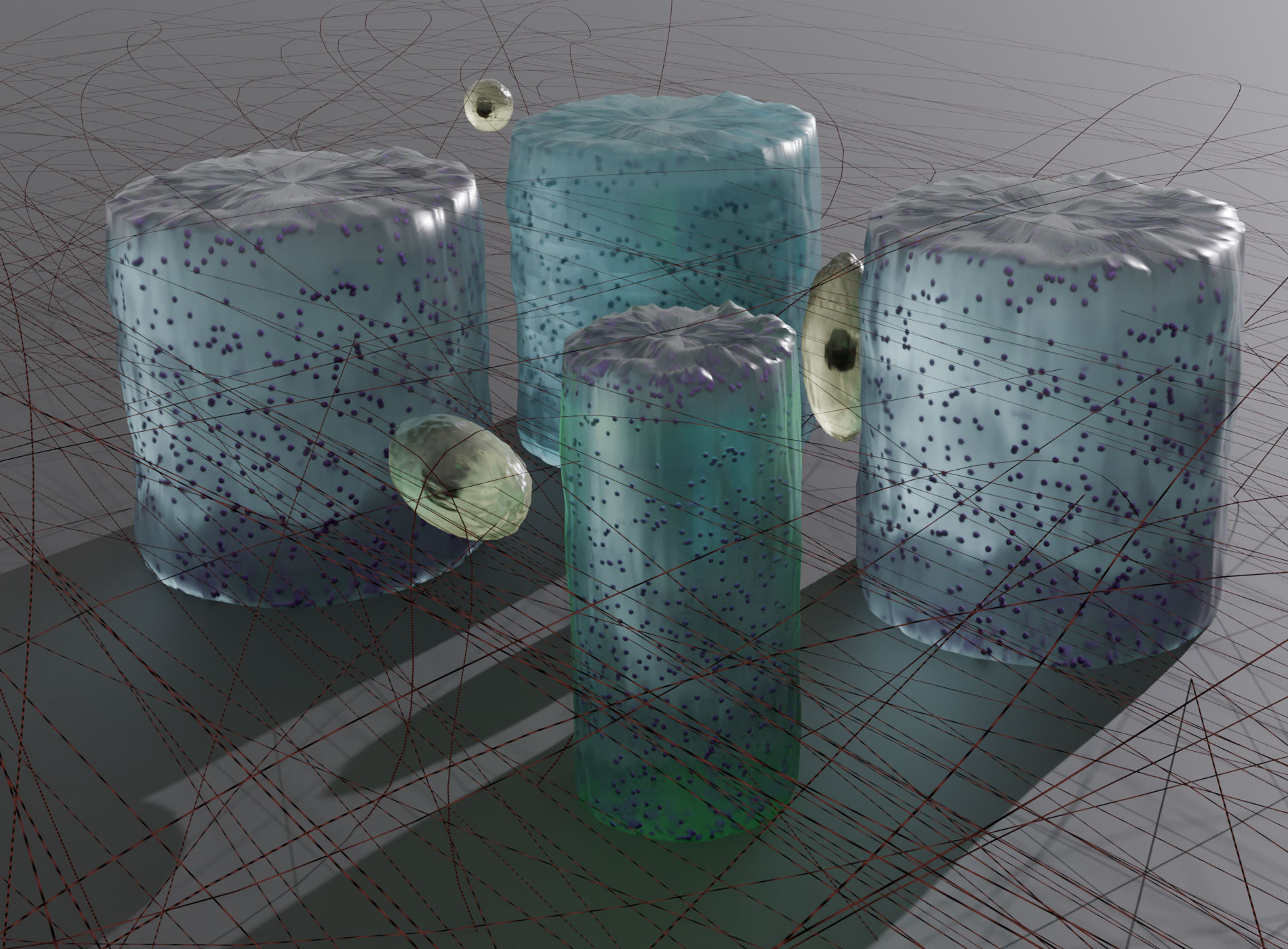
Scientists have engineered a lab-on-a-chip system capable of applying precisely controlled mechanical forces to biological materials that mimic the extracellular matrix.
Inside the body, cells are surrounded by intricate three-dimensional scaffolds called the extracellular matrix. The physical interactions between cells and this surrounding structure are essential for many biological functions.
Researchers at the Max Planck Institute for the Science of Light have created a new lab-on-a-chip platform built around responsive hydrogel structures. This system can apply carefully controlled pressure to tiny cellular environments. The approach may eventually support medical diagnostics aimed at detecting mechanical abnormalities in living tissues.
Biomechanics of cells simulated in lab-on-a-chip method
The extracellular matrix is constantly reshaped by mechanical forces. This remodeling is vital for normal development, the maintenance of physiological balance (homeostasis), and wound repair.
Reproducing these mechanical changes under laboratory conditions helps scientists better understand how diseases arise. Earlier technologies, however, were difficult to incorporate into compact lab-on-a-chip devices and did not provide the level of precision required for detailed studies.
Dr. Katja Zieske, who leads the independent research group “Molecular Biophysics & Living Matter” at the institute, and her colleagues have now introduced a technique that enables precise control of mechanical disturbances within biological polymer networks on a chip. These disturbances can be applied at defined locations and times. Researchers can then observe how the affected biological structures respond under a microscope.
Intelligent hydrogels as micromachines
The system relies on intelligent hydrogel microstructures. Hydrogels are polymer-based materials that change their shape when exposed to specific triggers such as light or temperature. Depending on the stimulus, they either shrink or swell.
The team harnessed this behavior to generate well-defined mechanical forces within biological materials, including collagen networks. They also tested whether the setup is compatible with living cells, which is crucial for future biomedical applications.
To begin, the researchers fabricated and refined thermoresponsive hydrogel microstructures inside flow chambers. By applying controlled temperature changes over specific time intervals, they induced the hydrogels to expand and compress surrounding molecular networks. These included Matrigel, a gel-like mixture of proteins, and collagen.
After compression, the scientists measured how each material responded. Matrigel showed plastic deformation, meaning it retained its altered shape. Collagen behaved differently and returned toward its original form, demonstrating elastic relaxation. By reproducing pressure forces similar to those generated by cells, the researchers established a flexible platform for studying how mechanical stress reshapes biological environments. Future work could explore how the extracellular matrix adapts under force and how such changes influence nearby cells in both healthy and diseased tissues.
“Our method allows us to generate mechanical forces with high spatial and temporal precision, and to record their effects on biological systems. In collagen, we were able to detect changes triggered by these forces even at distances of hundreds of micrometers by tracking fluorescent microspheres,” says Vicente Salas-Quiroz, first author of the presented work.
“Our vision is to develop smart microstructures for medical diagnostics in order to contribute to a sustainable healthcare system – for example, in the investigation of 3D cell model systems such as cancer models and models for blood vessel formation. Intelligent hydrogel microstructures in lab-on-a-chip systems could serve as micromachines in the future to manipulate tissue models on the micrometer scale. We see great potential here for diagnostic use,” adds Zieske.
Reference: “Stimulus-induced mechanical compaction of biological polymer networks via smart hydrogel microstructures” by Vicente Salas-Quiroz, Katharina Esch and Katja Zieske, 30 September 2025, Lab on a Chip.
DOI: 10.1039/D5LC00477B
Never miss a breakthrough: Join the SciTechDaily newsletter.
Follow us on Google and Google News.
1 Comment
thans for this