
Close Menu
    Facebook X (Twitter) Instagram
    SciTechDaily
    • Biology
    • Chemistry
    • Earth
    • Health
    • Physics
    • Science
    • Space
    • Technology
    Facebook X (Twitter) Pinterest YouTube RSS
    SciTechDaily
    Home»Biology»Tool Encoded in Coronaviruses Provides a Potential Drug Target for COVID-19
    Biology

    Tool Encoded in Coronaviruses Provides a Potential Drug Target for COVID-19

    By Biophysical SocietyFebruary 23, 2021No Comments3 Mins Read
    Facebook Twitter Pinterest Telegram LinkedIn WhatsApp Email Reddit
    Share
    Facebook Twitter LinkedIn Pinterest Telegram Email Reddit
    COVID Genes
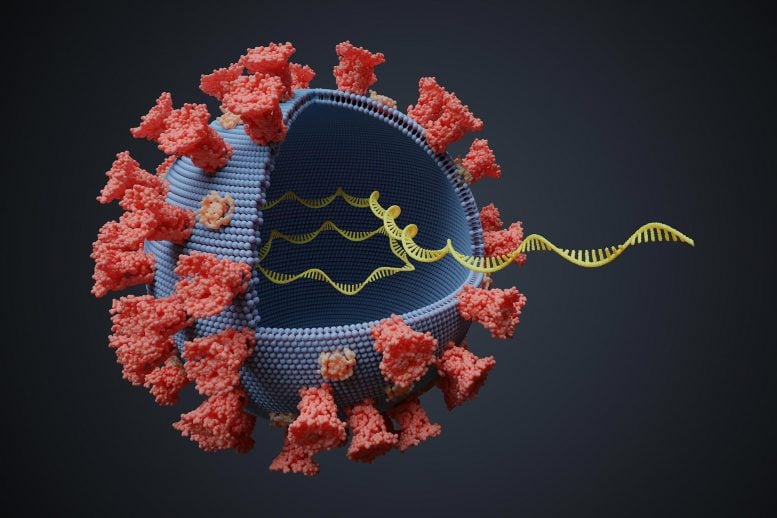
    Coronaviruses leverage host cells to replicate and produce copies. Researchers have recently studied a specific molecular tool used by the virus, identifying it as a potential drug target.

    Viruses make copies of themselves during an infection, and new research sheds light on one of the coronavirus molecules that is important for this process, providing a potential drug target that could work for Covid-19 and other coronavirus outbreaks too.

    Coronaviruses exploit our cells so they can make copies of themselves inside us. After they enter our cells, they use our cell machinery to make unique tools of their own that help them generate these copies. By understanding the molecular tools that are shared across coronaviruses, there is potential to develop treatments that can not only work in the current COVID-19 pandemic, but in future coronavirus outbreaks as well. Rockefeller University researchers in the labs of Tarun Kapoor and Shixin Liu, including postdoctoral associate Keith Mickolajczyk, recently published their study of one of these molecular tools, which is a potential drug target. They will present their research on Tuesday, February 23, 2021, at the 65th Annual Meeting of the Biophysical Society.
    SARS-CoV-2 Helicase
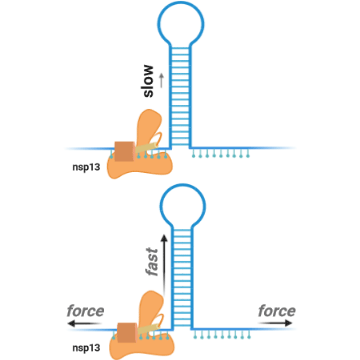
    Nsp13 helicase (orange) unwinds RNA (blue), the same material as the SARS-CoV-2 genome. Recent findings show that mechanical forces (black arrows) increase nsp13 unwinding efficiency. Credit: Image courtesy of Keith Mickolajczyk

    During a viral infection, viruses make copies of themselves inside their host, and viruses carry genetic instructions for several tools in order to do so. One of those tools is called a helicase – all organisms have helicases that unwind the genetic information so it can be read or copied. Mickolajczyk had been studying helicases and other molecular motors when the COVID-19 pandemic hit and turned his attention to a helicase encoded in the genome of SARS-CoV-2 (the virus that causes COVID-19), called nsp13.

    Single-Molecule Study of nsp13

    Mickolajczyk and colleagues investigated the mechanism that individual nsp13 molecules use to unwind genetic material, and their study marks the first single-molecule unwinding experiments to ever be done on a coronavirus helicase. They found that nsp13 is a relatively weak helicase, meaning it needs assisting mechanical forces to be activated, and other viral molecules may help it. They also found that nsp13 did not act like a Hepatitis C virus helicase with a similar shape, and instead acted more like ring-shaped helicases found in bacteriophages (viruses that infect bacteria).

    A Path Toward Broad-Spectrum Coronavirus Treatments

    Because coronaviruses have helicases that are very similar to nsp13, it is valuable to understand how this molecule works. “If we can come up with viral therapeutics that hit nsp13, we can have a first line of defense when new coronaviruses potentially erupt and cause new epidemics or pandemics in the future. Understanding this mechanism now can help us design inhibitors that can be treatments against coronaviruses,” Mickolajczyk says.

    Their results, Mickolajczyk says, can provide insights that can be leveraged for drug discovery efforts. By inhibiting nsp13, a drug could prevent coronaviruses from making copies of themselves, thereby halting infections and stopping or preventing a pandemic.

    Never miss a breakthrough: Join the SciTechDaily newsletter.
    Follow us on Google and Google News.

    Biochemistry Biomedical Engineering Biophysics COVID-19 Genetics Pharmaceuticals Virology
    Share. Facebook Twitter Pinterest LinkedIn Email Reddit

    Related Articles

    COVID-19: Achilles’ Heel of SARS-CoV-2 Viral RNA Identified

    Advanced Cryo-EM Reveals Viral RNA Replication Complex Structure in “Game-Changing” Detail

    Seaweed Extract Outperforms Remdesivir in Blocking COVID-19 Virus in Cell Studies

    Different Groups of Bats Have Their Own Unique Strains of Coronavirus – They Have Been Evolving Together for Millions of Years

    Specialized Proteins May Halt the Severe Cytokine Storms Seen in COVID-19 Patients

    Severity of COVID-19 May Depend on Your Individual Genetic Variation in Immune System

    Pangolins, Not Snakes, May Be Missing Link in Coronavirus Jump From Bats to Humans

    Stanford Scientists Genetically Reprogram Cells to Build Artificial Structures

    DNA2 Molecule Helps Repair Chromosome Rearrangements Linked to Cancer

    Leave A Reply Cancel Reply

    • Facebook
    • Twitter
    • Pinterest
    • YouTube

    Don't Miss a Discovery

    Subscribe for the Latest in Science & Tech!

    Trending News

    Artificial Sweeteners May Harm Future Generations, Study Suggests

    Splashdown! NASA Artemis II Returns From Record-Breaking Moon Mission

    What If Consciousness Exists Beyond Your Brain

    Scientists Finally Crack the 100-Million-Year Evolutionary Mystery of Squid and Cuttlefish

    Beyond “Safe Levels”: Study Challenges What We Know About Pesticides and Cancer

    Researchers Have Found a Dietary Compound That Increases Longevity

    Scientists Baffled by Bizarre “Living Fossil” From 275 Million Years Ago

    Your IQ at 23 Could Predict Your Wealth at 27, Study Finds

    Follow SciTechDaily
    • Facebook
    • Twitter
    • YouTube
    • Pinterest
    • Newsletter
    • RSS
    SciTech News
    • Biology News
    • Chemistry News
    • Earth News
    • Health News
    • Physics News
    • Science News
    • Space News
    • Technology News
    Recent Posts
    • Why Losing Too Much Fat Can Be Just As Dangerous as Obesity
    • Beef vs. Chicken: Surprising Results From New Prediabetes Study
    • Alzheimer’s Breakthrough: Scientists Discover Key Protein May Prevent Toxic Protein Clumps in the Brain
    • Scientists Discover New Way To Make Protein Shakes Taste Better
    • Scientists Break Optical Limits With Quantum Dot-Powered Nanoscopy
    Copyright © 1998 - 2026 SciTechDaily. All Rights Reserved.
    • Science News
    • About
    • Contact
    • Editorial Board
    • Privacy Policy
    • Terms of Use

    Type above and press Enter to search. Press Esc to cancel.