
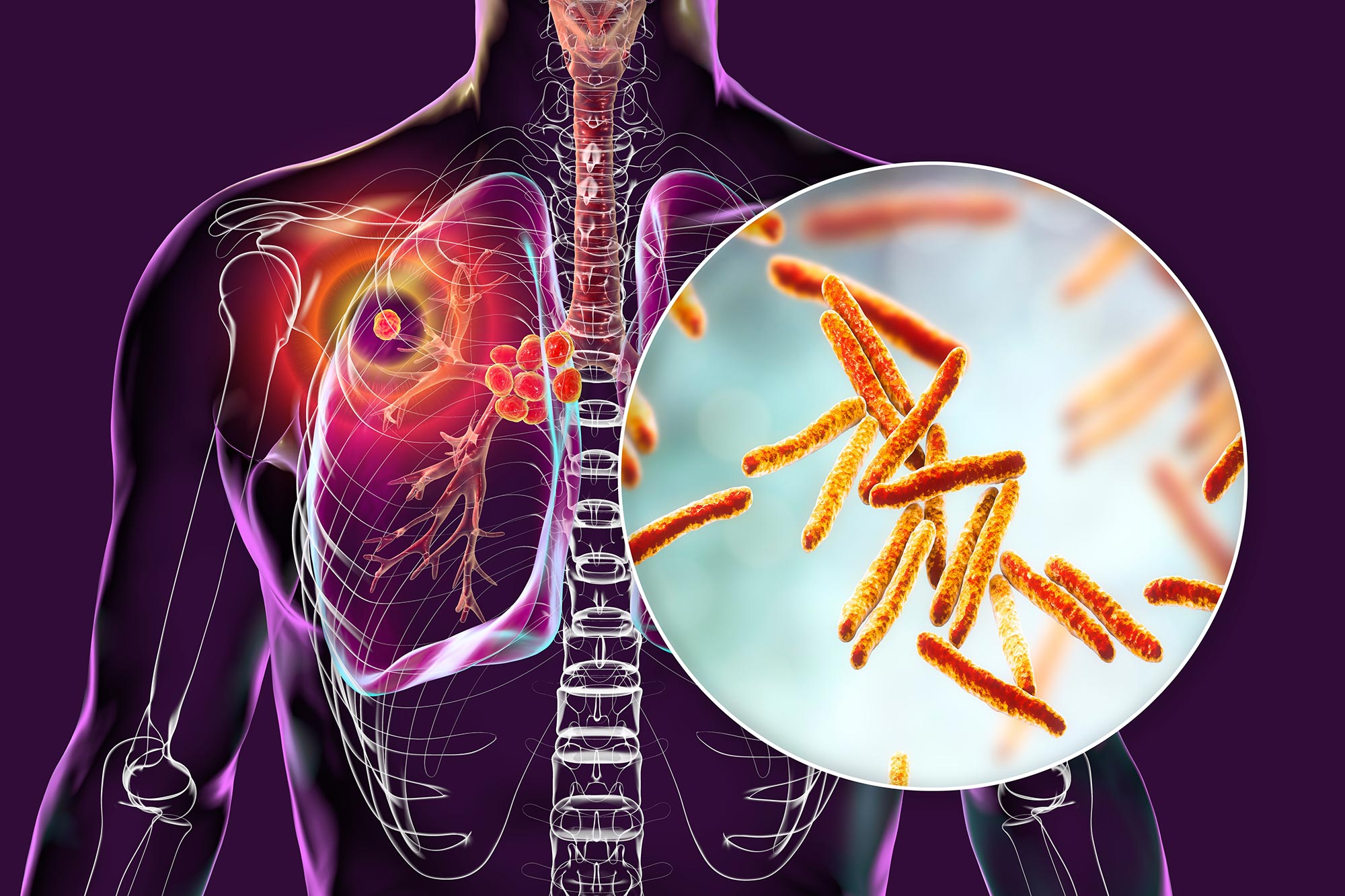
Researchers have engineered an inhalable nanoparticle system that keeps a critical TB drug in the lungs longer, raising the possibility of less frequent dosing and fewer systemic side effects.
Scientists at the Jacobs School of Medicine and Biomedical Sciences at the University at Buffalo have created an inhalable treatment for tuberculosis (TB) that could ease many of the challenges tied to current therapy.
Their results were published in the journal Antimicrobial Agents and Chemotherapy. The study’s senior author is Jessica L. Reynolds, PhD, associate professor of medicine at the Jacobs School.
The research describes a biocompatible nanoparticle system designed to be inhaled. These particles can modulate the immune system and are engineered to carry rifampin, one of the most widely used and important drugs for treating TB.
“TB is still one of the world’s deadliest infectious diseases, even though it can be cured. Treatment takes many months and involves multiple drugs that can cause serious side effects,” Reynolds says. “Because of this, many patients struggle to finish treatment, which leads to treatment failure and drug-resistant TB.”
Potential for lower side effects, fewer dosages
Although rifampin is highly effective, taking it by mouth presents significant drawbacks. It can harm the liver, and only limited amounts of the drug reach the lungs, where TB bacteria primarily reside, Reynolds explains.
To overcome these issues, the research team developed a method to send rifampin straight to the lungs through inhalation rather than through pills. The drug is packaged inside microscopic nanoparticles that can be breathed in.
According to Hilliard L. Kutscher, PhD, research assistant professor of medicine and the study’s first author, each nanoparticle contains a biodegradable core loaded with rifampin. The outer layer is designed to attach to macrophages, the immune cells that TB bacteria infect. A naturally derived molecule on the surface enhances uptake by immune cells and stimulates immune activity.
“These particles are specially built to go straight to the lungs and be taken up by lung immune cells called macrophages, which are where TB bacteria hide,” he adds. “They are designed to slowly release rifampin over time, to stimulate the immune system to better fight TB and to reduce drug exposure to the rest of the body, lowering side effects.”
Because the inhaled form allows rifampin to remain in lung tissue for longer periods, Kutscher suggests that patients might eventually need treatment only once a week instead of daily.
Drug delivered more effectively to lungs
To test the approach, the team evaluated it in two mouse models of TB (one that reflects general TB lung infection, and a second, more severe model that closely mimics human TB lung damage and is harder to treat). They compared once-weekly inhaled nanoparticle therapy with daily oral rifampin to see how effectively each reduced mycobacterium tuberculosis.
“Using both models makes the results more reliable and relevant to human disease,” Reynolds says.
The study found that inhaled nanoparticle treatment delivered rifampin much more effectively to the lungs.
“Compared to taking rifampin by mouth every day, the inhaled nanoparticles kept higher levels of the drug in the lungs for much longer — up to a week after a single dose,” Reynolds notes.
All experiments involving Mycobacterium tuberculosis were performed in a certified Biosafety Level 3 (BSL-3) laboratory, the standard setting required for TB research across the United States. These facilities follow federal, state, and institutional regulations and include restricted access, advanced ventilation systems, sterilization, and other validated safety procedures.
“The work highlights the potential of long-acting inhaled medicines to simplify TB therapy,” Reynolds says.
“Reducing treatment frequency could improve adherence, lower side effects, and make TB care more accessible worldwide,” she says. “These findings support continued development of inhalable, long-acting TB therapies as a promising strategy to improve treatment outcomes and reduce the global impact of tuberculosis.”
Reynolds adds that the next stage of research will examine how the nanoparticle system can be combined with other standard TB antibiotics to enable combination therapy, which remains the foundation of TB treatment of disease.
Potential benefits extend beyond TB
Patrick O. Kenney, MD, clinical assistant professor of pediatrics and co-author on the study, says the potential public health benefits of the research go beyond tuberculosis.
“Rifampin is not just a TB drug; it is also a key medication for other serious lung infections caused by non-tuberculous mycobacteria, such as Mycobacterium kansasii and Mycobacterium xenopi, which are increasingly recognized in the U.S.,” Kenney says. “These infections often affect people with chronic lung disease and can be difficult to treat.”
Kenney says targeted lung delivery could also potentially solve a long-standing drug interaction problem.
“One major limitation of rifampin is that when taken orally, it strongly activates liver enzymes and this reduces the effectiveness of other important antibiotics, such as azithromycin and clarithromycin, which are cornerstones of therapy for Mycobacterium avium/intracellulare complex (MAC) lung disease,” he says. “Because of this interaction, rifampin is often avoided, even when it could otherwise help.”
However, by delivering rifampin directly to the lungs instead of the whole body, this approach could achieve high drug levels at the site of the infection, minimize drug levels in the bloodstream, and potentially reduce harmful drug-drug interactions, Kenney notes.
“That opens the door to using rifampin more effectively in a broader range of pulmonary mycobacterial diseases — not just TB,” he says.
Reference: “Repeated pulmonary dosing of β-glucan-chitosan-PLGA nanoparticles controls Mycobacterium tuberculosis in mice” by Hilliard L. Kutscher, Maria Tamblin, Evon Smith, Arnav Shah, Patrick O. Kenney and Jessica L. Reynolds, 14 January 2026, Antimicrobial Agents and Chemotherapy.
DOI: 10.1128/aac.01480-25
The research was funded by the National Institute of Allergy and Infectious Diseases of the National Institutes of Health.
Never miss a breakthrough: Join the SciTechDaily newsletter.
Follow us on Google and Google News.