
New laser breakthrough to help increase understanding of gravitational waves.
Scientists have created a proof-of-concept setup of a new laser eigenmode sensor that offers over 1,000 times the sensitivity. After translating this work to gravitational wave detectors, they will offer the unprecedented precision needed to test the fundamental limits of general relativity and probe the interiors of neutron stars.
Gravitational wave scientists from The University of Western Australia (UWA) have led the development of a new laser mode sensor with unprecedented precision that will be used to probe the interiors of neutron stars and test the fundamental limits of general relativity.
Gravitational waves are “cosmic ripples” in space-time caused by some of the most energetic and violent processes in the Universe such as neutron stars or black holes orbiting each other, colliding black holes, supernovae, and colliding neutron stars.
Research Associate from UWA’s Center of Excellence for Gravitational Wave Discovery (OzGrav-UWA) Dr. Aaron Jones, said UWA co-ordinated a global collaboration of gravitational wave, metasurface, and photonics experts to pioneer a new method to measure structures of light called “eigenmodes.”
Addressing Challenges in Gravitational Wave Detectors
“Gravitational wave detectors like LIGO, Virgo, and KAGRA store enormous amount of optical power, and several pairs of mirrors are used to increase the amount of laser light stored along the massive arms of the detector,” Dr. Jones said.
“However, each of these pairs has small distortions that scatters light away from the perfect shape of the laser beam which can cause excess noise in the detector, limiting sensitivity and taking the detector offline.
“We wanted to test an idea that would let us zoom in on the laser beam and look for the small ‘wiggles’ in power that can limit the detectors’ sensitivity.”
Dr. Jones said a similar problem is encountered in the telecoms industry where scientists are investigating ways to use multiple eigenmodes to transport more data down optical fibers.
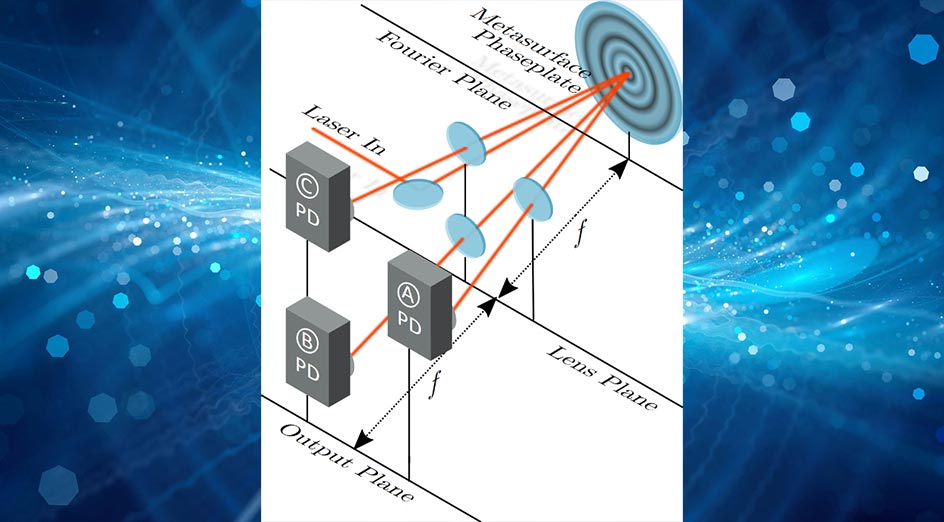
“Telecoms scientists have developed a way to measure the eigenmodes using a simple apparatus, but it’s not sensitive enough for our purposes,” he said. “We had the idea to use a metasurface – an ultra-thin surface with a special pattern encoded in sub-wavelength size – and reached out to collaborators who could help us make one.”
The proof-of-concept setup the team developed was over one thousand times more sensitive than the original apparatus developed by telecoms scientists and the researchers will now look to translate this work into gravitational wave detectors.
Gravitational waves are distortions in spacetime that result from the movements of objects with mass. Credit: ESO/L. Calçada
OzGrav-UWA Chief Investigator Associate Professor Chunnong Zhao said the development is another step forward in detecting and analyzing the information carried by gravitational waves, allowing us to observe the universe in new ways.
“Solving the mode sensing problem in future gravitational wave detectors is essential if we are to understand the insides of neutron stars and further our observation of the universe in a way never before possible,” Associate Professor Zhao said.
The breakthrough is detailed in a study published in Physical Review.
For more on this research, see Gravitational Wave Scientists Pioneer New Laser Mode Sensor With Unprecedented Precision.
Reference: “Metasurface-enhanced spatial mode decomposition” by Aaron W. Jones, Mengyao Wang, Xuecai Zhang, Samuel J. Cooper, Shumei Chen, Conor M. Mow-Lowry and Andreas Freise, 26 May 2022, Physical Review A.
DOI: 10.1103/PhysRevA.105.053523
Never miss a breakthrough: Join the SciTechDaily newsletter.
Follow us on Google and Google News.
4 Comments
Two stars 1 & 2 are present here.First mass of each star can be measured by GR precisely.Now interactions(or gravitational attraction) between them = Gravity of star 1 + Gravity of star 2 _ Gravity of binary system of stars 1 & 2.
Commonly measurement of gravity of indivisual star or of a system of stars are done by GR.
I believe Gravitational Waves will be used by antimatter rocket of the future. Great article !
How? Or are you just bunching cool looking terms together because it looks pretty!?
FWIW, it takes neutron star mergers to make significant GWs, at the very least. And the GWs we detect only stretch space by less than the width of a proton – hence the long arms to make them detectable at all. That isn’t a machine, by any practical measure.