

Researchers have repurposed adaptive optics to track and redirect space junk, safeguarding satellites from potential collisions.
Researchers at The Australian National University (ANU) have harnessed a technique that helps telescopes see objects in the night sky more clearly to fight against dangerous and costly space debris.
“Adaptive optics is like removing the twinkle from the stars.”
The researchers’ work on adaptive optics — which removes the haziness caused by turbulence in the atmosphere — has been applied to a new ‘guide star’ laser for better identifying, tracking and safely moving space debris.
Space debris is a major threat to the $US700 billion of space infrastructure delivering vital services around the globe each day. With laser guide star adaptive optics, this infrastructure now has a new line of defense.
The optics that focus and direct the guide star laser have been developed by the ANU researchers with colleagues from Electro Optic Systems (EOS), RMIT University, Japan, and the USA as part of the Space Environment Research Centre (SERC).
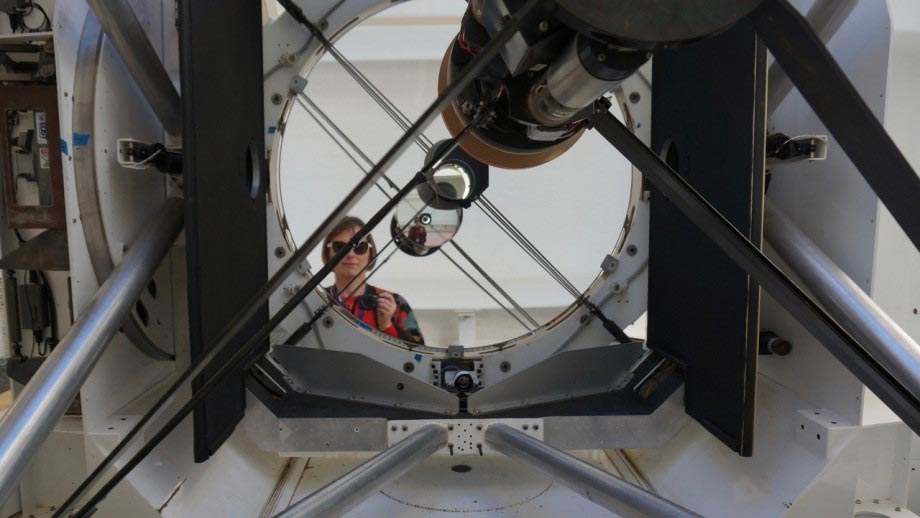
EOS will now commercialize the new guide star laser technology, which could also be incorporated in tool kits to enable high-bandwidth ground to space satellite communications.
The laser beams used for tracking space junk use infrared light and aren’t visible. In contrast, the new guide star laser, which is mounted on a telescope, propagates a visible orange beam into the night sky to create an artificial star that can be used to accurately measure light distortion between Earth and space.
Targeting Debris with Precision and Power
This guiding orange light enables adaptive optics to sharpen images of space debris. It can also guide a second, more powerful infra-red laser beam through the atmosphere to precisely track space debris or even safely move them out of orbit to avoid collisions with other debris and eventually burn up in the atmosphere.
Lead researcher, Professor Celine D’Orgeville from ANU, says adaptive optics is like “removing the twinkle from the stars.”
“But that’s a good thing,” Professor D’Orgeville said.
Sharpening the View of Space Junk
“Without adaptive optics, a telescope sees an object in space like a blob of light. This is because our atmosphere distorts the light traveling between the Earth and those objects.
“But with adaptive optics, these objects become easier to see and their images become a lot sharper. Essentially, adaptive optics cuts through the distortion in our atmosphere, making sure we can clearly see the incredible images our powerful telescopes capture.
“This includes small, human-made objects — like weather and communication satellites, or space junk.
“That’s why this development is such an important breakthrough when it comes to our efforts to clear our night skies of the ever-increasing clutter of space debris.”
The EOS guide star laser and the ANU adaptive optics systems are located at the ANU Mount Stromlo Observatory in Canberra, Australia.
The ANU researchers will now work with EOS to test the new technology and apply it to a range of other applications including laser communications between the Earth and space.
It’s an exciting development that will help to safeguard the wide range of vital applications of space technology in the 21st century.
The research was funded by the Australian Government’s Cooperative Research Centre Program, EOS, ANU, RMIT University and partners in Japan and the USA.
Never miss a breakthrough: Join the SciTechDaily newsletter.
Follow us on Google and Google News.
33 Comments
That is great to dispose of space garbage
But what about the life time waste from nuclear systems, They want to keep filling up space on earth, When they could be putting some of it on space vehicles and sending it into the sun,
Every maned and non maned space trip could have some radioactive rods and sent into the sun
NO DAMN EXCUSES FOR NOT DOING THIS
Shouldnt be sending anything into space unless its retrievable when its expired ..not only has the human race filled this planet with its unwanted junk we have now surrounded the planet above with our discarded junk absolutely unecceptable and irresponsible
They thought about it but launches have a pretty high failure rate and in the event of one you’d have nuclear waste spread out in a large area
I not sure but it has to do with money and safety of astronauts and the fact that vaporising nuclear waste in the sun is like pissing into the wind quite literally
Too risky. Radiation from an explosion in the atmosphere would be deviating to the entire world. How is this not obvious to you.
Except it is really really hard to put anything into the sun. Look up orbital mechanics and figure out how much fuel it would take to put something into the sun and you will see why we do not do that
Sending nuclear materials,to impacted
On the sun would be an option, but as
Some have said, not a responsible option. The journey really isn’t to
Impossible? Once launched cleared earth enroute gravity would do the rest the magnetic pull of the sun would, provide the rest of the need to get there.perhaps a light year away
On a distant system or a non M class
Planetary .
for the love of God it’s not easy to fly into the sun. also we loose all the useful resources in the rocket as well
The Earth is traveling at about 67,000 MPH. I don’t have the math background to understand how to calculate orbital trajectories, but even I understand it’s not so easy to bleed off that speed and send something directly into the sun. Mostly all our solar system travel is boosting vehicles to a greater orbit around the sun, but they are not going straight out, they orbit around and around. Trying to figure out how to make your space machine’s orbit intersect and match that of another planet is not an easy calculation.
Maybe you make a tractor beam to pull in space debris junk on earth or round up space junk in space and tow it to the sun using the suns rays to power a lazer propulsion system ion beam magnetic collider’s system that will power the space craft
The more we know and have the knowledge of everything and the more we ruin. Do they ever ask questions before they create something to be harmful to the environment, earth, and humanities?
But purposely detonating nuclear weapons for “tests” is any better? Or burying it for that matter an different?
The comments on this are hilariously stupid.
Pushing satellites into the sun would be a massive waste, and entirely unpractical. Nuclear irradiation of the upper stratosphere is not as catastrophic as you claim. The biggest issue with this system would be accidentally knocking an object into the tens of thousands of new satellites that 4 different countries propose sending up for global internet.
I am in awe that so many people know so much about everything. And they all want to grace us with their thoughts and opinions. If only some of you would move to Facebook and Twitter and enlightening millions more.
So…law of conservation of matter and energy. Our earth is a perfect balance, what happens to that balance as we keep sending our resources “away”
It doesn’t come back. Nothing is created or destroyed it merely “changes state” We can’t keep sending “matter and energy” into space. The resources of this earth are limited.
They likely are sending other junk into space already, we just don’t know about most of it. It will cause people to fight it and for good reasons. Instead of some here saying “throw garbage into space and leave earth alone” is not a responsible solution. Considering its VERY likely humans will need to leave earth and chose another planet(or space itself) tossing it up there really isn’t the answer. It’s bad enough earth is destroyed and no longer fixable, so why should anyone be polluting space? Nope.
Extremely interesting ideas here. Ignoring the ethical reasons why we prolly should not shoot nuclear waste into the sun I’m very interested the practical debate of these actions. Would it not be similar to shooting a torpedo out of a submarine. Do you need a fancy rocket to carry nuclear waste into sun or would not the gravity and inertia of a “space torpedo” being fired from space not from earth carry it the rest of the way without the need for propulsion.
The space agency needs to set up a team before august 2021. They need to address the current Situation of space junk leftover that is blocking astronomical. Observations. Those who put the junk up there,should be responsible for the removal of it. This should be done as soon asap. They won’t be able to see incoming astroids,etc..in time to warn us. Thank you c.lane
I’m Travis GUY KM UR NET BUILDER
until space we fill it with garbage, in a little while there is the solar system full of garbage made by us, in fact we have already started to fill it … we have already sent garbage to half of the planets in the system.
The new nuclear plants that are research by Bill Gates not only focus on safety but also will use the waste generated by the old (current ones).
Sad and ridiculous! We have polluted this earth and it’s resources in a very short time and in less than 40 years, polluted space. It’s gotta stop.
How cruel and selfish we are we haven’t leave the even space from our polluting nature
But it was not explained as to how the lasers can move space junk out of orbit and reduce clutter and is it a solution for all space junk.
The cost and hazards seem like legitimate reasons to not do it for now. Maybe when it’s cheaper and safer.
Why does it have to be the Sun and why do we care if Venus or Mars is full of our trash? By the time it has the potential to constrain us we’ll look at that trash as a resource.
They went from a magnet to a laser.
They about to kill us Star Wars style.
I suppose your going to tell us next that all the rubbish we have dumped in space will be moved by lazer beam to the Moon where it will be sorted, packaged up and sent to Mars for recycling. At least we will be safe in the knowledge that the guard Doges Elon has will keep the Aliens from stealing our precious junk.
Have used this pic as reference to how many tickets we’ve sent burning through the atmosphere,creating another stresser on our Planet. Never mind the ‘space disaster’ if they were all to lose their computer monitored & maintained orbits because of a giant Sun flare.
I don’t see how a laser is a viable solution.
Go get the junk and physically remove it. Recycle it. On Earth.
It’s your fault it’s there anyway. Make it a two decade long project or more. It doesn’t matter how long it takes. Employ people to do it. While they’re at it they can add recycling on earth as a priority too. Who knows they may come up with better solutions to suit both problems.
None of US made that decision. Everyone on this topic says “we” there’s no ‘we!’ It’s them! The leaders of America, China, Japan, Russia, Europe! The corporations, the boards of snooty, rich control freaks that for some reason no one holds responsible for their ‘executive’ decisions! Them, not us. We need to look back and hold the correct people responsible.
Charge them for the cleanup. The idiots who think there are no consequences to their actions because they have money. Well, it’s time they used that money to fix their mess!
Keep in mind, a lot of space debris are things like flecks of paint, urine and feces discarded by the early astronauts and other things no one thought about it’s accumulative effects. It’s not all big stuff but can do big damage at 17,500 MPH.
I don’t like the idea of a device existing with the ability to remove space junk. Who decides what is junk? The temptation to weaponize it for nefarious purposes will drive some gov’t’s to spend huge sums of $$.
I have brain damage from reading this comments section
David, you can’t just launch nuclear waste up to space, it can come back, that thing gravity, plus what if the rocket cashes or explodes!! We’d really be in a bind…