
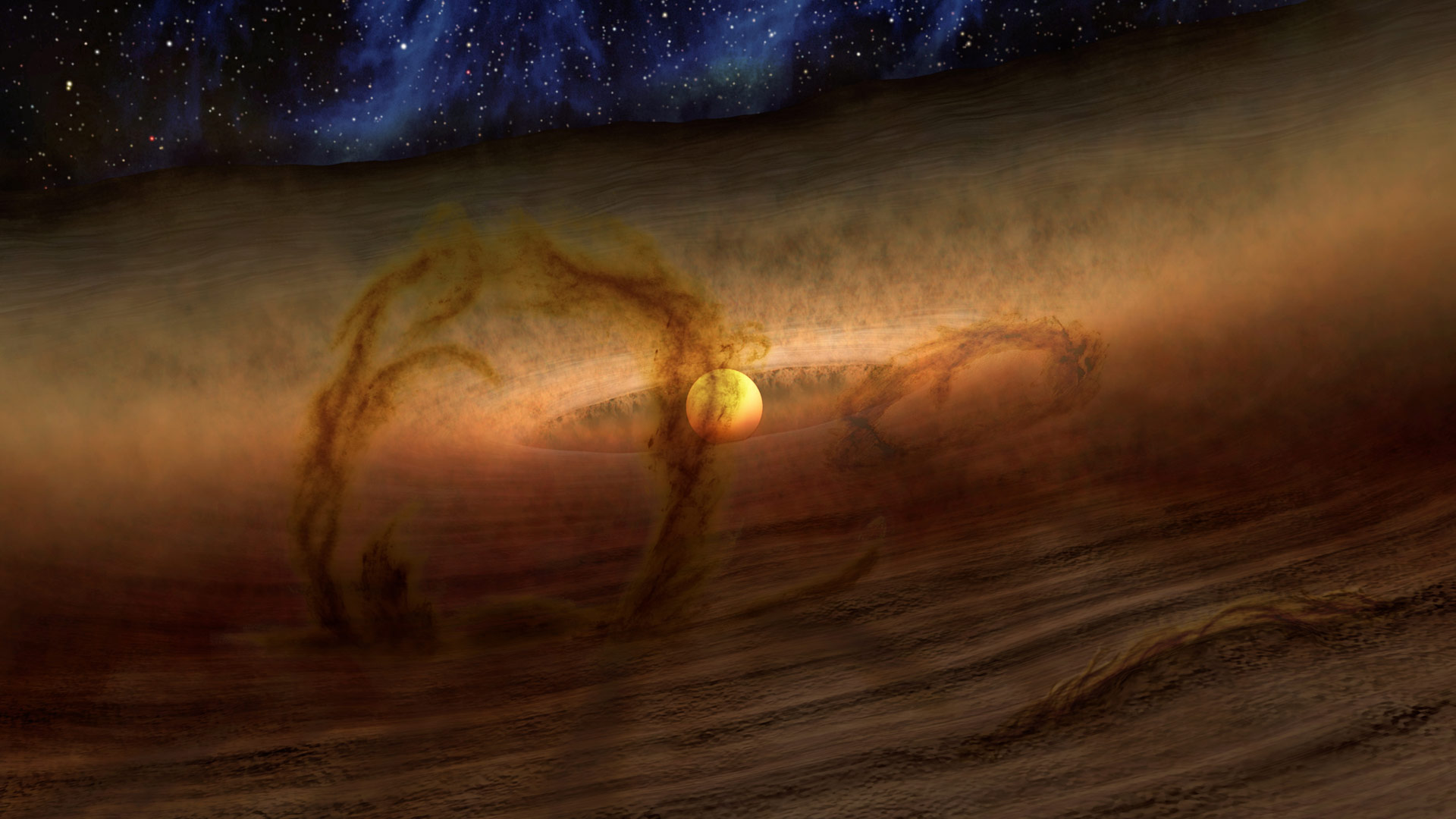
Using data from NASA’s Spitzer Space Telescope, researchers have developed a new theory explaining the mystery of planet-forming disks that circle the young stars.
Astronomers say that magnetic storms in the gas orbiting young stars may explain a mystery that has persisted since before 2006.
Researchers using NASA’s Spitzer Space Telescope to study developing stars have had a hard time figuring out why the stars give off more infrared light than expected. The planet-forming disks that circle the young stars are heated by starlight and glow with infrared light, but Spitzer detected additional infrared light coming from an unknown source.
A new theory, based on three-dimensional models of planet-forming disks, suggests the answer: Gas and dust suspended above the disks on gigantic magnetic loops like those seen on the sun absorb the starlight and glow with infrared light.
“If you could somehow stand on one of these planet-forming disks and look at the star in the center through the disk atmosphere, you would see what looks like a sunset,” said Neal Turner of NASA’s Jet Propulsion Laboratory, Pasadena, California.
The new models better describe how planet-forming material around stars is stirred up, making its way into future planets, asteroids, and comets.
While the idea of magnetic atmospheres on planet-forming disks is not new, this is the first time they have been linked to the mystery of the observed excess infrared light. According to Turner and colleagues, the magnetic atmospheres are similar to what takes place on the surface of our sun, where moving magnetic field lines spur tremendous solar prominences to flare up in big loops.
Stars are born out of collapsing pockets in enormous clouds of gas and dust, rotating as they shrink down under the pull of gravity. As a star grows in size, more material rains down toward it from the cloud, and the rotation flattens this material out into a turbulent disk. Ultimately, planets clump together out of the disk material.
In the 1980s, the Infrared Astronomical Satellite mission, a joint project that included NASA, began finding more infrared light than expected around young stars. Using data from other telescopes, astronomers pieced together the presence of dusty disks of planet-forming material. But eventually, it became clear the disks alone weren’t enough to account for the extra infrared light — especially in the case of stars a few times the mass of the sun.
One theory introduced the idea that instead of a disk, the stars were surrounded by a giant dusty halo, which intercepted the star’s visible light and re-radiated it at infrared wavelengths. Then, recent observations from ground-based telescopes suggested that both a disk and a halo were needed. Finally, three-dimensional computer modeling of the turbulence in the disks showed the disks ought to have fuzzy surfaces, with layers of low-density gas supported by magnetic fields, similar to the way solar prominences are supported by the sun’s magnetic field.
The new work brings these pieces together by calculating how the starlight falls across the disk and its fuzzy atmosphere. The result is that the atmosphere absorbs and re-radiates enough to account for all the extra infrared light.
“The starlight-intercepting material lies not in a halo, and not in a traditional disk either, but in a disk atmosphere supported by magnetic fields,” said Turner. “Such magnetized atmospheres were predicted to form as the disk drives gas inward to crash onto the growing star.”
Over the next few years, astronomers will further test these ideas about the structure of the disk atmospheres by using giant ground-based telescopes linked together as interferometers. An interferometer combines and processes data from multiple telescopes to show details finer than each telescope can see alone. Spectra of the turbulent gas in the disks will also come from NASA’s SOFIA telescope, the Atacama Large Millimeter/submillimeter Array (ALMA) telescope in Chile, and from NASA’s James Webb Space Telescope after its launch in 2018.
JPL manages the Spitzer Space Telescope mission for NASA’s Science Mission Directorate, Washington. Science operations are conducted at the Spitzer Science Center at the California Institute of Technology in Pasadena. Spacecraft operations are based at Lockheed Martin Space Systems Company, Littleton, Colorado. Data are archived at the Infrared Science Archive housed at the Infrared Processing and Analysis Center at Caltech. Caltech manages JPL for NASA.
References:
“Transport and Accretion in Planet-Forming Disks” by N. J. Turner, S. Fromang, C. Gammie, H. Klahr, G. Lesur, M. Wardle and X.-N. Bai, 28 Jan 2014, Protostars and Planets VI.
DOI: 10.2458/azu_uapress_9780816531240-ch018
arXiv:1401.7306
“CSI 2264: Characterizing Accretion-Burst Dominated Light Curves for Young Stars in NGC 2264” by John Stauffer, Ann Marie Cody, Annie Baglin, Silvia H. P. Alencar, Luisa Rebull, Lynne A. Hillenbrand, Laura Venuti, Neal J. Turner, John Carpenter, Peter Plavchan, Krzysztof Findeisen, Sean Carey, Susan Terebey, María Morales-Calderón, Jerome Bouvier, Giusi Micela, Ettore Flaccomio, Inseok Song, Rob Gutermuth, Lee Hartmann, Nuria Calvet, Barbara Whitney, David Barrado, Frederick J. Vrba, Kevin Covey, William Herbst, Gabor Furesz and Suzanne Aigrain, 13 March 2014, The Astrophysical Journal.
DOI: 10.1088/0004-6256/147/4/83
arXiv:1401.6600
“CSI 2264: Simultaneous optical and infrared light curves of young disk-bearing stars in NGC 2264 with CoRoT and Spitzer– evidence for multiple origins of variability” by Ann Marie Cody, John Stauffer, Annie Baglin, Giuseppina Micela, Luisa M. Rebull, Ettore Flaccomio, María Morales-Calderón, Suzanne Aigrain, Jèrôme Bouvier, Lynne A. Hillenbrand, Robert Gutermuth, Inseok Song, Neal Turner, Silvia H. P. Alencar, Konstanze Zwintz, Peter Plavchan, John Carpenter, Krzysztof Findeisen, Sean Carey, Susan Terebey, Lee Hartmann, Nuria Calvet, Paula Teixeira, Frederick J. Vrba, Scott Wolk, Kevin Covey, Katja Poppenhaeger, Hans Moritz Günther, Jan Forbrich, Barbara Whitney, Laura Affer, William Herbst, Joseph Hora, David Barrado, Jon Holtzman, Franck Marchis, Kenneth Wood, Marcelo Medeiros Guimarães, Jorge Lillo Box, Ed Gillen, Amy McQuillan, Catherine Espaillat, Lori Allen, Paola D’Alessio and Fabio Favata, 13 March 2014, The Astrophysical Journal.
DOI: 10.1088/0004-6256/147/4/82
arXiv:1401.6582
Never miss a breakthrough: Join the SciTechDaily newsletter.
Follow us on Google and Google News.