
Close Menu
    Facebook X (Twitter) Instagram
    SciTechDaily
    • Biology
    • Chemistry
    • Earth
    • Health
    • Physics
    • Science
    • Space
    • Technology
    Facebook X (Twitter) Pinterest YouTube RSS
    SciTechDaily
    Home»Technology»New Molecule Supercharges Perovskite Solar Cells for Higher Efficiency and Stability
    Technology

    New Molecule Supercharges Perovskite Solar Cells for Higher Efficiency and Stability

    By King Abdullah University of Science & Technology (KAUST)April 28, 20252 Comments3 Mins Read
    Facebook Twitter Pinterest Telegram LinkedIn WhatsApp Email Reddit
    Share
    Facebook Twitter LinkedIn Pinterest Telegram Email Reddit
    Solar Cell Research
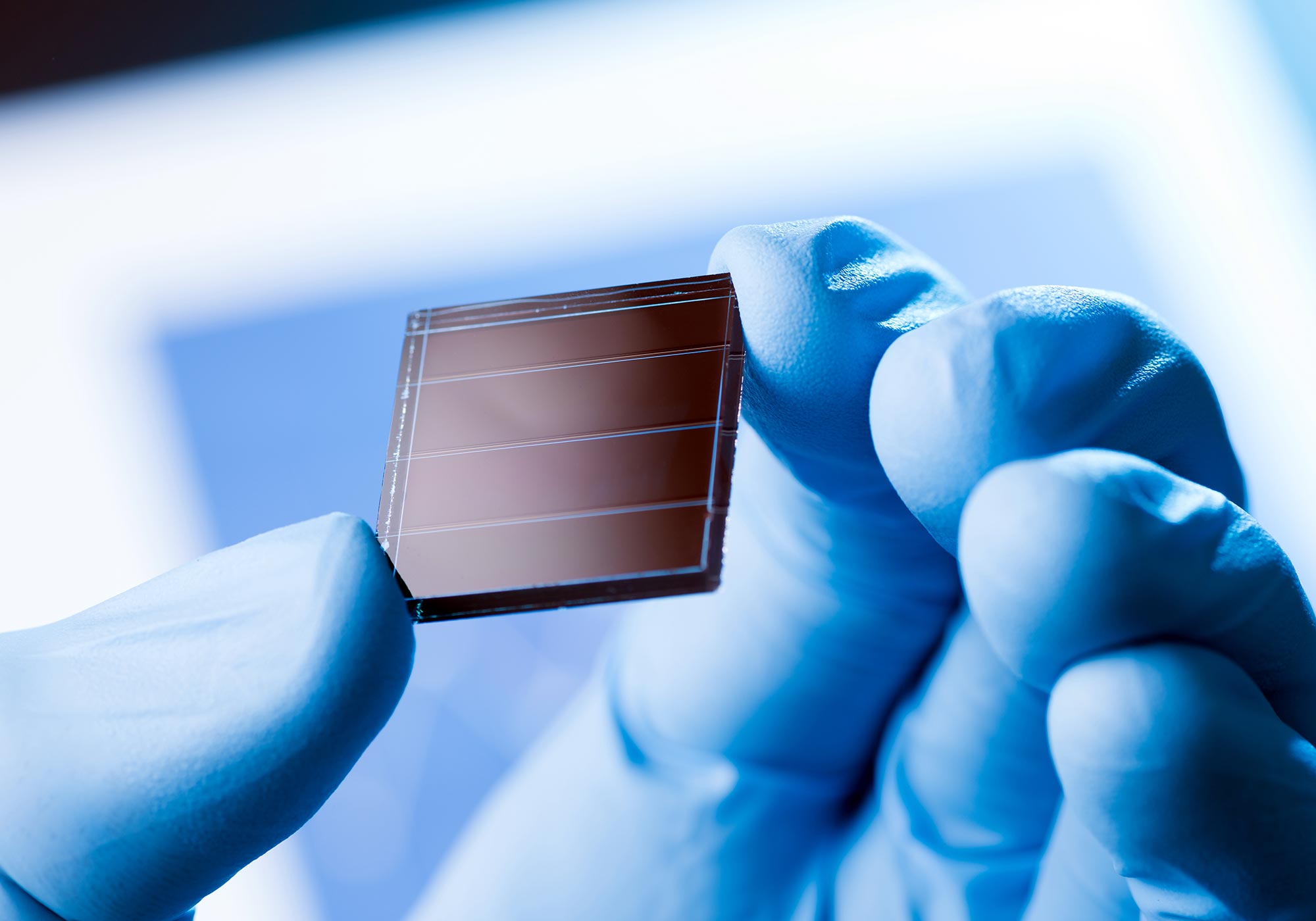
    A new study shows that the synthetic molecule CPMAC, developed from buckminsterfullerene (C₆₀), significantly improves the energy efficiency and durability of perovskite solar cells. By forming stronger ionic bonds with the perovskite material, CPMAC enhances the electronic properties of the cells and minimizes mechanical degradation.

    KAUST is part of an international collaboration that has demonstrated how an ionic salt molecule, known as CPMAC, can significantly boost solar cell performance by 0.6%.

    A new study published in Science reveals that integrating a synthetic molecule significantly improves the energy efficiency and lifespan of perovskite solar cells. The molecule, called CPMAC, was developed through an international collaboration that included researchers from King Abdullah University of Science and Technology (KAUST).

    CPMAC is an ionic salt synthesized from buckminsterfullerene, a black, carbon-based material composed of 60 atoms, commonly referred to as C60. While C60 has helped perovskite solar cells achieve record-breaking energy efficiencies, it also poses challenges by limiting the cells’ overall performance and long-term stability. To overcome these limitations, scientists have been investigating alternative materials, leading to the development of CPMAC.

    “For over a decade, C₆₀ has been an integral component in the development of perovskite solar cells. However, weak interactions at the perovskite/C₆₀ interface lead to mechanical degradation that compromises long-term solar cell stability. To address this limitation, we designed a C₆₀-derived ionic salt, CPMAC, to significantly enhance the stability of the perovskite solar cells,” explained Professor Osman Bakr, Executive Faculty of the KAUST Center of Excellence for Renewable Energy and Sustainable Technologies (CREST), who led the KAUST contributions to the research.
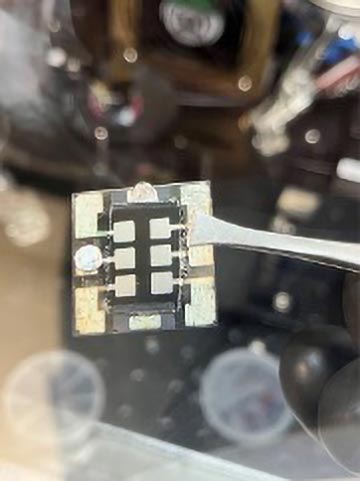
    Perovskite Solar Cell Made With CPMAC
    A perovskite solar cell made with CPMAC. Credit: King Abdullah University of Science and Technology

    Performance Improvements with CPMAC

    The chemistry of CPMAC improved the electronic properties of the solar cells. Cells with CPMAC had a power conversion efficiency – a standard metric used to evaluate the energy efficiency of solar cells – that was 0.6% higher than solar cells built with C60.

    If the average power plant produces 1 gigawatt of power, then less than a 1% difference would still be enough to power 5,000 extra homes.

    “When we deal with the scale of a typical power station, the additional electricity generated even from a fraction of a percentage point is quite significant,” said Hongwei Zhu, a research scientist at KAUST who also contributed to the study.

    Furthermore, CPMAC solar cells showed a drop in their power conversion efficiency that was one-third that of C60 solar cells when the two types were exposed to hot temperatures at different humidities for over 2,000 hours, a benchmark for testing the stability of solar cells.

    The difference between the two types became more apparent upon assembling them into modules consisting of four solar cells, a simplified model of a solar panel, which generally consists of somewhere between 50 to 100 cells.

    These benefits were attributed to CPMAC reducing defects in a key component of the solar cell known as the electron transfer layer by creating ionic bonds with the perovskite rather than the weaker van der Waals bonds made with C60.

    Reference: “C60-based ionic salt electron shuttle for high-performance inverted perovskite solar modules” by Shuai You, Hongwei Zhu, Zhongjin Shen, Xiaoming Wang, Bingyao Shao, Qingxiao Wang, Jianxun Lu, Youyou Yuan, Benjia Dak Dou, Erin M. Sanehira, Todd Russell, Adam Lorenz, Yifan Dong, Lei Chen, Marco Casareto, Nicholas Rolston, Matthew C. Beard, Joseph J. Berry, Marina Freitag, Yanfa Yan, Osman M. Bakr and Kai Zhu, 17 April 2025, Science.
    DOI: 10.1126/science.adv4701

    Never miss a breakthrough: Join the SciTechDaily newsletter.
    Follow us on Google and Google News.

    Energy KAUST Perovskite Solar Cell Photovoltaics Solar Cells
    Share. Facebook Twitter Pinterest LinkedIn Email Reddit

    Related Articles

    Revolutionizing the Future of Energy: Advancement in Halide Perovskite Solar Cell Technology

    Innovative Technology Offers Big Performance Boost to Perovskite–Silicon Tandem Solar Cells

    The Michael Jordan of Solar Cells: New Technology Proves Its Lasting Power

    Artificial Intelligence Helps Scale Up Advanced Solar Cell Manufacturing

    Researchers Set New World Record for Solar Cell Efficiency

    Predicting Semiconductor Solar Cell Performance From Terahertz and Microwave Spectroscopy

    Solar Modules With a Marble Look for House Facades

    Templating Approach Stabilizes “Ideal” Perovskite Material for Cheap, Efficient Solar Cells

    New Efficiency Record Set by Novel Multi-Material Solar Cells

    2 Comments

    1. kamir bouchareb st on April 29, 2025 1:14 am

      thank you for this

      Reply
    2. Boba on April 29, 2025 4:24 pm

      Another “lab news” that is never gonna hit the retail.

      Reply
    Leave A Reply Cancel Reply

    • Facebook
    • Twitter
    • Pinterest
    • YouTube

    Don't Miss a Discovery

    Subscribe for the Latest in Science & Tech!

    Trending News

    Scientists Discover Game-Changing New Way To Treat High Cholesterol

    This Small Change to Your Exercise Routine Could Be the Secret to Living Longer

    Scientists Discover 430,000-Year-Old Wooden Tools, Rewriting Human History

    AI Could Detect Early Signs of Alzheimer’s in Under a Minute – Far Before Traditional Tests

    What if Dark Matter Has Two Forms? Bold New Hypothesis Could Explain a Cosmic Mystery

    This Metal Melts in Your Hand – and Scientists Just Discovered Something Strange

    Beef vs. Chicken: Surprising Results From New Prediabetes Study

    Alzheimer’s Breakthrough: Scientists Discover Key Protein May Prevent Toxic Protein Clumps in the Brain

    Follow SciTechDaily
    • Facebook
    • Twitter
    • YouTube
    • Pinterest
    • Newsletter
    • RSS
    SciTech News
    • Biology News
    • Chemistry News
    • Earth News
    • Health News
    • Physics News
    • Science News
    • Space News
    • Technology News
    Recent Posts
    • Scientists Reveal Why a Common Drug Causes Birth Defects and Autism
    • A Medieval Japanese Diary Just Helped Scientists Detect a Dangerous Solar Event
    • Humans Returned to Britain 500 Years Earlier Than Scientists Thought
    • 250-Million-Year-Old Egg Solves One of Evolution’s Biggest Mysteries
    • Living With Roommates Might Be Changing Your Gut Microbiome Without You Knowing
    Copyright © 1998 - 2026 SciTechDaily. All Rights Reserved.
    • Science News
    • About
    • Contact
    • Editorial Board
    • Privacy Policy
    • Terms of Use

    Type above and press Enter to search. Press Esc to cancel.