
Close Menu
    Facebook X (Twitter) Instagram
    SciTechDaily
    • Biology
    • Chemistry
    • Earth
    • Health
    • Physics
    • Science
    • Space
    • Technology
    Facebook X (Twitter) Pinterest YouTube RSS
    SciTechDaily
    Home»Space»New NASA Mission Will Study Giant Solar Particle Storms With 6 Spacecraft
    Space

    New NASA Mission Will Study Giant Solar Particle Storms With 6 Spacecraft

    By NASA / Jet Propulsion LaboratoryApril 5, 2020No Comments4 Mins Read
    Facebook Twitter Pinterest Telegram LinkedIn WhatsApp Email Reddit
    Share
    Facebook Twitter LinkedIn Pinterest Telegram Email Reddit
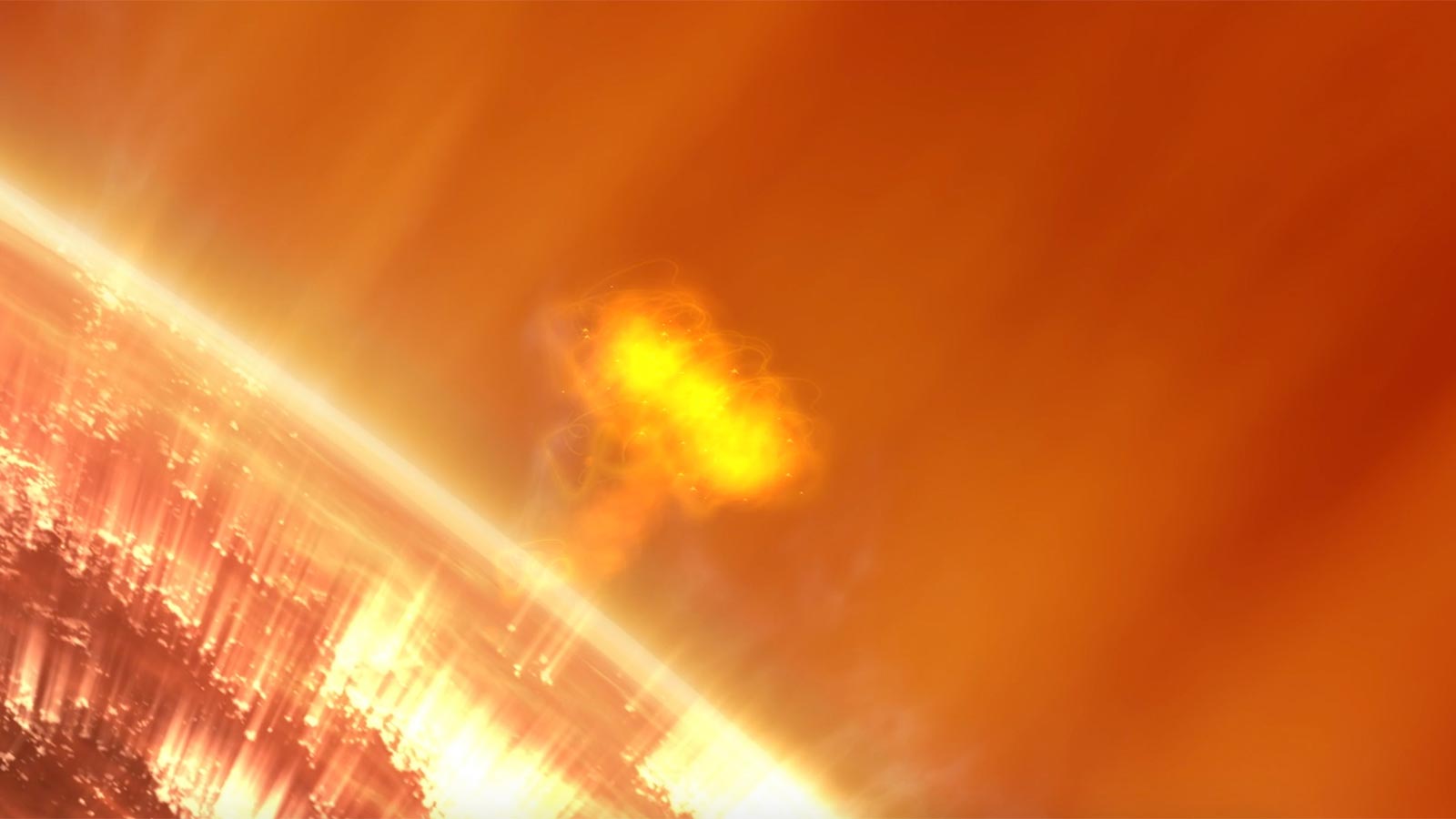
    NASA SunRISE Mission Solar Particle Storms
    A new NASA mission called SunRISE will study what drives solar particle storms — giant surges of solar particles that erupt off of the Sun — as depicted in this illustration. Understanding how such storms affect interplanetary space can help protect spacecraft and astronauts. Credit: NASA

    An array of six spacecraft, each about the size of a toaster oven, will help us understand our nearest star and better protect astronauts traveling beyond Earth.

    NASA has selected a new mission to study how the Sun generates and releases giant space weather storms — known as solar particle storms — into planetary space. Not only will such information improve understanding of how our solar system works, but it ultimately can help protect astronauts traveling to the Moon and Mars by providing better information on how the Sun’s radiation affects the space environment they must travel through.

    The new mission, called the Sun Radio Interferometer Space Experiment (SunRISE), is an array of six CubeSats operating as one very large radio telescope. NASA has awarded $62.6 million to design, build and launch SunRISE by no earlier than July 1, 2023.

    NASA chose SunRISE in August 2017 as one of two Mission of Opportunity proposals to conduct an 11-month mission concept study. In February 2019, the agency approved a continued formulation study of the mission for an additional year. SunRISE is led by Justin Kasper at the University of Michigan in Ann Arbor and managed by NASA’s Jet Propulsion Laboratory (JPL) in Pasadena, California.

    “We are so pleased to add a new mission to our fleet of spacecraft that help us better understand the Sun, as well as how our star influences the space environment between planets,” said Nicky Fox, director of NASA’s Heliophysics Division. “The more we know about how the Sun erupts with space weather events, the more we can mitigate their effects on spacecraft and astronauts.”

    The mission design relies on six solar-powered CubeSats — each about the size of a toaster oven — to simultaneously observe radio images of low-frequency emission from solar activity and share them via NASA’s Deep Space Network. The constellation of CubeSats will fly within 6 miles (10 kilometers) of each other, above Earth’s atmosphere, which otherwise blocks the radio signals SunRISE will observe. Together, the six CubeSats will create 3D maps to pinpoint where giant particle bursts originate on the Sun and how they evolve as they expand outward into space. This, in turn, will help determine what initiates and accelerates these giant jets of radiation. The six individual spacecraft will also work together to map, for the first time, the pattern of magnetic field lines reaching from the Sun out into interplanetary space.

    NASA’s Missions of Opportunity maximize science return by pairing new, relatively inexpensive missions with launches on spacecraft already approved and preparing to go into space. SunRISE proposed an approach for access to space as a hosted rideshare on a commercial satellite provided by Maxar of Westminster, Colorado, and built with a Payload Orbital Delivery System, or PODS. Once in orbit, the host spacecraft will deploy the six SunRISE spacecraft and then continue its prime mission.

    Missions of Opportunity are part of the Explorers Program, which is the oldest continuous NASA program designed to provide frequent, low-cost access to space using principal investigator-led space science investigations relevant to the Science Mission Directorate’s (SMD) astrophysics and heliophysics programs. The program is managed by NASA’s Goddard Space Flight Center in Greenbelt, Maryland, for SMD, which conducts a wide variety of research and scientific exploration programs for Earth studies, space weather, the solar system, and universe.

    Never miss a breakthrough: Join the SciTechDaily newsletter.
    Follow us on Google and Google News.

    JPL NASA Popular Sun SunRISE
    Share. Facebook Twitter Pinterest LinkedIn Email Reddit

    Related Articles

    NASA’s SunRISE Mission: Six Mini-Satellites Set To Illuminate Solar Mysteries

    NASA’s Nuclear Spectroscopic Telescope Array Reveals Hidden Light Shows on the Sun

    First of NASA’s SunRISE Satellites Complete – Will Track Hazardous Explosive Space Weather Events

    US Space Force Releases Decades of “Fireballs” Data to NASA for Planetary Defense Studies

    NASA’s Curiosity Mars Rover Reroutes Away From Knife-Edged “Gator-Back” Rocks

    NASA Skywatching Tips for April 2022: Conjunction Junction and a Hidden Surprise in the Big Dipper

    What Mercury’s Unusual Orbit Reveals About the Sun [Video]

    Powerful Solar Flare Erupts From Sun – Captured by NASA’s Solar Dynamics Observatory

    NASA SPHEREx Mission: Finalized Plans for a Cutting-Edge Cosmic Mapmaker

    Leave A Reply Cancel Reply

    • Facebook
    • Twitter
    • Pinterest
    • YouTube

    Don't Miss a Discovery

    Subscribe for the Latest in Science & Tech!

    Trending News

    The Strange “Spacetime Crystal” That Can Suddenly Turn Into a Black Hole

    The Surprising Way Asteroids May Have Helped Life Begin on Earth

    Vast Hidden Structure Discovered Under Miles of Ice in East Antarctica

    A Surprising Discovery Suggests Autism Is Not One Condition

    New Alzheimer’s Discovery Could Change How Scientists Fight the Disease

    Yale Discovery Overturns Long-Held “Evolutionary Dead End” Theory

    UCLA Scientists Uncover a “Hidden Weakness” in Some of the World’s Deadliest Cancers

    Humpback Whale Stuns Scientists With 15,000 Kilometer Journey Across Oceans

    Follow SciTechDaily
    • Facebook
    • Twitter
    • YouTube
    • Pinterest
    • Newsletter
    • RSS
    SciTech News
    • Biology News
    • Chemistry News
    • Earth News
    • Health News
    • Physics News
    • Science News
    • Space News
    • Technology News
    Recent Posts
    • Meet the Artemis III Astronauts Preparing for NASA’s Boldest Moon Mission Yet
    • Scientists Develop a New Way To Measure Gravitational Waves in the Expanding Universe
    • MIT’s New Dual-Mode Rocket System Could Send Tiny Satellites to Mars
    • Scientists Discover a Biological Clock Unlike Anything Seen Before
    • This “Zombie” Sea Creature Keeps Growing After Being Cut Apart
    Copyright © 1998 - 2026 SciTechDaily. All Rights Reserved.
    • Science News
    • About
    • Contact
    • Editorial Board
    • Privacy Policy
    • Terms of Use

    Type above and press Enter to search. Press Esc to cancel.