
Cell therapies hold great promise for revolutionizing the treatment of cancers and autoimmune diseases. But this multibillion-dollar industry requires long-term storage of cells at super-cold cryogenic conditions, while ensuring they’ll continue to function upon thawing. However, these cold temperatures trigger the formation and growth of ice, which can pierce and tear apart cells. Research published in the Journal of the American Chemical Society by University of Utah chemists Pavithra Naullage and Valeria Molinero provides the foundation to design efficient polymers that can prevent the growth of ice that damages cells.
Nature’s antifreeze
Current strategies to cryopreserve cells and organs involve bathing them with large amounts of dimethyl sulfoxide, a toxic chemical that messes up ice formation but stresses the cells, decreasing their odds for survival.
Nature, however, has found a way to keep organisms alive under extreme cold conditions: antifreeze proteins. Fish, insects and other cold-blooded organisms have evolved potent antifreeze glycoproteins that bind to ice crystallites and halt them from growing and damaging cells.
The growing area of cell-based therapeutics demands the development of potent inhibitors of ice recrystallization that can compete in activity with natural antifreeze glycoproteins but do not have the cost and toxicity of dimethyl sulfoxide. This demand has propelled the synthesis of polymers that mimic the action of antifreeze glycoproteins. But the most potent synthetic ice recrystallization inhibitor found to date, polyvinyl alcohol (PVA), is orders of magnitude less potent than natural glycoproteins.
“Efforts to identify stronger inhibitors for ice growth seem to have stalled, as there is not yet a molecular understanding of the factors that limit the ice recrystallization inhibition efficiency of polymers,” Molinero says.
A hidden polymer design variable
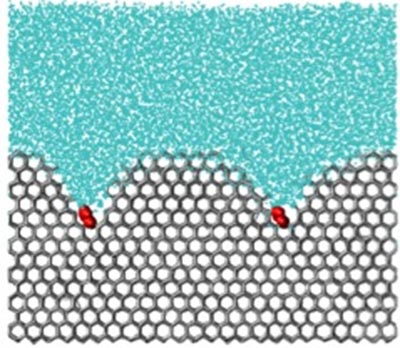
How do molecules prevent ice crystals from getting bigger? Molecules that bind strongly to ice pin its surface — like stones on a pillow — making the ice front develop a curved surface around the molecules. This curvature destabilizes the ice crystal, halting its growth. Molecules that stay bound to ice for times longer than the time it takes to grow ice crystals succeed in preventing further growth and recrystallization.
Molinero and Naullage used large-scale molecular simulations to elucidate the molecular underpinnings of how flexibility, length and functionalization of polymers control their binding to ice and their efficiency to prevent ice growth. Their study shows that the bound time of the molecules at the ice surface is controlled by the strength of their ice binding coupled with the length of the polymer and how fast they propagate on the ice surface.
“We found that the efficiency of flexible polymers in halting ice growth is limited by the slow propagation of their binding to ice,” Molinero says.
The study dissects the various factors that control the binding of flexible polymers to ice and that account for the gap in potency of PVA and natural antifreeze glycoproteins. In a nutshell, each block of antifreeze glycoproteins binds more strongly to ice than PVA does, and are also favored by their secondary molecular structure that segregates the binding and non-binding blocks to allow them to attach faster to ice to stop its growth.
“To our knowledge, this work is first to identify the time of propagation of binding as a key variable in the design of efficient ice-binding flexible polymers,” Naullage says. “Our study sets the stage for the de novo design of flexible polymers that can meet or even surpass the efficiency of antifreeze glycoproteins and make an impact in biomedical research.”
Reference: “Slow Propagation of Ice Binding Limits the Ice-Recrystallization Inhibition Efficiency of PVA and Other Flexible Polymers” by Pavithra M. Naullage and Valeria Molinero, 13 February 2020, Journal of the American Chemical Society.
DOI: 10.1021/jacs.9b12943
Never miss a breakthrough: Join the SciTechDaily newsletter.
Follow us on Google and Google News.
1 Comment
very good