
Close Menu
    Facebook X (Twitter) Instagram
    SciTechDaily
    • Biology
    • Chemistry
    • Earth
    • Health
    • Physics
    • Science
    • Space
    • Technology
    Facebook X (Twitter) Pinterest YouTube RSS
    SciTechDaily
    Home»Science»New Quantum-Mechanical Dissipation Mechanism Observed for the First Time
    Science

    New Quantum-Mechanical Dissipation Mechanism Observed for the First Time

    By University of BaselOctober 15, 2019No Comments3 Mins Read
    Facebook Twitter Pinterest Telegram LinkedIn WhatsApp Email Reddit
    Share
    Facebook Twitter LinkedIn Pinterest Telegram Email Reddit
    Measuring Friction with a Pendulum Crop
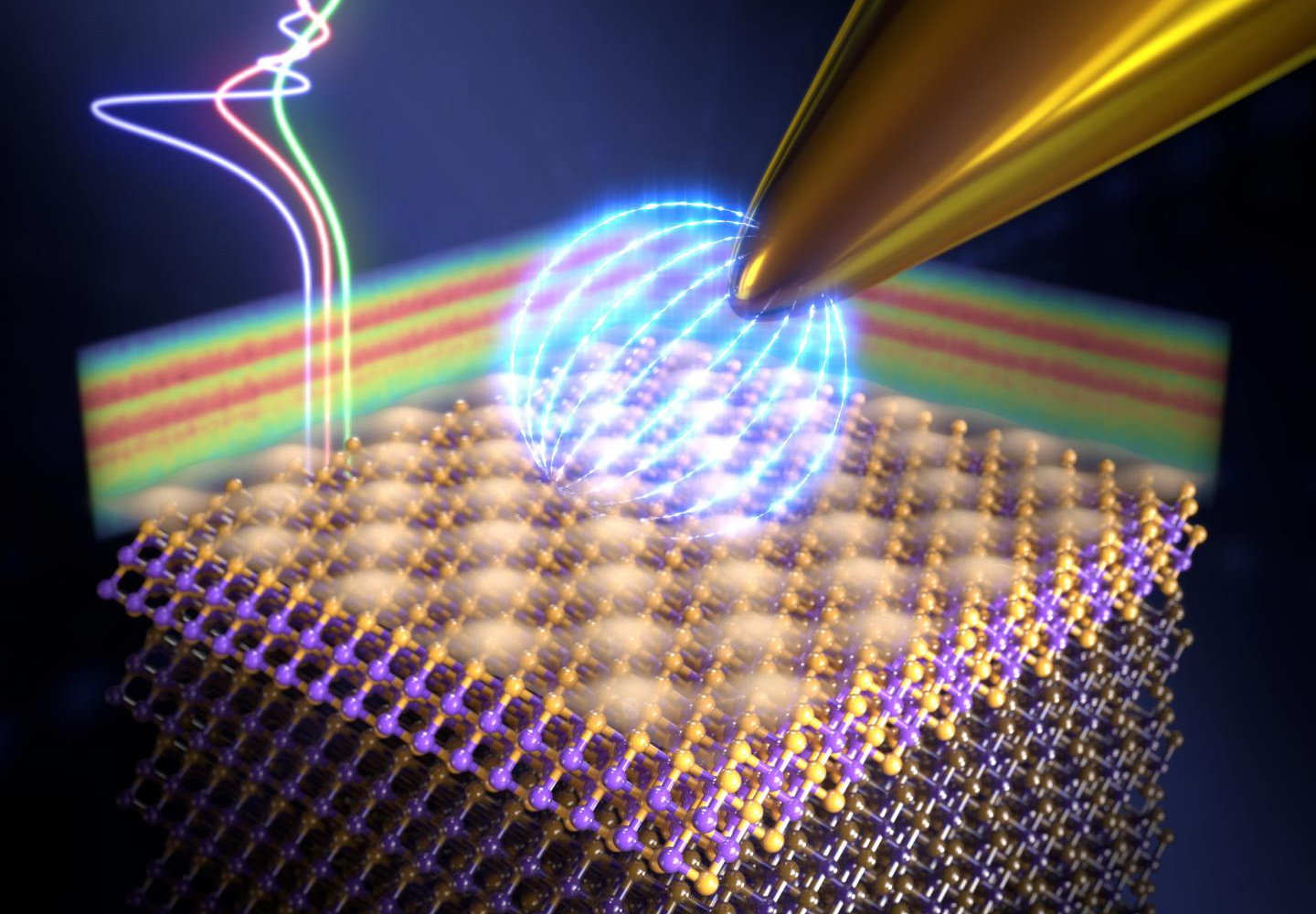
    The gold tip is moved across the surface of the topological insulator and experiences energy loss only at discrete, quantized energies. This is related to the image potential states that are formed over the conducting surface of the topological insulator. Credit: University of Basel, Departement of Physics

    How to control friction in topological insulators.

    Topological insulators are innovative materials that conduct electricity on the surface, but act as insulators on the inside. Physicists at the University of Basel and the Istanbul Technical University have begun investigating how they react to friction. Their experiment shows that the heat generated through friction is significantly lower than in conventional materials. This is due to a new quantum mechanism, the researchers report in the scientific journal Nature Materials.

    Thanks to their unique electrical properties, topological insulators promise many innovations in the electronics and computer industries, as well as in the development of quantum computers. The thin surface layer can conduct electricity almost without resistance, resulting in less heat than traditional materials. This makes them of particular interest for electronic components.

    “Our measurements clearly show that at certain voltages there is virtually no heat generation caused by electronic friction.” — Dr. Dilek Yildiz

    Furthermore, in topological insulators, the electronic friction – i.e. the electron-mediated conversion of electrical energy into heat – can be reduced and controlled. Researchers of the University of Basel, the Swiss Nanoscience Institute (SNI) and the Istanbul Technical University have now been able to experimentally verify and demonstrate exactly how the transition from energy to heat through friction behaves – a process known as dissipation.

    Measuring friction with a pendulum

    The team headed by Professor Ernst Meyer at the Department of Physics of the University of Basel investigated the effects of friction on the surface of a bismuth telluride topological insulator. The scientists used an atomic force microscope in pendulum mode. Here, the conductive microscope tip made of gold oscillates back and forth just above the two-dimensional surface of the topological insulator. When a voltage is applied to the microscope tip, the movement of the pendulum induces a small electrical current on the surface.

    In conventional materials, some of this electrical energy is converted into heat through friction. The result on the conductive surface of the topological insulator looks very different: the loss of energy through the conversion to heat is significantly reduced.

    “Our measurements clearly show that at certain voltages there is virtually no heat generation caused by electronic friction,” explains Dr. Dilek Yildiz, who carried out this work within the SNI Ph.D. School.

    A novel mechanism

    The researchers were also able to observe for the first time a new quantum-mechanical dissipation mechanism that occurs only at certain voltages. Under these conditions, the electrons migrate from the tip through an intermediate state into the material – similar to the tunneling effect in scanning tunneling microscopes. By regulating the voltage, the scientists were able to influence the dissipation. “These measurements confirm the great potential of topological insulators, since electronic friction can be controlled in a targeted manner,” adds Meyer.

    Reference: “Mechanical dissipation via image potential states on a topological insulator surface” by D. Yildiz, M. Kisiel, U. Gysin, O. Gürlü and E. Meyer, 14 October 2019, Nature Materials.
    DOI: 10.1038/s41563-019-0492-3

    Never miss a breakthrough: Join the SciTechDaily newsletter.
    Follow us on Google and Google News.

    Materials Science Nanomaterials Quantum Mechanics University of Basel
    Share. Facebook Twitter Pinterest LinkedIn Email Reddit

    Related Articles

    Scientists Discover Surprising Applications of Nanodiamonds

    Surprisingly, Molecules Move Faster on Rough Terrain

    Previously Unknown Capabilities of Common Materials Discovered by Big Data Analysis

    Scientists Develop an Ultrathin Invisibility Cloak

    Pillared Graphene Structures Gain Strength, Toughness and Ductility

    New Observations Reveal the Inner Workings of Lithium-Ion Batteries

    Experimental Evidence Shows New Boron Nanomaterial is Possible

    Researchers Demonstrate High Temperature Superconductivity in a Topological Insulator

    Hybrid Crystalline/Amorphous Material Capable of Indenting Diamonds

    Leave A Reply Cancel Reply

    • Facebook
    • Twitter
    • Pinterest
    • YouTube

    Don't Miss a Discovery

    Subscribe for the Latest in Science & Tech!

    Trending News

    Breakthrough Bowel Cancer Trial Leaves Patients Cancer-Free for Nearly 3 Years

    Natural Compound Shows Powerful Potential Against Rheumatoid Arthritis

    100,000-Year-Old Neanderthal Fossils in Poland Reveal Unexpected Genetic Connections

    Simple “Gut Reset” May Prevent Weight Gain After Ozempic or Wegovy

    2.8 Days to Disaster: Scientists Warn Low Earth Orbit Could Suddenly Collapse

    Common Food Compound Shows Surprising Power Against Superbugs

    5 Simple Ways To Remember More and Forget Less

    The Atomic Gap That Could Cost the Semiconductor Industry Billions

    Follow SciTechDaily
    • Facebook
    • Twitter
    • YouTube
    • Pinterest
    • Newsletter
    • RSS
    SciTech News
    • Biology News
    • Chemistry News
    • Earth News
    • Health News
    • Physics News
    • Science News
    • Space News
    • Technology News
    Recent Posts
    • Scientists Print Artificial Neurons That Can Talk to the Brain
    • Bowel and Ovarian Cancers Are Dramatically Rising in Young Adults and Scientists Aren’t Sure Why
    • Alzheimer’s May Begin Decades Earlier Than You Think, New Mayo Clinic Study Finds
    • The Hidden Risk of Taking Breaks From Weight-Loss Drugs Like Ozempic
    • Total Solar Eclipse Made Cities Go Eerily Quiet Beneath the Surface
    Copyright © 1998 - 2026 SciTechDaily. All Rights Reserved.
    • Science News
    • About
    • Contact
    • Editorial Board
    • Privacy Policy
    • Terms of Use

    Type above and press Enter to search. Press Esc to cancel.