
Close Menu
    Facebook X (Twitter) Instagram
    SciTechDaily
    • Biology
    • Chemistry
    • Earth
    • Health
    • Physics
    • Science
    • Space
    • Technology
    Facebook X (Twitter) Pinterest YouTube RSS
    SciTechDaily
    Home»Health»New Research Indicates That Atherosclerosis – Thought To Be Irreversible – Can Be Reversed
    Health

    New Research Indicates That Atherosclerosis – Thought To Be Irreversible – Can Be Reversed

    By Centro Nacional de Investigaciones Cardiovasculares Carlos III (F.S.P.)November 27, 2023No Comments5 Mins Read
    Facebook Twitter Pinterest Telegram LinkedIn WhatsApp Email Reddit
    Share
    Facebook Twitter LinkedIn Pinterest Telegram Email Reddit
    Atherosclerosis
    A new study reveals that young people are particularly susceptible to atherosclerosis from risk factors like high cholesterol and hypertension. Early and aggressive risk management is essential to prevent or reverse atherosclerosis, as shown in the comprehensive PESA-CNIC-Santander study. These findings are significant for personalized cardiovascular prevention and treatment strategies.

    Younger individuals are at a higher risk of experiencing the adverse cardiovascular effects associated with elevated blood cholesterol and hypertension.

    Younger individuals might be more vulnerable to the influences of risk factors that can lead to atherosclerosis. Research conducted by the Centro Nacional de Investigaciones Cardiovasculares (CNIC) indicates that younger populations are particularly vulnerable to the harmful consequences of high blood cholesterol and hypertension, which are among the key modifiable factors influencing cardiovascular health.

    These findings, published in the Journal of the American College of Cardiology, underline the need to implement aggressive control of cardiovascular risk factors at younger ages, requiring a change in primary prevention strategies to include “surveillance of subclinical atherosclerosis and early cardiovascular risk factor control.”

    The study was co-led by Dr. Valentín Fuster, CNIC General Director and Physician-in-Chief at Mount Sinai Medical Center in New York, and Dr. Borja Ibáñez, CNIC Scientific Director, a cardiologist at Hospital Universitario Fundación Jiménez Díaz, and a member of the CIBERCV cardiovascular research network in Spain.

    Progression of Subclinical Atherosclerosis

    Subclinical atherosclerosis often progresses in middle-aged individuals, especially if LDL-cholesterol levels and blood pressure are even mildly or moderately elevated. Medical professionals and the general public need to be aware that atherosclerosis progression can be stopped if risk factors are managed aggressively from an early age.
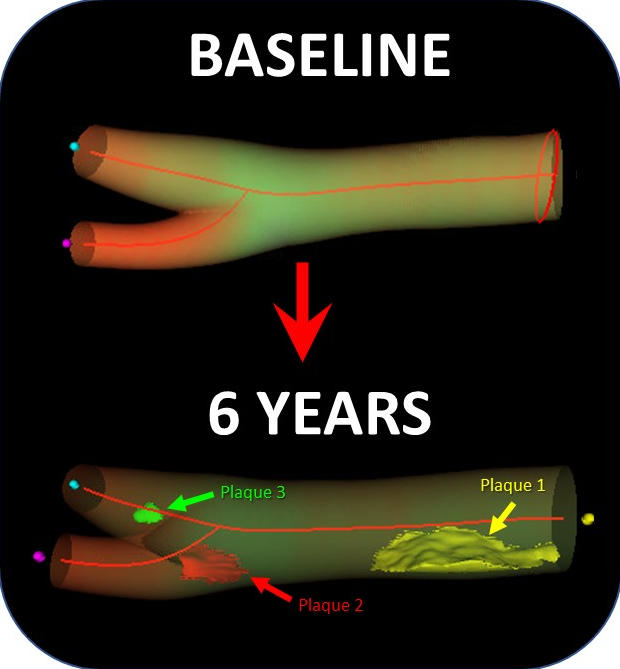
    3 Dimensional Ultrasound Reconstruction of a Carotid Artery
    3-dimensional ultrasound reconstruction of a carotid artery in an apparently healthy PESA-CNIC-Santander study participant. The upper image shows the situation at the time of the first imaging study, when no atherosclerotic plaques were detected. The lower image shows the same artery 6 years later, when several plaques were detected. Credit: CNIC

    “Screening for subclinical atherosclerosis from an early age together with aggressive risk-factor control could help to reduce the global burden of cardiovascular disease,” said Dr. Fuster.

    Dr. Ibáñez explained that “in this study, we show that moderate increases in blood pressure and cholesterol have a much more pronounced impact on atherosclerosis progression in younger people.”

    Very few studies have investigated the progression of silent atherosclerosis in people who are completely free of symptoms, whether they are young or in apparently healthy middle-age, and how this disease progresses throughout life.  

    The PESA-CNIC-Santander Study

    The PESA-CNIC-Santander study (Progression of Early Subclinical Atherosclerosis) was launched in 2009 and is a close collaboration between the CNIC and Santander Bank. More than 4000 apparently healthy middle-aged Santander Bank employees in Madrid volunteered to undergo an exhaustive, noninvasive analysis of the carotid, femoral, and coronary arteries and the aorta. Participants also provided blood samples for advanced genomic, proteomic, and metabolomic analysis.
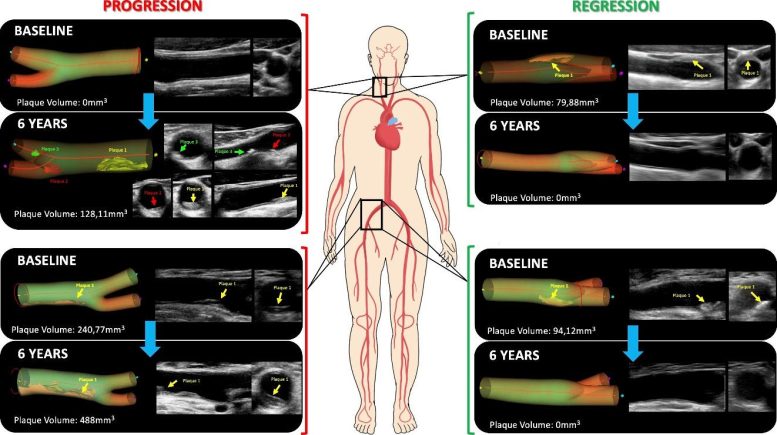
    Representative Results From Participants Showing Atherosclerosis Progression and Regression in Arteries of the Neck and Groin
    Representative results from participants showing atherosclerosis progression (left) and regression (disappearance of plaques, right) in arteries of the neck (carotids) and groin (femorals). Each image pair shows the results of the initial study at baseline and the follow-up study of the same artery 6 years later. The images show representative vascular ultrasound images on the right and 3-dimensional reconstructions on the left. Credit: CNIC

    “The PESA study has already made important contributions to our understanding of cardiovascular disease and is considered the most advanced study of its kind in the field,” said Dr. Fuster.

    Implications for Prevention and Personalized Medicine

    The current findings have important implications for cardiovascular prevention and personalized medicine. The study shows that the control of risk factors (principally elevated cholesterol and hypertension) should begin early in life, when the arteries are more vulnerable to the effects of these risk factors.

    And as Dr. Borja Ibáñez emphasized, “These results point the way to personalized approaches that use imaging technology to monitor the presence and progression of silent atherosclerosis and guide the intensity of risk-factor control.”

    Cardiologist Guiomar Mendieta, the first author on the study, added that “the other key finding of this study is that atherosclerosis, previously believed to be irreversible, can disappear if risk factors are controlled from an early stage.”

    “These findings are the outcome of the exhaustive collection of imaging and biochemical data over 6 years, combined with an innovative statistical analysis,” explained Dr. Mendieta, who joined the CNIC through the CARDIOJOVEN SEC-CNIC training program, a joint initiative of the CNIC and the Spanish Society of Cardiology.

    Reference: “Determinants of Progression and Regression of Subclinical Atherosclerosis Over 6 Years” by Guiomar Mendieta, Stuart Pocock, Virginia Mass, Andrea Moreno, Ruth Owen, Inés García-Lunar, Beatriz López-Melgar, Jose J. Fuster, Vicente Andres, Cristina Pérez-Herreras, Hector Bueno, Antonio Fernández-Ortiz, Javier Sanchez-Gonzalez, Ana García-Alvarez, Borja Ibáñez and Valentin Fuster, 20 November 2023, Journal of the American College of Cardiology.
    DOI: 10.1016/j.jacc.2023.09.814

    The CNIC investigators received funding from the European Commission, the Spanish Ministry of Science and Innovation, and the Community of Madrid regional government.

    Never miss a breakthrough: Join the SciTechDaily newsletter.
    Follow us on Google and Google News.

    Atherosclerosis Cardiology Cholesterol CNIC Heart Hypertension
    Share. Facebook Twitter Pinterest LinkedIn Email Reddit

    Related Articles

    New Study Shakes Up Heart Disease Theory: High Cholesterol May Not Mean High Risk

    Scientists Discover “Completely Different” New Risk Factor for Heart Disease

    Heart Disease: “Good” Cholesterol May Not Be Good for Everyone

    New Research Reveals Optimal Dose of Omega-3 Fatty Acids To Lower Blood Pressure

    Coffee’s Link to Raised Cholesterol Depends on Drinker’s Sex Plus Brewing Method

    Benefits of Taking Statins Called Into Question: Link Between High Cholesterol and Heart Disease “Inconsistent”

    Hypertensive Crisis: Uncontrolled Blood Pressure Is Sending Twice As Many People to the Hospital

    Another Way HDL “Good” Cholesterol Is Good: Combatting Inflammation

    Circle Back: New Evidence Linking Eggs, Cholesterol to Poor Cardiovascular Health and Death

    Leave A Reply Cancel Reply

    • Facebook
    • Twitter
    • Pinterest
    • YouTube

    Don't Miss a Discovery

    Subscribe for the Latest in Science & Tech!

    Trending News

    Scientists May Have Found the Key to Jupiter and Saturn’s Moon Mystery

    Scientists Uncover Brain Changes That Link Pain to Depression

    Saunas May Do More Than Raise Body Temperature – They Activate Your Immune System

    Exercise in a Pill? Metformin Shows Surprising Effects in Cancer Patients

    Hidden Oceans of Magma Could Be Protecting Alien Life

    New Study Challenges Alzheimer’s Theories: It’s Not Just About Plaques

    Artificial Sweeteners May Harm Future Generations, Study Suggests

    Splashdown! NASA Artemis II Returns From Record-Breaking Moon Mission

    Follow SciTechDaily
    • Facebook
    • Twitter
    • YouTube
    • Pinterest
    • Newsletter
    • RSS
    SciTech News
    • Biology News
    • Chemistry News
    • Earth News
    • Health News
    • Physics News
    • Science News
    • Space News
    • Technology News
    Recent Posts
    • “A Plague Is Upon Us”: The Mass Death That Changed an Ancient City Forever
    • This Strange Material Can Turn Superconductivity on and off Like a Switch
    • Scientists Discover Game-Changing New Way To Treat High Cholesterol
    • Breakthrough Drug Delays Rheumatoid Arthritis for Years After Treatment Ends
    • This Small Change to Your Exercise Routine Could Be the Secret to Living Longer
    Copyright © 1998 - 2026 SciTechDaily. All Rights Reserved.
    • Science News
    • About
    • Contact
    • Editorial Board
    • Privacy Policy
    • Terms of Use

    Type above and press Enter to search. Press Esc to cancel.