
Discovery of a topological change of an interfacial hydrodynamics by a partial miscibility and creating a cross-disciplinary discipline of chemical thermodynamics and interfacial hydrodynamics.
The international collaborative team of Tokyo University of Agriculture and Technology (TUAT) in Japan, Indian Institute of Technology Ropar (IIT Ropar) in India, and Osaka University in Japan has discovered for the first time a topological change of viscous fingering (one of classical interfacial hydrodynamics), which is driven by “a partial miscibility,” where the two liquids do not mix completely with finite solubility. This topological change originates from a phase separation and the spontaneous motion driven by it. It is a phenomenon that cannot be seen with completely mixed (fully miscible) system with infinite solubility or immiscible system with no solubility.
The researchers published their results in the Journal of Fluid Mechanics on June 30th, 2020.
When a less viscous fluid displaces a more viscous fluid in porous media, the interface between the two fluids becomes hydrodynamically unstable and deforms in a finger shape. This phenomenon is technically called “Viscous fingering (VF)”. Since the 1950s, the VF has been studied as one fluid dynamics issue. Then, it is now widely known that the properties can be classified according to whether the two fluids are fully miscible or immiscible. The viscous fingering dynamics helps to understand the process of fluid displacement in porous media in reactions and separation in chemical processes, as well as in enhanced-oil-recovery and CO2 sequestration.
“It has long been pointed out that viscous fingering in partially miscible fluids occurs in underground processes with high-pressure conditions, such as oil recovery and CO2 storage. However, such viscous fingering has been theoretically studied in the last few years,” said Dr. Nagatsu, one of the corresponding authors of the paper and Associate Professor in the Department of Chemical Engineering at Tokyo University of Agriculture and Technology (TUAT). “Experimental studies of such VF have not been done at all. One of the reasons is that fluid mechanics researchers did not use experimental conditions that were partially miscible at room temperature and atmospheric pressure.”
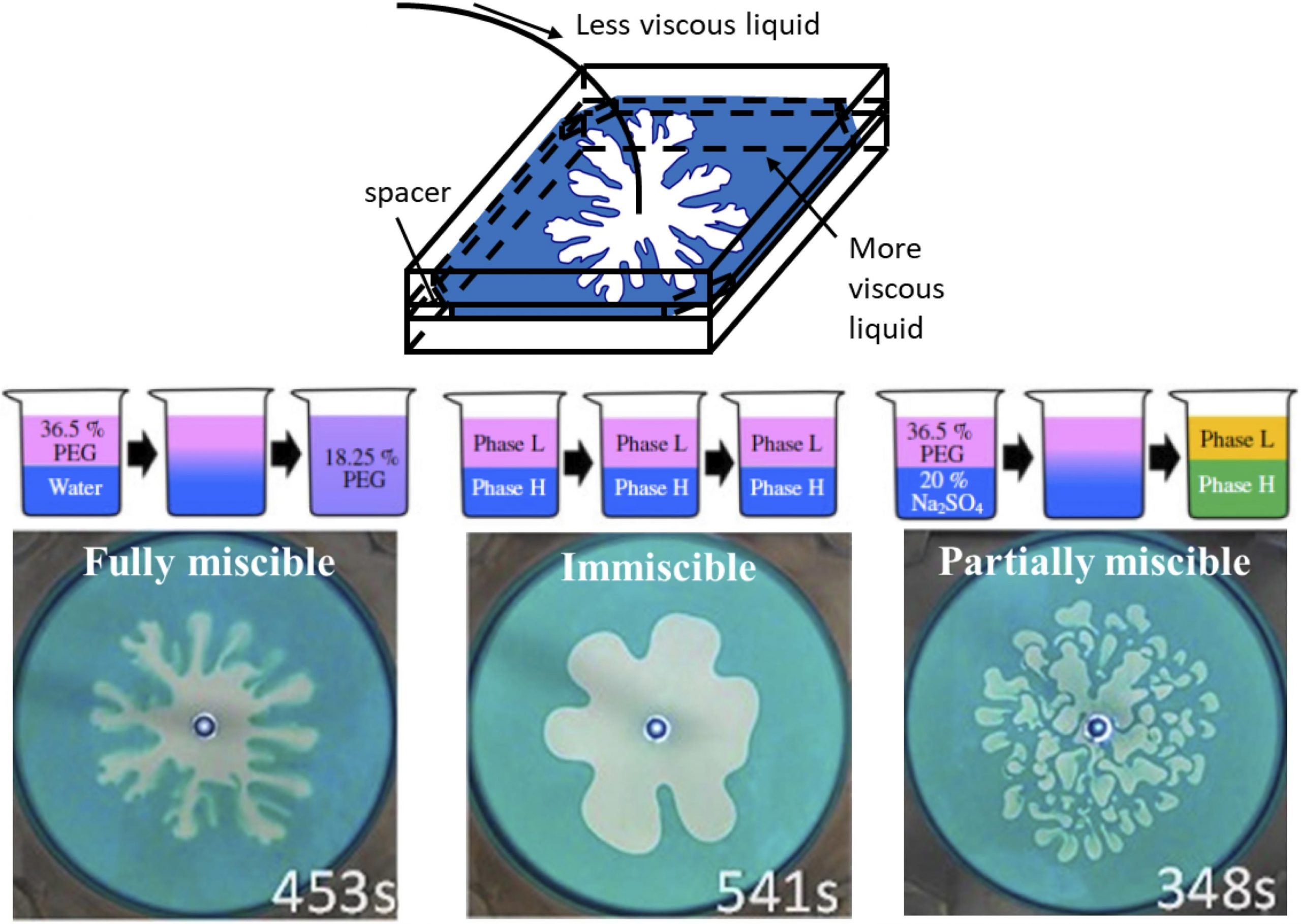
The research team succeeded in changing the miscibility of the system to fully miscible, immiscible, and partially miscible with little change in the viscosities at room temperature and atmospheric pressure. They used an aqueous two-phase system consisting of polyethylene-glycol (PEG), sodium-sulfate (Na2SO4), and water (see Figure), which were described in the same research team’s paper published in 2019. Here, in the partially miscible system, a pure PEG solution and a pure Na2SO4 solution dissolve each other with finite solubility, and as a result, the phase is separated into a PEG-rich phase (phase L) and a Na2SO4-rich phase (phase H) (see Figure).
They have carried out experiments by using this solution system in which a less-viscous liquid displaces a more-viscous one in a Hele-Shaw cell (see Figure) which is a model mimics flow in porous media. “Our team found that topological change is observed in the case where the two liquids are partially miscible (see Figure and Movie). This is the first instance of topological change in viscous fingering although various changes in the pattern due to various physicochemical effects, so far, have been reported when the two fluids are fully miscible or immiscible. We clearly showed this topological change originates from a phase separation occurring between the two fluids and the spontaneous motion driven by it,” Nagatsu explains.
“Our result overturns the common understanding of more than 60 years in VF research which began in the 1950s that the characteristics of VF are divided into immiscible and fully miscible cases and it demonstrates the existence and importance of the partially miscible case, which becomes the third classification category. This will open a new cross-disciplinary research area involving hydrodynamics and chemical thermodynamics. Also, the displacement with partial miscibility in a porous medium takes place in the oil recovery process from the formation and the CO2 injection process into the formation. Thus, our finding is expected to create a new control methodology of those processes by utilizing the partial miscibility,” adds Nagatsu.
Reference: “Phase separation effects on a partially miscible viscous fingering dynamics” by Ryuta X. Suzuki, Yuichiro Nagatsu, Manoranjan Mishra and Takahiko Ban, 30 June 2020, Journal of Fluid Mechanics.
DOI: 10.1017/jfm.2020.406
This work was supported by PRESTO-JST (No. 25103004 “Phase Interfaces for Highly Efficient Energy Utilization”) and JSPS Invitation Fellowships for Research in Japan (No. S15063 and No. L19548).
Never miss a breakthrough: Join the SciTechDaily newsletter.
Follow us on Google and Google News.
1 Comment
They are just abstract art purveyers trying to hawk a third rate piece of art. pay no mind to their miscibility sophistries. Everyone knows oil and water don’t mix