
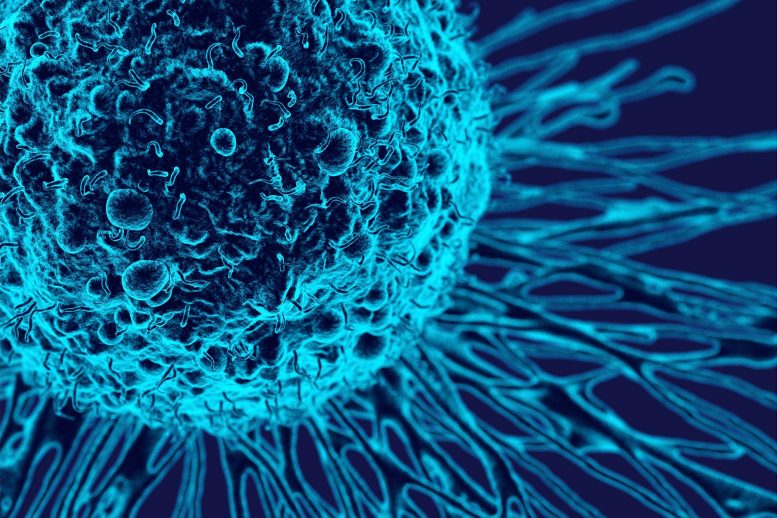
New research connects mitochondrial damage caused by fumarate accumulation to inflammation, providing hope for innovative cancer treatments.
A groundbreaking study has uncovered a link between a mitochondrial metabolite and the triggering of an inflammatory response. As essential components of our cells, mitochondria play a crucial role in performing various tasks such as chemical reactions that are necessary for cell functioning. One of these functions is the production of energy, which is vital for cell growth and replication. However, any alterations in the chemical reactions within the mitochondria can result in the development of diseases.
For example, a shortage of fumarate hydratase (FH) in the Krebs cycle, a key metabolic pathway in the mitochondria, leads to a severe form of kidney cancer in humans. The absence of FH results in a buildup of the molecule fumarate, which is a contributing factor to cancer development. Hence, fumarate is referred to as an oncogenic metabolite or simply an “oncometabolite.”
The research team led by Alexander von Humboldt Professor Dr. Christian Frezza, formerly at the University of Cambridge (United Kingdom) and now at the CECAD Cluster of Excellence for Aging Research at the University of Cologne, has now developed a new mouse and cell model together with the research group led by Professor Prudent of the University of Cambridge to deepen the understanding of aggressive kidney cancer.
Mitochondrial Vesicles
In the models, the silencing of the fumarate hydratase gene can be temporally controlled by the scientists. Using a combination of high-resolution imaging techniques and precise biochemical experiments, the scientists have shown that fumarate causes mitochondrial damage. This in turn releases the genetic material of the mitochondria in small vesicles called mitochondrial-derived vesicles.
These vesicles filled with mitochondrial DNA (mtDNA) and RNA (mtRNA) trigger an immune reaction that eventually leads to inflammation. The study was recently published in the journal Nature.
“Our study shows for the first time a correlation between a mitochondrial metabolite and the onset of inflammation, which could be the trigger for cancer and autoimmune diseases,” said Professor Frezza. “Based on these findings, we can now work on new approaches to treat patients, which will hopefully lead to the development of new therapeutic strategies to treat cancer patients in the future.”
Reference: “Fumarate induces vesicular release of mtDNA to drive innate immunity” by Vincent Zecchini, Vincent Paupe, Irene Herranz-Montoya, Joëlle Janssen, Inge M. N. Wortel, Jordan L. Morris, Ashley Ferguson, Suvagata Roy Chowdury, Marc Segarra-Mondejar, Ana S. H. Costa, Gonçalo C. Pereira, Laura Tronci, Timothy Young, Efterpi Nikitopoulou, Ming Yang, Dóra Bihary, Federico Caicci, Shun Nagashima, Alyson Speed, Kalliopi Bokea, Zara Baig, Shamith Samarajiwa, Maxine Tran, Thomas Mitchell, Mark Johnson, Julien Prudent, and Christian Frezza, 8 March 2023, Nature.
DOI: 10.1038/s41586-023-05770-w
In addition, a group at Trinity Biomedical Sciences Institute in Dublin led by Professor Luke O’Neill in collaboration with Christian Frezza’s research group has described a similar mechanism in macrophages. Macrophages are cells of the body that are responsible for eliminating harmful microbes. Here, the researchers found that mitochondrial RNA released by the macrophages’ mitochondria, rather than DNA, is the main trigger of inflammation. The study “Macrophage fumarate hydratase restrains mtRNA-mediated interferon production” was also published in the journal Nature.
The research was carried out at the University of Cambridge and the CECAD Cluster of Excellence for Aging Research of the University of Cologne. It was funded by Cancer Research UK, the European Research Council, the German Research Foundation (DFG), the Alexander von Humboldt Foundation, and the Medical Research Council. The collaborative research was conducted in the laboratory of Luke O’Neill at Trinity Biomedical Sciences Institute in Dublin, Ireland.
Never miss a breakthrough: Join the SciTechDaily newsletter.
Follow us on Google and Google News.