
Revolutionizing Imaging with Nanoparticle Light Sources
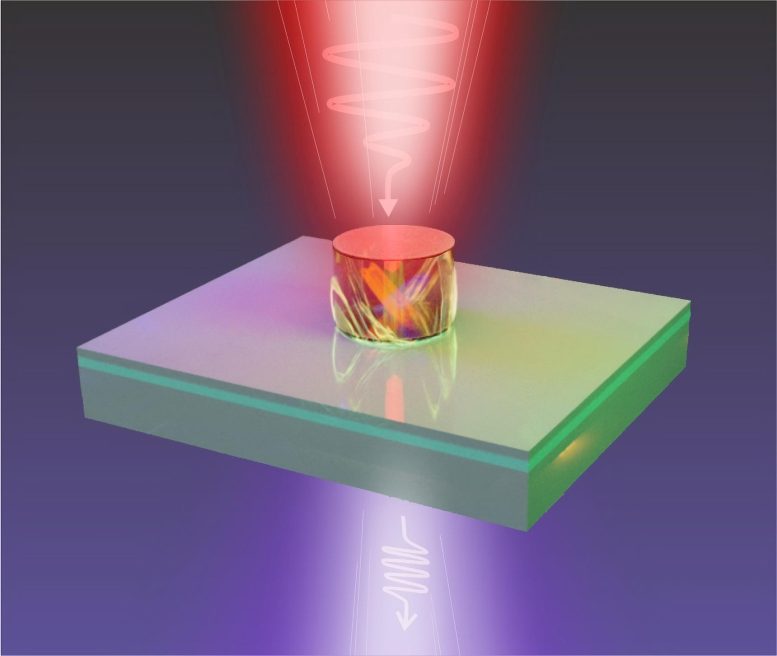
Physicists at The Australian National University (ANU) are using nanoparticles to create innovative light sources that will allow us to “peel back the curtain” into the world of extremely tiny objects – objects that are thousands of times smaller than a human hair. This will lead to significant advancements in medical and other technological fields.
The findings, published in the journal Science Advances, hold enormous potential for the field of medical science. It presents a cost-effective and efficient method for examining objects that are too small to be seen by microscopes let alone the naked eye. This research could also have a positive impact on the semiconductor industry by enhancing the quality control process in the production of computer chips.
Amplifying Light Frequencies
The ANU technology uses carefully engineered nanoparticles to increase the frequency of light that cameras and other technologies see by up to seven times. The researchers say there is “no limit” to how high the frequency of light can be increased. The higher the frequency, the smaller the object we are able to see using that light source.
The technology, which requires only a single nanoparticle to work, could be implemented into microscopes to help scientists zoom into the world of super small things at 10 times the resolution of conventional microscopes. This would enable researchers to study objects that would otherwise be too small to see, such as the inner structures of cells and individual viruses.
Being able to analyze such small objects could help scientists better understand and fight certain diseases and health conditions.
“Conventional microscopes are only able to study objects bigger than about a ten-millionth of a meter. However, there is growing demand across a range of sectors, including the medical field, to be able to analyze much smaller objects down to one billionth of a meter,” lead author Dr. Anastasiia Zalogina, from the ANU Research School of Physics and the University of Adelaide, said.
“Our technology could help meet that demand.”
The researchers say the ANU-developed nanotech could help create a new generation of microscopes that can produce much more detailed images.
“Scientists who want to generate a highly-magnified image of an extremely small, nanoscale object can’t use a conventional optical microscope. Instead, they must rely on either super-resolution microscopy techniques or use an electron microscope to study these tiny objects,” Dr. Zalogina said.
“But such techniques are slow and the technology is very expensive, often costing more than a million dollars.
“Another disadvantage of electron microscopy is that it may damage delicate samples being analyzed, whereas light-based microscopes mitigate this issue.”
A New Era of Extreme-Ultraviolet Imaging
Beams of light that we perceive as different colors of the rainbow are electromagnetic waves that oscillate with different frequencies.
What we see as red is the lowest frequency that our eyes can detect. Even lower frequencies not visible to the human eye are called infrared. Violet has the highest light frequency that we can see. Ultraviolet, which has an even higher frequency, is invisible to the human eye.
Although our eyes cannot detect infrared and ultraviolet light, it is possible for us to ‘see’ it using cameras and other technologies.
Co-author Dr. Sergey Kruk, also from ANU, said researchers are interested in achieving very high frequencies of light, also known as ‘extreme-ultraviolet’.
“With violet light, we can see much smaller things compared to using red light. And with extreme-ultraviolet light sources, we can see things beyond what’s possible using conventional microscopes of today,” Dr. Kruk said.
Dr. Kruk said the ANU technology could also be used in the semiconductor industry as a quality control measure to ensure a streamlined manufacturing process.
“Computer chips consist of very tiny components with feature sizes almost as small as one billionth of a meter. During the chip production process, it would be beneficial for manufacturers to use tiny sources of extreme-ultraviolet light to monitor this process in real-time to diagnose any problems early on,” he said.
“That way manufacturers could save resources and time on bad batches of chips, thereby increasing yields of chip manufacturing. It’s estimated that a one percent increase in yields of computer chip manufacturing translates into two billion dollars in savings.
“Australia’s booming optics and photonics industry is represented by nearly 500 companies and accounts for about $4.3 billion of economic activity, making our high-tech ecosystem well-positioned to adopt new types of light sources in order to reach new global markets in nanotechnology industries and research.”
Reference: “High-harmonic generation from a subwavelength dielectric resonator” by Anastasiia Zalogina, Luca Carletti, Anton Rudenko, Jerome V. Moloney, Aditya Tripathi, Hoo-Cheol Lee, Ilya Shadrivov, Hong-Gyu Park, Yuri Kivshar and Sergey S. Kruk, 26 April 2023, Science Advances.
DOI: 10.1126/sciadv.adg2655
This work was conducted in collaboration with researchers from the University of Brescia, the University of Arizona and Korea University.
Never miss a breakthrough: Join the SciTechDaily newsletter.
Follow us on Google and Google News.