
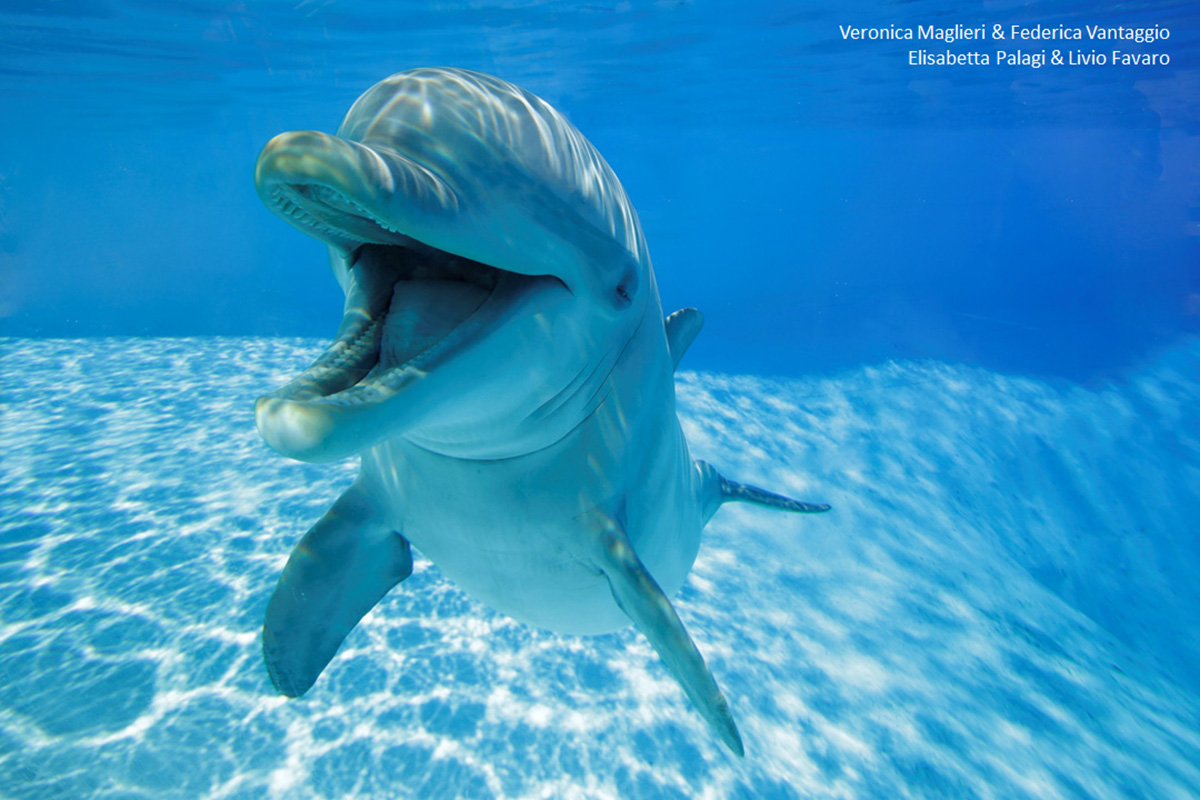
Bottlenose dolphins use an “open mouth” facial expression during social play to signal playfulness. This expression is mimicked by playmates 33% of the time, suggesting its role in dolphin communication.
Dolphins are extremely playful, but little is known about how they—and other marine mammals—communicate during playtime. New research recently published in the Cell Press journal iScience shows that bottlenose dolphins (Tursiops truncates) use the “open mouth” facial expression—analogous to a smile—to communicate during social play.
The dolphins almost always use the facial expressions when they are in their playmate’s field of view, and when playmates perceived a “smile,” they responded in kind 33% of the time.
“We’ve uncovered the presence of a distinct facial display, the open mouth, in bottlenose dolphins, and we showed that dolphins are also able to mirror others’ facial expressions,” says senior author and evolutionary biologist Elisabetta Palagi of the University of Pisa. “Open-mouth signals and rapid mimicry appear repeatedly across the mammal family tree, which suggests that visual communication has played a crucial role in shaping complex social interactions, not only in dolphins but in many species over time.”
Dolphin play can include acrobatics, surfing, playing with objects, chasing, and playfighting, and it’s important that these activities aren’t misinterpreted as aggression. Other mammals use facial expressions to communicate playfulness, but whether marine mammals also use facial expressions to signal playtime hasn’t been previously explored.
Evolution of the Open Mouth Gesture
“The open mouth gesture likely evolved from the biting action, breaking down the biting sequence to leave only the ‘intention to bite’ without contact,” says Palagi. “The relaxed open mouth, seen in social carnivores, monkeys’ play faces, and even human laughter, is a universal sign of playfulness, helping animals—and us—signal fun and avoid conflict.”
To investigate whether dolphins visually communicate playfulness, the researchers recorded captive bottlenose dolphins while they were playing in pairs and while they were playing freely with their human trainers.
They showed that dolphins frequently use the open-mouth expression when playing with other dolphins, but they don’t seem to use it when playing with humans or when they’re playing by themselves. While only one open-mouth event was recorded during solitary play, the researchers recorded a total of 1,288 open-mouth events during social play sessions, and 92% of these events occurred during dolphin-dolphin play sessions. Dolphins were also more likely to assume the open-mouth expression when their faces were in the field of view of their playmate—89% of recorded open-mouth expressions were emitted in this context—and when this “smile” was perceived, the playmate smiled back 33% of the time.
Mimicry and Future Research
“Some may argue that dolphins are merely mimicking each other’s open-mouth expressions by chance, given they’re often involved in the same activity or context, but this doesn’t explain why the probability of mimicking another dolphin’s open mouth within 1 second is 13 times higher when the receiver actually sees the original expression,” says Palagi. “This rate of mimicry in dolphins is consistent with what’s been observed in certain carnivores, such as meerkats and sun bears.”
The researchers didn’t record the dolphins’ acoustic signals during playtime, and they say that future studies should investigate the possible role of vocalizations and tactile signals during playful interactions.
“Future research should dive into eye-tracking to explore how dolphins see their world and utilize acoustic signals in their multimodal communication during play,” says corresponding author and zoologist Livio Favaro. “Dolphins have developed one of the most intricate vocal systems in the animal world, but sound can also expose them to predators or eavesdroppers. When dolphins play together, a mix of whistling and visual cues helps them cooperate and achieve goals, a strategy particularly useful during social play when they’re less on guard for predators.”
Reference: “Smiling underwater: Exploring playful signals and rapid mimicry in bottlenose dolphins” by Veronica Maglieri, Federica Vantaggio, Cristina Pilenga, Martin Böye, Alban Lemasson, Livio Favaro and Elisabetta Palagi, 2 October 2024, iScience.
DOI: 10.1016/j.isci.2024.110966
Never miss a breakthrough: Join the SciTechDaily newsletter.
Follow us on Google and Google News.
1 Comment
What if the smile is in conjunction with a telepathic message saying “Let’s play”?
There must be some way that animals and insects communicate. Why couldn’t it be telepathically?
I was watching the new Big Cat Nature show on PBS and it was amazing how lions coordinate between themselves to trap prey and kill them. How do animals manage to strategize w/o obvious language? Is it really inborn for them to understand that if they want to eat, then one must position themselves in one place and another in another place and another in another place?