
Researchers reveal that Fe-O alloys are stable at extreme conditions, suggesting oxygen can exist in Earth’s inner core
Oxygen is the key substance for life and one of the most abundant elements on Earth. However, it’s still unknown whether oxygen is present and in which form in the inner core, which is composed of almost pure iron and subject to extreme high pressure and temperature conditions.
Now, scientists reveal that Fe-rich Fe-O alloys are stable at extreme pressures of nearly 300 GPa and high temperatures of more than 3,000 K (~5,000 degrees F). The results prove that oxygen can exist in the solid inner core, which provides key constraints for further understanding of the formation process and evolution history of the Earth’s core. The study, which was co-led by Dr. Jin Liu from HPSTAR (the Center for High Pressure Science &Technology Advanced Research) and Dr. Yang Sun from Columbia University, was published recently in the journal The Innovation.
As one of the most mysterious places on the planet, the Earth’s solid inner core is in the most extreme temperature and pressure environment on Earth, with a pressure of more than 3 million atmospheres and a temperature close to the surface of the Sun, about 6000 K (~10,000 degrees F). Because the inner core is far beyond the reach of humans, we can only infer its density and chemical composition from the seismic signals generated by earthquakes.
At present, it is believed that light elements exist in the inner core, but the type and content are still debated. Cosmochemical and geochemical evidence suggests that it should contain sulfur, silicon, carbon, and hydrogen. Experiments and calculations also confirmed that these elements mix with pure iron to form various Fe alloys under high temperatures and high-pressure conditions of the deep Earth.
However, oxygen, which is closely related to us, is usually excluded from the inner core. This is mainly because Fe-O alloys with iron-rich compositions have never been found in the surface or mantle environments. The oxygen content in all known iron oxides is greater than or equal to 50 atomic percent. Although people have been trying to synthesize iron oxide compounds with iron-rich compositions, such substances have never been found yet. Is the Earth’s inner core so “anoxic?” To answer this question, a series of experiments and theoretical calculations were carried out in this study.
Breakthrough in Fe-O Alloy Synthesis
To be close to the temperature and pressure of Earth’s core, pure iron and iron oxide were placed on the tips of two diamond anvils and heated with a high-energy laser beam. After many attempts, it was found that a chemical reaction between iron and iron oxide occurs above 220-260 GPa and 3000 K. The XRD results reveal that the reaction product is different from the common high-temperature and high-pressure structure of pure iron and iron oxide.
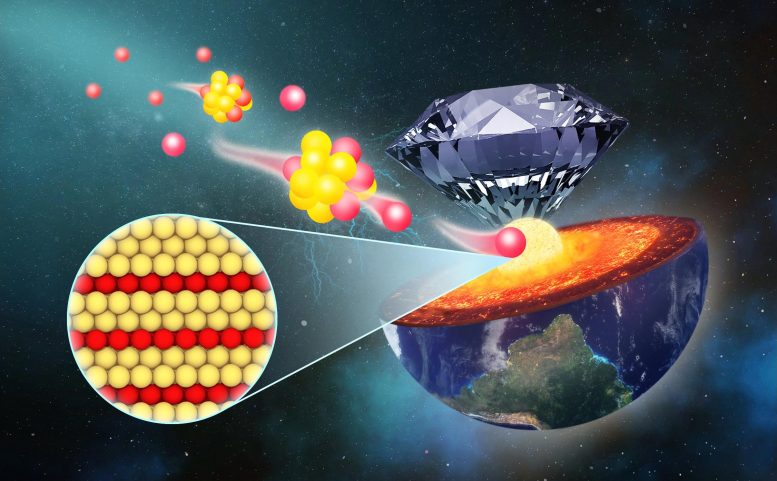
A theoretical crystal structure search using a genetic algorithm proved that the iron-rich Fe-O alloy could exist stably at approximately 200 GPa. Under such conditions, the new Fe-rich Fe-O alloys form a hexagonal close-packed structure, where the oxygen layers are arranged in between Fe layers to stabilize the structure. Such a mechanism produces many close-packed arrangements forming a large family of Fe-rich Fe-O compounds with large configurational entropy.
Based on this theoretical information, an atomic configuration of Fe28O14 was found to match the experimentally measured XRD pattern. Further calculations showed that Fe-rich Fe-O phases are metallic, in contrast with common iron oxides at low pressures. The electronic structure depends on O concentration and the Fe and O layer arrangements. The mechanical properties and thermal properties of the alloy need to be further studied in the future.
Reference: “Iron-rich Fe–O compounds at Earth’s core pressures” by Jin Liu, Yang Sun, Chaojia Lv, Feng Zhang, Suyu Fu, Vitali B. Prakapenka, Caizhuang Wang, Kaiming Ho, Jungfu Lin and Renata M. Wentzcovitch, 15 November 2022, The Innovation.
DOI: 10.1016/j.xinn.2022.100354
Never miss a breakthrough: Join the SciTechDaily newsletter.
Follow us on Google and Google News.
1 Comment
Why do we not find such iron oxides, or the decomposition products of them, in iron meteorites, which are thought to be the core of a disrupted planet or planetoid?