
Close Menu
    Facebook X (Twitter) Instagram
    SciTechDaily
    • Biology
    • Chemistry
    • Earth
    • Health
    • Physics
    • Science
    • Space
    • Technology
    Facebook X (Twitter) Pinterest YouTube RSS
    SciTechDaily
    Home»Space»New Simulation Shows How the ‘Pillars of Creation’ Were Created
    Space

    New Simulation Shows How the ‘Pillars of Creation’ Were Created

    By Royal Astronomical SocietyJuly 1, 2014No Comments4 Mins Read
    Facebook Twitter Pinterest Telegram LinkedIn WhatsApp Email Reddit
    Share
    Facebook Twitter LinkedIn Pinterest Telegram Email Reddit
    New Simulation Shows How the Pillars of Creation Were Created
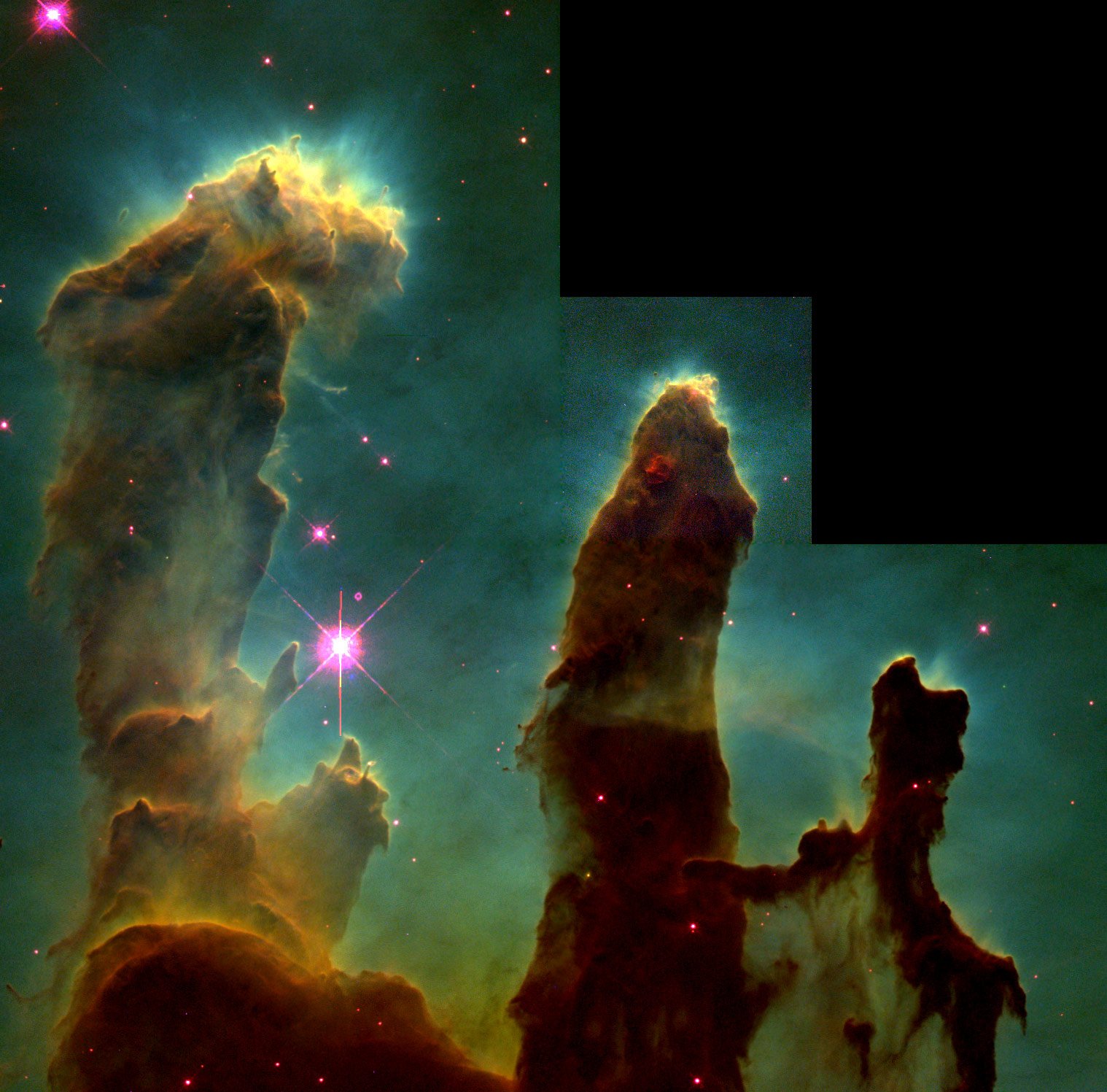
    The famous Hubble Space Telescope image of the ‘Pillars of Creation’, from 1995. Credit: NASA / ESA / STScI / J. Hester and P. Scowen (Arizona State University)

    A new simulation shows how the ‘Pillars of Creation’ were created, showing how the cloud collapses and forms ‘elephant trunks’ and bright rims over 1.6 million years.

    The ‘Pillars of Creation’, an image made with the Hubble Space Telescope in 1995, is one of the most famous astronomical views. It shows how ‘elephant trunks’ of cooler interstellar gas are eroded by the intense radiation and winds from nearby massive stars.

    Now Scott Balfour, an astronomer at Cardiff University, has run a new simulation where similar structures appear with a remarkably close appearance to their real life counterparts. He also suggests that the stars that make these structures are of little help in forming new siblings. Scott presented his results in a talk at the National Astronomy Meeting in Portsmouth.

    The massive O-type stars, more than 16 times as ‘heavy’ as our Sun, have short but dramatic lives. During their most stable phase on the so-called main sequence, they have surface temperatures of more than 30,000 degrees Celsius or 54,000 degrees Fahrenheit (on the Sun the surface is about 5,500 degrees Celsius or 9,900 degrees Fahrenheit), are strong sources of ultraviolet light, and emit copious material in a powerful wind.


    A movie of the simulation, showing how the cloud collapses and forms ‘elephant trunks’ and bright rims over 1.6 million years. Credit: S. Balfour / University of Cardiff

    All of this shapes their surroundings. The O-type stars heat any interstellar gas in their vicinity, creating bubbles that act like snow plows sweeping up surrounding colder material. In these regions, where gas is compressed, large numbers of new stars are seen forming so many scientists argue that the O stars drive star formation.

    In his new work, Scott has tried to test this idea by simulating the way the gas behaves over a period of 1.6 million years, a simulation that took several weeks of computing time to calculate. His model explored what would happen when a massive star forms in a smooth cloud of gas that is already collapsing under its own weight.

    Light from the O-type star creates a bubble in the cloud as expected, but its future can follow one of three paths. It may expand forever; expand, contract a little, and then become almost stationary or expand and then contract all the way back to the center of the cloud. Scott found that only the second case leads to prolific star formation and even then only under very specific conditions.
    Simulation Shows How the Pillars of Creation Were Created
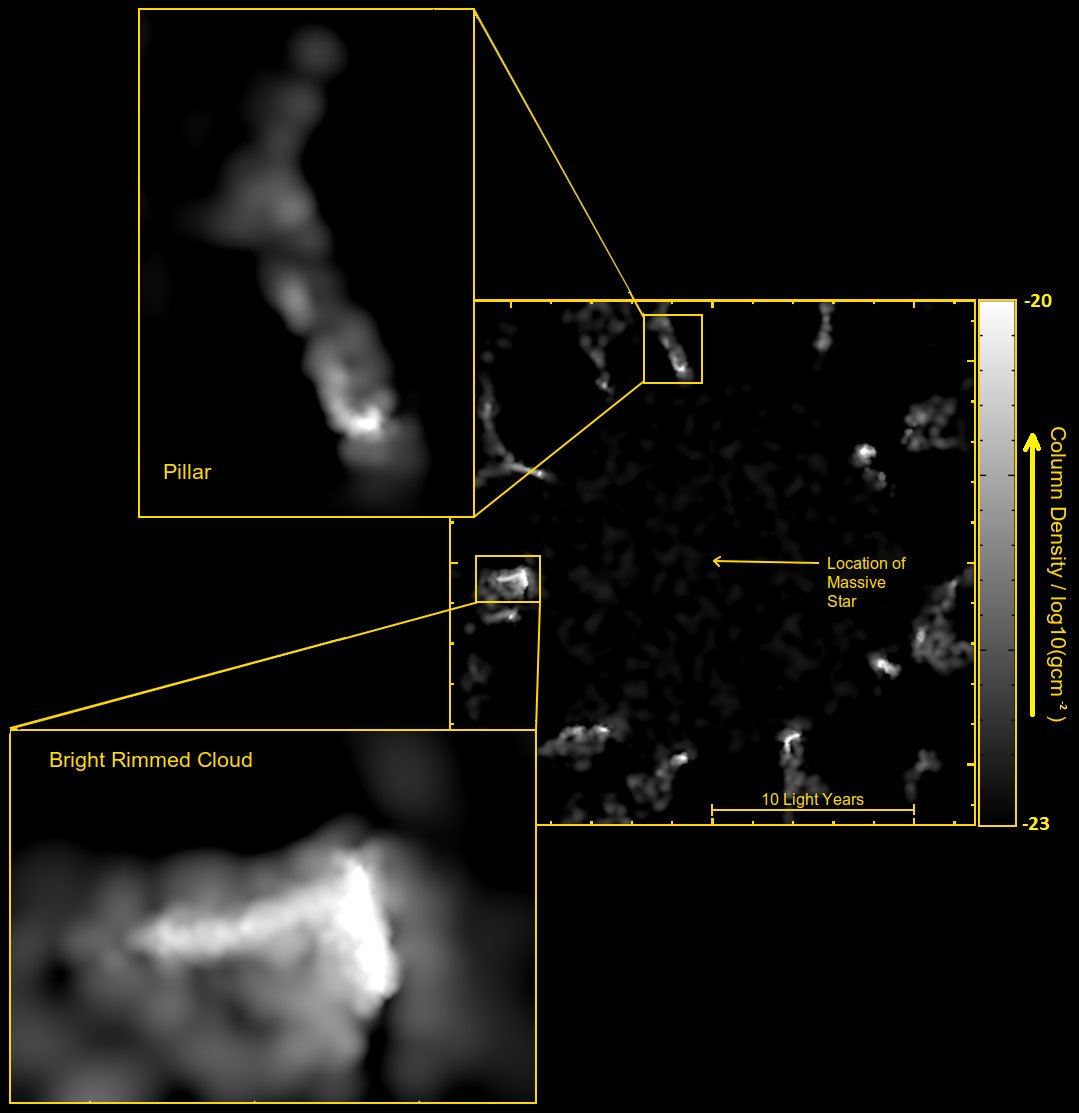
    An image from the simulation, showing a slice of space 25 x 25 light-years across and 0.2 light years thick (for reference 1 light year is about 9.6 million million km or a bit more than 63000 times the distance from the Earth to the Sun). The model depicts how a hot star in the center of the cloud changes its surroundings over 1.6 million years, creating the ‘elephant trunks’ seen in Hubble imagery. Insets show close-ups of a pillar and bright bright-rimmed cloud. Credit: S. Balfour / University of Cardiff

    He comments: “If I’m right, it means that O-type and other massive stars play a much more complex role than we previously thought in nursing a new generation of stellar siblings to life.”

    His model also neatly replicates the bright rims and pillars seen in the Hubble image, which seem to form naturally along the outer edge of the bubble as it breaks up.

    Scott adds: “The model neatly produces exactly the same kind of structures seen by astronomers in the classic 1995 image, vindicating the idea that giant O-type stars have a major effect in sculpting their surroundings.”

    Never miss a breakthrough: Join the SciTechDaily newsletter.
    Follow us on Google and Google News.

    Astronomy Astrophysics Cardiff University Royal Astronomical Society
    Share. Facebook Twitter Pinterest LinkedIn Email Reddit

    Related Articles

    Planetary Shields Will Buckle Under Furious Stellar Winds From Their Dying Stars – Nearly Impossible for Life To Survive

    Lucky Encounter: Solar Orbiter Spacecraft Flies Through the Tail of a Disintegrated Comet

    A Bug’s Life: Mountains on Neutron Stars May Be Only Fractions of Millimeters Tall

    Habitable Planets With Earth-Like Biospheres May Be Much Rarer Than Thought

    Mysterious Hydrogen-Free Supernova Sheds Light on Massive Stars’ Violent Death Throes

    New Research Finds That Supermassive Black Holes Could Form From Dark Matter

    Stunning “Honeycomb Heart” Revealed in Iconic Supernova Explosion Remnant

    Giant Radio Galaxies: Cosmic Beasts and Where to Find Them

    Shocking Discovery As Astronomers Peer 12 Billion Years Into the Past – “Defies Our Understanding of Galaxy Formation”

    Leave A Reply Cancel Reply

    • Facebook
    • Twitter
    • Pinterest
    • YouTube

    Don't Miss a Discovery

    Subscribe for the Latest in Science & Tech!

    Trending News

    Monster Storms on Jupiter Unleash Lightning Beyond Anything on Earth

    Scientists Create “Liquid Gears” That Spin Without Touching

    The Simple Habit That Could Help Prevent Cancer

    Millions Take These IBS Drugs, But a New Study Finds Serious Risks

    Scientists Unlock Hidden Secrets of 2,300-Year-Old Mummies Using Cutting-Edge CT Scanner

    Bread Might Be Making You Gain Weight Even Without Eating More Calories

    Scientists Discover Massive Magma Reservoir Beneath Tuscany

    Europe’s Most Active Volcano Just Got Stranger – Here’s Why Scientists Are Rethinking It

    Follow SciTechDaily
    • Facebook
    • Twitter
    • YouTube
    • Pinterest
    • Newsletter
    • RSS
    SciTech News
    • Biology News
    • Chemistry News
    • Earth News
    • Health News
    • Physics News
    • Science News
    • Space News
    • Technology News
    Recent Posts
    • 25-Year Study Uncovers Hidden Paths and Early Warning Signs of Blood Cancer
    • Not Just Snoring – New Research Reveals Sleep Apnea May Be Damaging Your Muscles
    • Scientists Discover a Surprising Reason Intermittent Fasting Extends Life
    • Scientists Discover a New Meteor Shower From a Mysterious Crumbling Asteroid
    • This Simple Fruit Wash Could Make Produce Safer and Last Days Longer
    Copyright © 1998 - 2026 SciTechDaily. All Rights Reserved.
    • Science News
    • About
    • Contact
    • Editorial Board
    • Privacy Policy
    • Terms of Use

    Type above and press Enter to search. Press Esc to cancel.