
Close Menu
    Facebook X (Twitter) Instagram
    SciTechDaily
    • Biology
    • Chemistry
    • Earth
    • Health
    • Physics
    • Science
    • Space
    • Technology
    Facebook X (Twitter) Pinterest YouTube RSS
    SciTechDaily
    Home»Space»Stunning “Honeycomb Heart” Revealed in Iconic Supernova Explosion Remnant
    Space

    Stunning “Honeycomb Heart” Revealed in Iconic Supernova Explosion Remnant

    By Royal Astronomical SocietyFebruary 17, 2021No Comments3 Mins Read
    Facebook Twitter Pinterest Telegram LinkedIn WhatsApp Email Reddit
    Share
    Facebook Twitter LinkedIn Pinterest Telegram Email Reddit
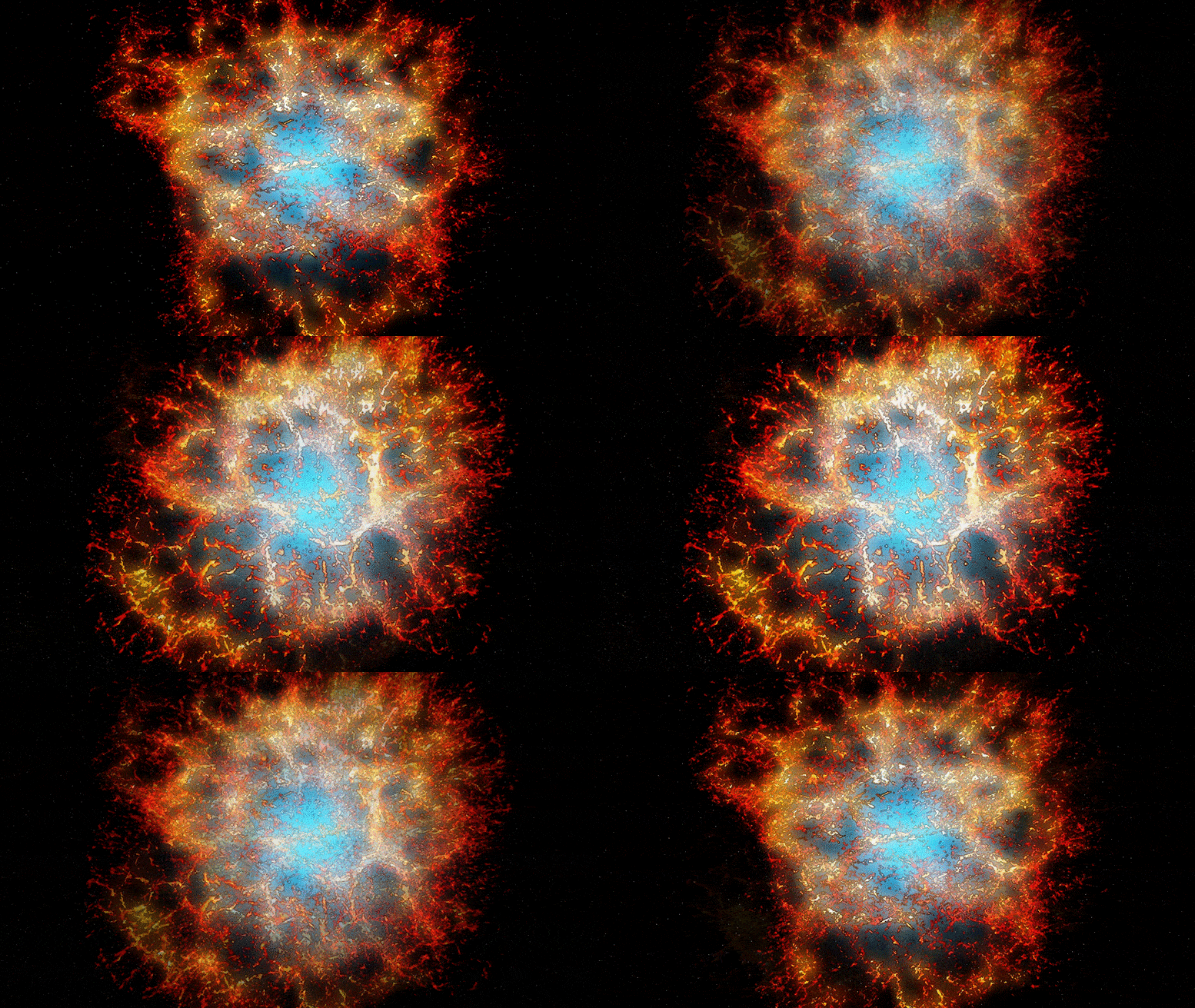
    Crab Nebula 3D Reconstruction
    C3D mapping of the Crab Nebula

    Crab Nebula’s Heart-Shaped Void Challenges Old Supernova Theories

    A unique “heart-shape,” with wisps of gas filaments showing an intricate honeycomb-like arrangement, has been discovered at the center of the iconic supernova remnant, the Crab Nebula. Astronomers have mapped the void in unprecedented detail, creating a realistic three-dimensional reconstruction. The new work is published in Monthly Notices of the Royal Astronomical Society.

    The Crab, formally known as Messier 1, exploded as a dramatic supernova in 1054 CE, and was observed over the subsequent months and years by ancient astronomers across the world. The resulting nebula — the remnant of this enormous explosion — has been studied by amateur and professional astronomers for centuries. However, despite this rich history of investigation, many questions remain about what type of star was originally there and how the original explosion took place.
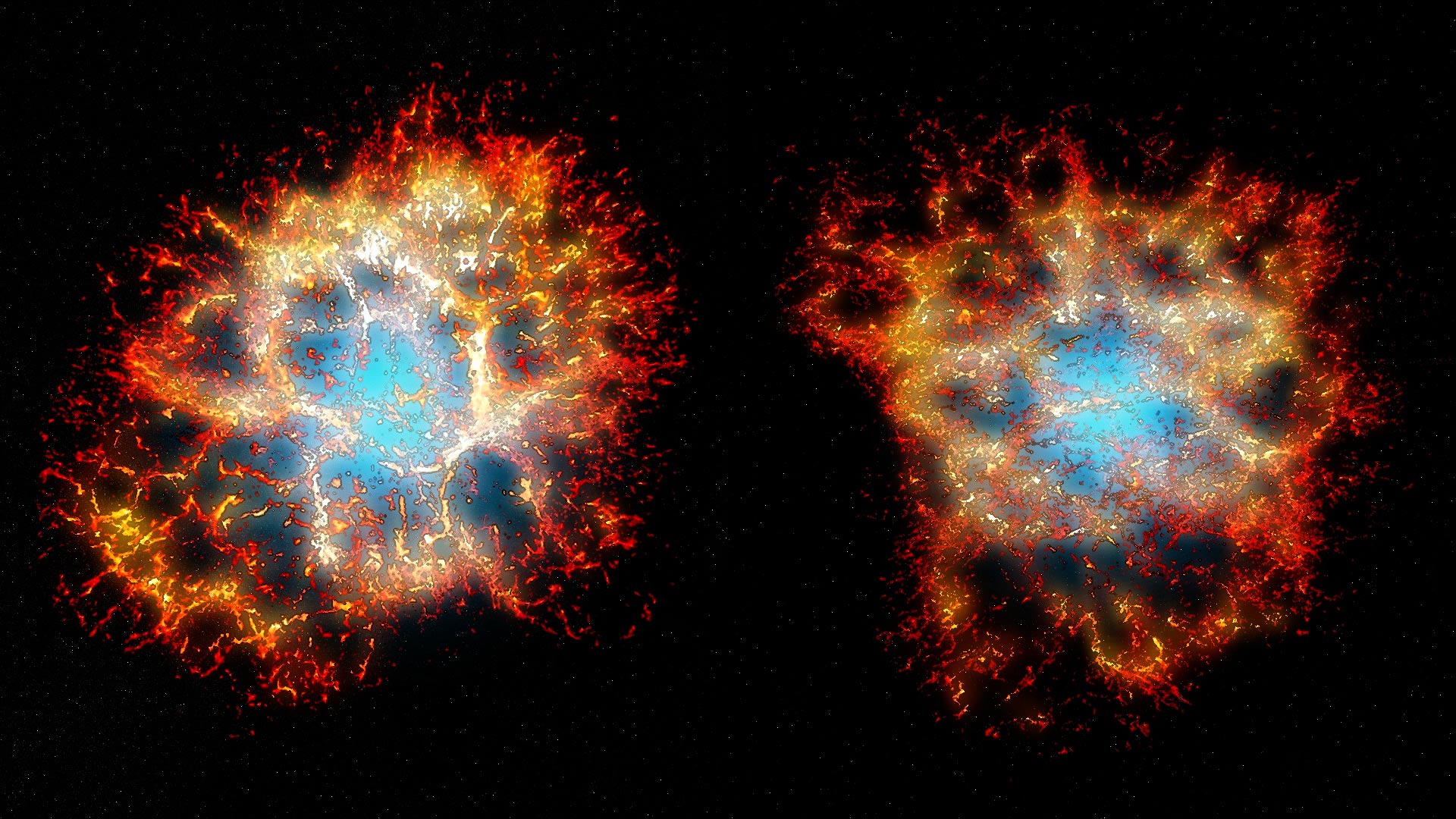
    Crab Nebula 3D Reconstruction
    3D reconstruction of the Crab nebula remnant as seen from Earth (right), and from another point of view showing its heart-shaped morphology (left). Credit: Thomas Martin, Danny Milisavljevic and Laurent Drissen

    Thomas Martin, the researcher at Université Laval who led the study, hopes to answer these questions using a new 3D reconstruction of the nebula. “Astronomers will now be able to move around and inside the Crab Nebula and study its filaments one by one,” said Martin.

    Similar Structures in Other Supernova Remnants

    The team used the powerful SITELLE imaging spectrometer on the Canada-Hawaii-France Telescope (CFHT) in Mauna Kea, Hawaii, to compare the 3D shape of the Crab to two other supernova remnants. Remarkably, they found that all three remnants had ejecta arranged in large-scale rings, suggesting a history of turbulent mixing and radioactive plumes expanding from a collapsed iron core.

    Co-author Dan Milisavljevic, an assistant professor at Purdue University and supernova expert, concludes that the fascinating morphology of the Crab seems to go against the most popular explanation of the original explosion.

    “The Crab is often understood as being the result of an electron-capture supernova triggered by the collapse of an oxygen-neon-magnesium core, but the observed honeycomb structure may not be consistent with this scenario,” Milisavljevic said.

    The new reconstruction was made possible by the ground-breaking technology used by SITELLE, which incorporates a Michelson interferometer design allowing scientists to obtain over 300,000 high-resolution spectra of every single point of the nebula.

    “SITELLE was designed with objects like the Crab Nebula in mind; but its wide field of view and adaptability make it ideal to study nearby galaxies and even clusters of galaxies at large distances,” said co-author Laurent Drissen.

    Supernova explosions are among the most energetic and influential phenomena in the universe. Consequently, Milisavljevic adds: “It is vital that we understand the fundamental processes in supernovae which make life possible. SITELLE will play a new and exciting role in this understanding.”

    Reference: “3D mapping of the Crab Nebula with SITELLE – I. Deconvolution and kinematic reconstruction” by T Martin, D Milisavljevic and L Drissen, 18 January 2021, Monthly Notices of the Royal Astronomical Society.
    DOI: 10.1093/mnras/staa4046

    Never miss a breakthrough: Join the SciTechDaily newsletter.
    Follow us on Google and Google News.

    Astronomy Astrophysics Royal Astronomical Society
    Share. Facebook Twitter Pinterest LinkedIn Email Reddit

    Related Articles

    Artificial Intelligence Helps Resolve Long-Running Astrophysics Debate on Supermassive Black Holes

    Martian Meteorite Hunters: Paving the Way for Future Rovers To Search for Meteorites on Mars

    Planetary Shields Will Buckle Under Furious Stellar Winds From Their Dying Stars – Nearly Impossible for Life To Survive

    Lucky Encounter: Solar Orbiter Spacecraft Flies Through the Tail of a Disintegrated Comet

    A Bug’s Life: Mountains on Neutron Stars May Be Only Fractions of Millimeters Tall

    Habitable Planets With Earth-Like Biospheres May Be Much Rarer Than Thought

    Mysterious Hydrogen-Free Supernova Sheds Light on Massive Stars’ Violent Death Throes

    New Research Finds That Supermassive Black Holes Could Form From Dark Matter

    Giant Radio Galaxies: Cosmic Beasts and Where to Find Them

    Leave A Reply Cancel Reply

    • Facebook
    • Twitter
    • Pinterest
    • YouTube

    Don't Miss a Discovery

    Subscribe for the Latest in Science & Tech!

    Trending News

    Scientists Warn That This Common Pet Fish Can Wreck Entire Ecosystems

    Scientists Make Breakthrough in Turning Plastic Trash Into Clean Fuel Using Sunlight

    This Popular Supplement May Interfere With Cancer Treatment, Scientists Warn

    Scientists Finally Solved One of Water’s Biggest Mysteries

    Could This New Weight-Loss Pill Disrupt the Entire Market? Here’s What You Should Know About Orforglipron

    Earth’s Crust Is Tearing Open in Africa, and It Could Form a New Ocean

    Breakthrough Bowel Cancer Trial Leaves Patients Cancer-Free for Nearly 3 Years

    Natural Compound Shows Powerful Potential Against Rheumatoid Arthritis

    Follow SciTechDaily
    • Facebook
    • Twitter
    • YouTube
    • Pinterest
    • Newsletter
    • RSS
    SciTech News
    • Biology News
    • Chemistry News
    • Earth News
    • Health News
    • Physics News
    • Science News
    • Space News
    • Technology News
    Recent Posts
    • Researchers Discover Boosting a Single Protein Helps the Brain Fight Alzheimer’s
    • AI Detects “Invisible” Signs of Pancreatic Cancer Years Before Diagnosis
    • Kratom Use Explodes in the US, With Life-Changing Consequences
    • Scientists Uncover Fatal Weakness in “Zombie Cells” Linked to Cancer
    • World-First Study Reveals Human Hearts Can Regenerate After a Heart Attack
    Copyright © 1998 - 2026 SciTechDaily. All Rights Reserved.
    • Science News
    • About
    • Contact
    • Editorial Board
    • Privacy Policy
    • Terms of Use

    Type above and press Enter to search. Press Esc to cancel.