
Close Menu
    Facebook X (Twitter) Instagram
    SciTechDaily
    • Biology
    • Chemistry
    • Earth
    • Health
    • Physics
    • Science
    • Space
    • Technology
    Facebook X (Twitter) Pinterest YouTube RSS
    SciTechDaily
    Home»Space»New Study Measures the Strength of Magnetic Fields Near Black Holes
    Space

    New Study Measures the Strength of Magnetic Fields Near Black Holes

    By Kate Greene, Lawrence Berkeley National LaboratoryJune 5, 2014No Comments3 Mins Read
    Facebook Twitter Pinterest Telegram LinkedIn WhatsApp Email Reddit
    Share
    Facebook Twitter LinkedIn Pinterest Telegram Email Reddit
    Strong Magnetic Fields Challenge Black Hole Pull
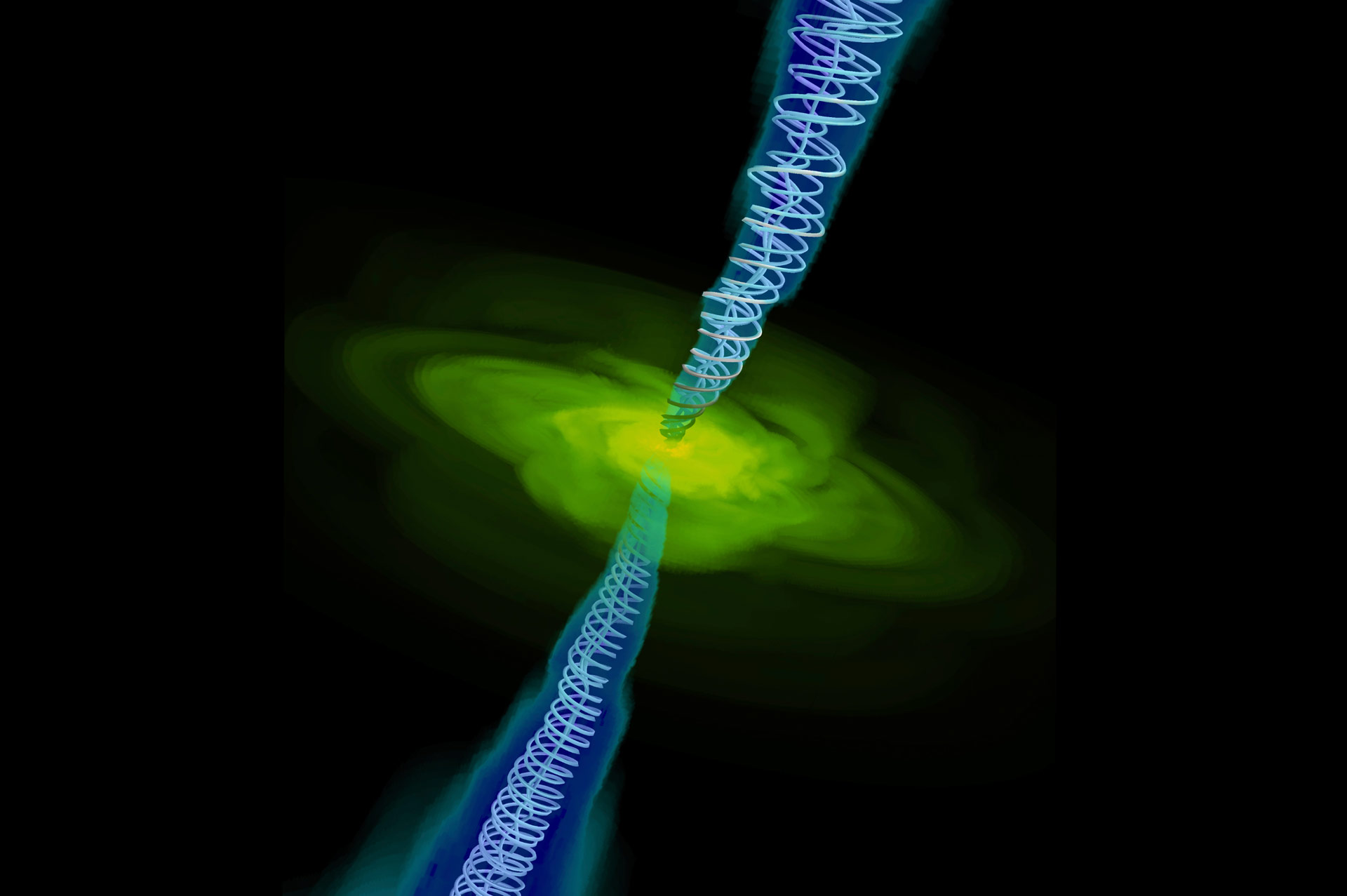
    A computer simulation of gas (in yellow) falling into a black hole (too small to be seen). Twin jets are also shown with magnetic field lines. Credit: Alexander Tchekhovskoy, LBL

    New research from the Berkeley Lab systematically measures the strength of magnetic fields near black holes for the first time, revealing that the measured magnetic fields can be as strong as a black hole’s gravity.

    A new study of supermassive black holes at the centers of galaxies has found magnetic fields play an impressive role in the systems’ dynamics. In fact, in dozens of black holes surveyed, the magnetic field strength matched the force produced by the black holes’ powerful gravitational pull, says a team of scientists from the U.S. Department of Energy’s Lawrence Berkeley National Laboratory (Berkeley Lab) and Max Planck Institute for Radio Astronomy (MPIfR) in Bonn, Germany. The findings are published in this week’s issue of Nature.

    “This paper for the first time systematically measures the strength of magnetic fields near black holes,” says Alexander Tchekhovskoy, the Berkeley Lab researcher who helped interpret the observational data within the context of existing computational models. “This is important because we had no idea, and now we have evidence from not just one, not just two, but from 76 black holes.”

    Previously, Tchekhovskoy, who is also a postdoctoral fellow at the University of California, Berkeley, had developed computational models of black holes that included magnetic fields. His models suggested a black hole could sustain a magnetic field that was as strong as its gravity, but there was not yet observational evidence to support this prediction. With the two forces balancing out, a cloud of gas caught on top of the magnetic field would be spared the pull of gravity and instead levitate in place.

    The magnetic field strength was confirmed by evidence from jets of gas that shoot away from supermassive black holes. Formed by magnetic fields, these jets produce a radio emission. “We realized that the radio emission from black holes’ jets can be used to measure the magnetic field strength near the black hole itself,” says Mohammad Zamaninasab, the lead author of the study, who did the work while at MPIfR.

    Other research teams had previously collected radio-emission data from “radio-loud” galaxies using the Very Long Baseline Array, a vast network of radio telescopes in the United States. The researchers analyzed this pre-existing data to create radio-emission maps at different wavelengths. Shifts in jet features between different maps let them calculate the field strength near the black hole.

    Based on the results, the team found not only that the measured magnetic fields can be as strong as a black hole’s gravity, but that they are also comparable in strength to those produced inside MRI machines found in hospitals–roughly 10,000 times greater than the field of the Earth itself.

    Tchekhovskoy says the new results mean theorists must re-evaluate their understanding of black-hole behavior. “The magnetic fields are strong enough to dramatically alter how gas falls into black holes and how gas produces outflows that we do observe, much stronger than what has usually been assumed,” he says. “We need to go back and look at our models once again.”

    Reference: “Dynamically important magnetic fields near accreting supermassive black holes” by M. Zamaninasab, E. Clausen-Brown, T. Savolainen and A. Tchekhovskoy, 4 June 2014, Nature.
    DOI: 10.1038/nature13399

    Never miss a breakthrough: Join the SciTechDaily newsletter.
    Follow us on Google and Google News.

    Astronomy Astrophysics Black Hole Lawrence Berkeley National Laboratory Popular
    Share. Facebook Twitter Pinterest LinkedIn Email Reddit

    Related Articles

    Mysterious “Universe Breaker” Red Dots Could Be Black Holes in Disguise

    90% Chance: Physicists Predict a Black Hole Could Explode This Decade

    Webb Telescope Spots Oldest Black Hole, Shattering Cosmic Records

    Astronomers Spot Possible Biggest Black Hole in the Universe

    “How Can We Make Sense of This?” – Strange “Infinity” Galaxy Stuns Scientists

    Astronomers Stunned As Mysterious Flare Repeats From Same Black Hole Two Years Later

    “Never Been Seen Before” – Astronomers Discover Bizarre “Infinity” Galaxy

    LIGO Detects Black Hole Smashup So Extreme It’s Bending Einstein’s Rules

    Cosmic Heavyweights Collide – LIGO Detects Largest, Fastest-Spinning Black Holes Yet

    Leave A Reply Cancel Reply

    • Facebook
    • Twitter
    • Pinterest
    • YouTube

    Don't Miss a Discovery

    Subscribe for the Latest in Science & Tech!

    Trending News

    Artificial Sweeteners May Harm Future Generations, Study Suggests

    Splashdown! NASA Artemis II Returns From Record-Breaking Moon Mission

    What If Consciousness Exists Beyond Your Brain

    Scientists Finally Crack the 100-Million-Year Evolutionary Mystery of Squid and Cuttlefish

    Beyond “Safe Levels”: Study Challenges What We Know About Pesticides and Cancer

    Researchers Have Found a Dietary Compound That Increases Longevity

    Scientists Baffled by Bizarre “Living Fossil” From 275 Million Years Ago

    Your IQ at 23 Could Predict Your Wealth at 27, Study Finds

    Follow SciTechDaily
    • Facebook
    • Twitter
    • YouTube
    • Pinterest
    • Newsletter
    • RSS
    SciTech News
    • Biology News
    • Chemistry News
    • Earth News
    • Health News
    • Physics News
    • Science News
    • Space News
    • Technology News
    Recent Posts
    • This Metal Melts in Your Hand – and Scientists Just Discovered Something Strange
    • Why Losing Too Much Fat Can Be Just As Dangerous as Obesity
    • Beef vs. Chicken: Surprising Results From New Prediabetes Study
    • Alzheimer’s Breakthrough: Scientists Discover Key Protein May Prevent Toxic Protein Clumps in the Brain
    • Scientists Discover New Way To Make Protein Shakes Taste Better
    Copyright © 1998 - 2026 SciTechDaily. All Rights Reserved.
    • Science News
    • About
    • Contact
    • Editorial Board
    • Privacy Policy
    • Terms of Use

    Type above and press Enter to search. Press Esc to cancel.