
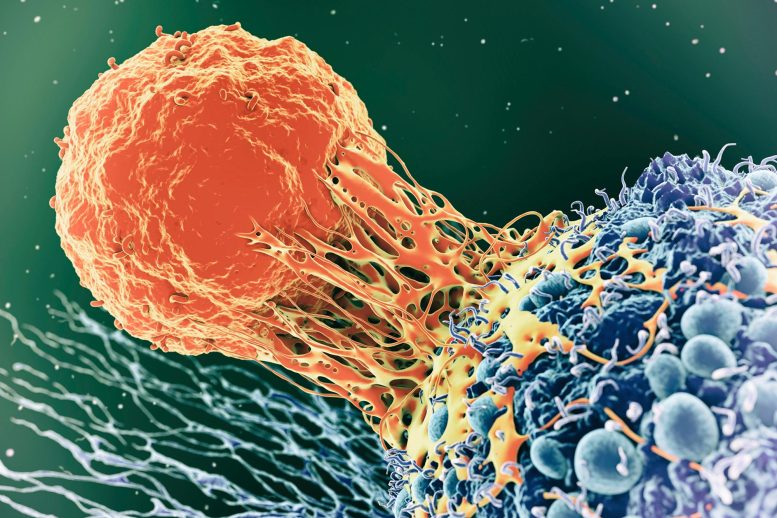
A Yale University study presents a new explanation for why immunotherapy only works for some cancer patients.
Immunotherapy, a biotherapy that improves the immune system’s ability to recognize and fight mutant tumor cells, has changed the treatment landscape for patients suffering from cancer, which is caused by the progressive accumulation of DNA mutations. Many individuals, however, do not respond to immunotherapy. For instance, studies have indicated that only half of patients with highly mutated colorectal and endometrial cancers will respond to immunotherapy.
A recent study conducted by Yale School of Medicine researchers recently published in the journal Cancer Discovery has uncovered a possible explanation for why this occurs. According to an analysis of a phase 2 study involving 24 patients with endometrial cancer and the immunotherapy drug pembrolizumab, the Yale team pinpoints a specific mechanism of faulty DNA repair in tumors as a key factor in determining patient outcomes.
“We wanted to understand why some patients respond better than others to immunotherapy,” said co-corresponding author Ryan Chow, an M.D./Ph.D. candidate working in Yale’s Department of Genetics and the Systems Biology Institute.
Mismatch Repair: The DNA Editing Process
The Yale team’s research concentrated on the failure of a process known as “mismatch repair.” When cells divide, errors in their DNA often arise. A special group of proteins identifies and corrects DNA errors through mismatch repair. However, a breakdown in this editing process occurs in many different types of cancer, resulting in high mutation levels.
The research team — led by Chow, Dr. Eric Song, an ophthalmology resident and former M.D./Ph.D. student at Yale, and Dr. Alessandro Santin, a professor of obstetrics, gynecology, and reproductive sciences — zeroed in on the fact that mismatch repair deficiency can result from two distinct mechanisms. In one, mutations occur in the DNA repair machinery itself, leading to the production of defective repair proteins; in the second, production of the DNA repair machinery is halted entirely. In both cases, the tumors accumulate very high levels of mutations that would be expected to make them good candidates for immunotherapy.
“An analogy would be a dysfunctional toy factory,” Chow said. “Maybe the factory makes broken toys that don’t work, or the factory has no personnel and stops producing toys altogether. Either way, kids won’t be happy.”
Immunotherapy Responses: A Tale of Two Tumor Types
However, the researchers found that tumors with defective DNA repair proteins had significantly better responses to immunotherapy than those in which the production of DNA repair proteins had been silenced. These differences could ultimately be traced to changes in the immune response that was mounted against each of the two classes of tumors, they said.
“When it comes to immunotherapy, it seems that the journey — in this case, the underlying cause of mismatch repair deficiency — may be just as important as the destination,” Chow said.
Added Song: “The innovative use of clinical trial data can guide our understanding of how immunotherapy manipulates the immune system and ultimately improve how we treat patients.”
Reference: “Distinct mechanisms of mismatch repair deficiency delineate two modes of response to PD-1 immunotherapy in endometrial carcinoma” by Ryan D. Chow, Tai Michaels, Stefania Bellone, Tobias MP. Hartwich, Elena Bonazzoli, Akiko Iwasaki, Eric Song and Alessandro D. Santin, 27 October 2022, Cancer Discovery.
DOI: 10.1158/2159-8290.CD-22-0686
Santin is part of the Yale Cancer Center and Song is a resident at Smilow Cancer Hospital.
Never miss a breakthrough: Join the SciTechDaily newsletter.
Follow us on Google and Google News.