
Close Menu
    Facebook X (Twitter) Instagram
    SciTechDaily
    • Biology
    • Chemistry
    • Earth
    • Health
    • Physics
    • Science
    • Space
    • Technology
    Facebook X (Twitter) Pinterest YouTube RSS
    SciTechDaily
    Home»Space»Newly Discovered Planetary Candidates are Nearly Skimming Their Host Star’s Surface
    Space

    Newly Discovered Planetary Candidates are Nearly Skimming Their Host Star’s Surface

    By Carnegie Institution for ScienceOctober 11, 2013No Comments3 Mins Read
    Facebook Twitter Pinterest Telegram LinkedIn WhatsApp Email Reddit
    Share
    Facebook Twitter LinkedIn Pinterest Telegram Email Reddit
    Survey Reveals Planetary Candidates with Orbital Periods as Short as Four Hours
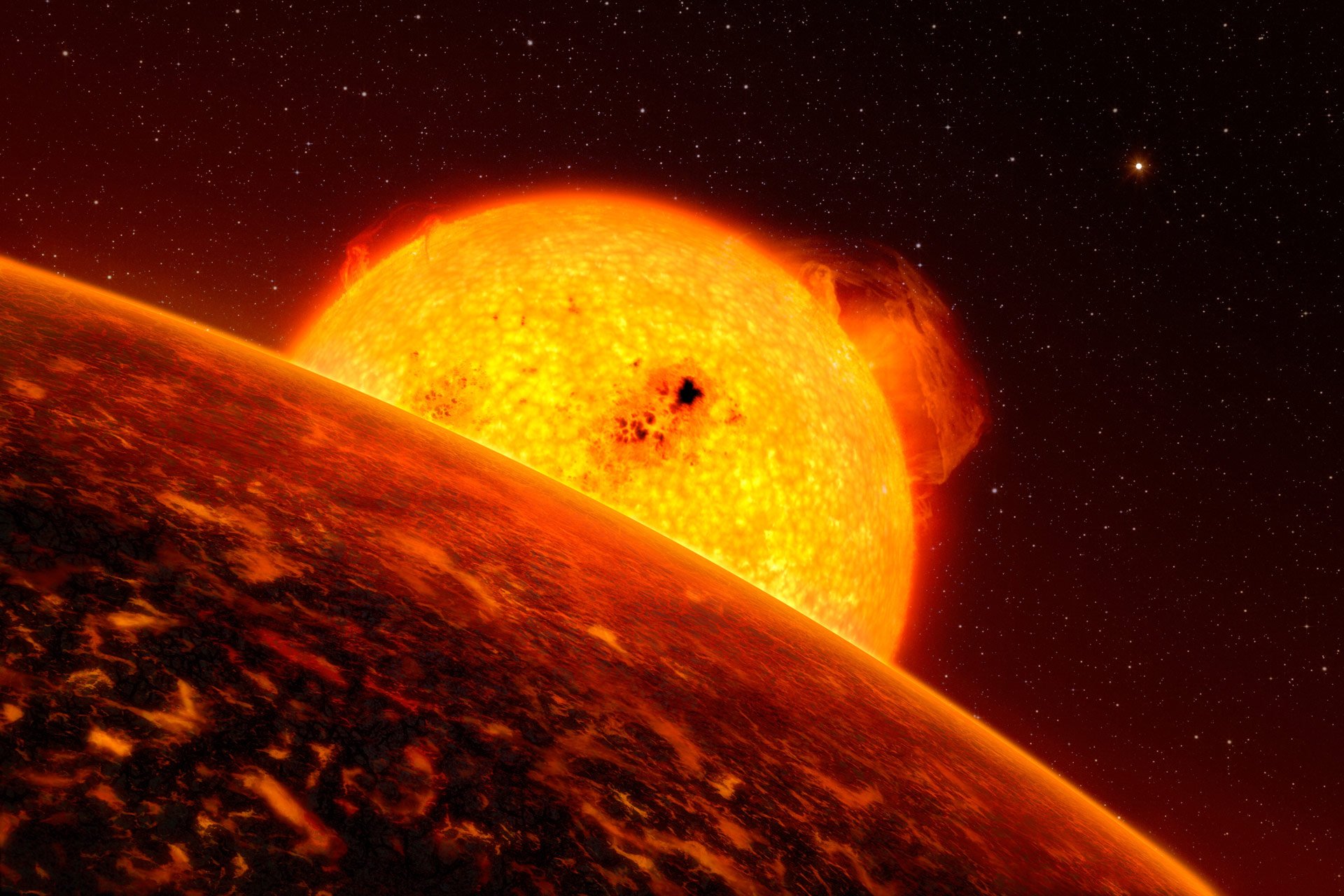
    Brian Jackson’s study focuses on planetary candidates with orbital periods so close to their host stars that they are nearly skimming the stellar surface. The exoplanet Corot-7b is so close to its Sun-like host star that it must experience extreme conditions. This planet has a mass five times that of Earth’s and is in fact the closest known exoplanet to its host star, which also makes it the fastest — it orbits its star at a speed of more than 750,000 kilometers (466,000 miles) per hour. The probable temperature on its “day-face” is above 2,000 degrees (3,600 °F), but minus 200 degrees (-330 °F) on its night face. Theoretical models suggest that the planet may have lava or boiling oceans on its surface. Our artist has provided an impression of how it may look like if it were covered by lava. The sister planet, Corot-7c, is seen in the distance. Credit: ESO/L. Calcada

    New research presented at the American Astronomical Society’s Division of Planetary Sciences details the discovery of planetary candidates with orbital periods as short as four hours, so close to their host stars that they are nearly skimming the stellar surface.

    Washington, D.C.— A new planet-hunting survey has revealed planetary candidates with orbital periods as short as four hours and so close to their host stars that they are nearly skimming the stellar surface. If confirmed, these candidates would be among the closest planets to their stars discovered so far. Brian Jackson of the Carnegie Institution for Science’s Department of Terrestrial Magnetism presented his team’s findings, which are based on data from NASA’s Kepler mission, at the American Astronomical Society’s Division of Planetary Sciences meeting Tuesday.

    Most gas giant exoplanets with orbital periods less than or equal to a few days are unstable. This is due to decay in their orbits caused by the effects of their star’s proximity. For rocky or icy planets, this disruption could bring them close enough to the star that the force of their own gravity can no longer hold them together in the face of the star’s gravity.

    Motivated by these considerations, Jackson’s team conducted a search for very short-period transiting objects in the publicly available Kepler dataset. Their preliminary survey revealed about a half dozen planetary candidates, all with periods less than 12 hours. Even with masses of only a few times that of Earth, the short periods mean they might be detectable by currently operating ground-based facilities.

    If confirmed, these planets would be among the shortest-period planets ever discovered, and if common, such planets would be particularly amenable to discovery by the planned TESS mission, which will look for, among other things, short-period rocky planets.

    In his presentation, Jackson described the survey, what has been learned about the candidates from Kepler data, and the team’s plans for follow-up observations.

    The team includes Carnegie’s Christopher Stark and Alan Boss, as well as Elisabeth Adams of the Planetary Science Institute, Michael Endl of the McDonald Observatory, Phil Arras of the University of Virginia, and Drake Deming of the University of Maryland at College Park.

    Funding for this work was provided by the Carnegie Institution for Science’s Department of Terrestrial Magnetism.

    Never miss a breakthrough: Join the SciTechDaily newsletter.
    Follow us on Google and Google News.

    Astronomy Astrophysics Carnegie Institution for Science Planetary Science
    Share. Facebook Twitter Pinterest LinkedIn Email Reddit

    Related Articles

    JWST Reveals a “Forbidden” Planet With a Baffling Composition

    Webb Telescope Spots “Impossible” Atmosphere Around Ancient Super-Earth

    The Interior Chemistry of Distant Planet’s May Differ from Earth

    Study Reveals Water on Earth is Older Than Our Sun

    Cool Planet-Like Object May Have Spent Much of Its Youth as Hot as a Star

    Recently Discovered Luhman 16AB System May Harbor Planet

    3D Models Confirm Supernova’s Role in the Formation of Our Solar System

    Trajectory Models of Refractory Particles Help Solve Two Solar System Puzzles

    Diogenites Provide Clues of the Earliest Days of Our Solar System

    Leave A Reply Cancel Reply

    • Facebook
    • Twitter
    • Pinterest
    • YouTube

    Don't Miss a Discovery

    Subscribe for the Latest in Science & Tech!

    Trending News

    New Study Reveals Why Ozempic Works Better for Some People Than Others

    Climate Change Is Altering a Key Greenhouse Gas in a Way Scientists Didn’t Expect

    New Study Suggests Gravitational Waves May Have Created Dark Matter

    Scientists Discover Why the Brain Gets Stuck in Schizophrenia

    Scientists Engineer “Tumor-Eating” Bacteria That Devour Cancer From Within

    Even “Failed” Diets May Deliver Long-Term Health Gains, Study Finds

    NIH Scientists Discover Powerful New Opioid That Relieves Pain Without Dangerous Side Effects

    Collapsing Plasma May Hold the Key to Cosmic Magnetism

    Follow SciTechDaily
    • Facebook
    • Twitter
    • YouTube
    • Pinterest
    • Newsletter
    • RSS
    SciTech News
    • Biology News
    • Chemistry News
    • Earth News
    • Health News
    • Physics News
    • Science News
    • Space News
    • Technology News
    Recent Posts
    • JWST Reveals a “Forbidden” Planet With a Baffling Composition
    • New Research Challenges 30-Year-Old Theory of Eye Development
    • The Protein “Sabotaging” Aging Muscle Recovery Could Be Key to Surviving Aging
    • This Diet–Gut Interaction Could Transform Fat Into a Calorie-Burning Machine
    • Why Some People Reach 100: New Study Reveals Key Biological Differences
    Copyright © 1998 - 2026 SciTechDaily. All Rights Reserved.
    • Science News
    • About
    • Contact
    • Editorial Board
    • Privacy Policy
    • Terms of Use

    Type above and press Enter to search. Press Esc to cancel.