
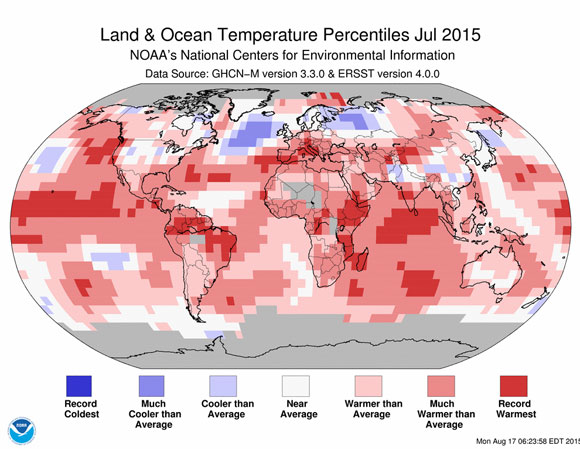
A new report from the National Oceanic and Atmospheric Administration reveals that July 2015 had the all-time highest monthly temperature in the 1880–2015 record, at 61.86°F (16.61°C), surpassing the previous record set in 1998 by 0.14°F (0.08°C).
Global highlights: July 2015
- The July average temperature across global land and ocean surfaces was 1.46°F (0.81°C) above the 20th century average. As July is climatologically the warmest month for the year, this was also the all-time highest monthly temperature in the 1880–2015 record, at 61.86°F (16.61°C), surpassing the previous record set in 1998 by 0.14°F (0.08°C).
- Separately, the July globally-averaged land surface temperature was 1.73°F (0.96°C) above the 20th century average. This was the sixth highest for July in the 1880–2015 record.
- The July globally-averaged sea surface temperature was 1.35°F (0.75°C) above the 20th century average. This was the highest temperature for any month in the 1880–2015 record, surpassing the previous record set in July 2014 by 0.13°F (0.07°C). The global value was driven by record warmth across large expanses of the Pacific and Indian Oceans.
- The average Arctic sea ice extent for July was 350,000 square miles (9.5 percent) below the 1981–2010 average. This was the eighth smallest July extent since records began in 1979 and largest since 2009, according to analysis by the National Snow and Ice Data Center using data from NOAA and NASA.
- Antarctic sea ice during July was 240,000 square miles (3.8 percent) above the 1981–2010 average. This was the fourth largest July Antarctic sea ice extent on record and 140,000 square miles smaller than the record-large July extent of 2014.
Global highlights: Year-to-date (January–July 2015)
- The year-to-date temperature combined across global land and ocean surfaces was 1.53°F (0.85°C) above the 20th century average. This was the highest for January–July in the 1880–2015 record, surpassing the previous record set in 2010 by 0.16°F (0.09°C).
- The year-to-date globally-averaged land surface temperature was 2.41°F (1.34°C) above the 20th century average. This was the highest for January–July in the 1880–2015 record, surpassing the previous record of 2007 by 0.27°F (0.15°C).
- The year-to-date globally-averaged sea surface temperature was 1.21°F (0.67°C) above the 20th century average. This was also the highest for January–July in the 1880–2015 record, surpassing the previous record of 2010 by 0.11°F (0.06°C). Every major ocean basin observed record warmth in some areas.
Never miss a breakthrough: Join the SciTechDaily newsletter.
Follow us on Google and Google News.
3 Comments
The real problem here is that we cannot trust anything that NOAA has to say about anything. There have been direct measurements we used to calculate Mean Global Temperature for the last 180 years and NOAA has “recalibrated” those records, afterwards claiming that they are now more accurate when they completely dismiss previous records and years of occurrence.
We have NOAA crying about the CO2 that man is “adding” to the atmosphere and when you read the fine print they have said that man is responsible for 1.5% of the atmospheric “pollution”. Upon closer inspection of that it turns out that 1% (or 67% of that “pollution) is WATER VAPOR while the remaining half percent is miscellaneous gases mostly CO2.
They provided charts demonstrating the Vostok Ice Cores and talked about how the CO2 profile showed that it was effecting temperature. However, they provided the charts from the Russian sources which are backwards to the way Americans would read them. Read from the past to the present these charts PLAINLY demonstrate that the CO2 trails the changes in temperature and not the other way around. So changes in CO2 are likely to be a biological effect to the changes in temperature.
There is hardly a spot in claims from NOAA where you cannot argue faulty science.
Imbecile. It has been shown repeatedly that even if you use unadjusted data, you get the same trend. Your crap about the ice cores is equally fallacious–they show that CO2 can also play the role of a feedback. Maybe you should actually look at some science.
This divergence between land and satellite measurements is quite disturbing. Someone is cooking the books. Since land has always cooled the past and warmed the present makes them suspect. Satellites corrections have been in both directions.