
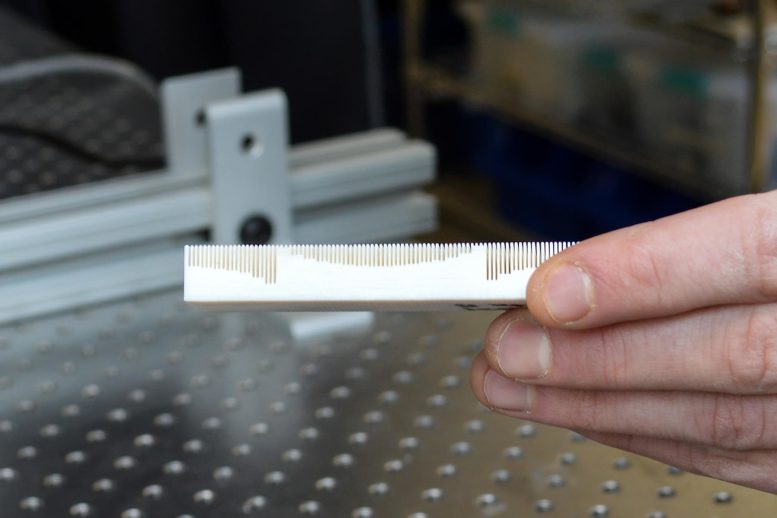
This contactless manipulation method has potential applications in industries including robotics and manufacturing.
A team of researchers at the University of Minnesota Twin Cities has uncovered a way to manipulate objects using ultrasound waves, paving the way for contactless movement in industries like manufacturing and robotics without the need for an internal power source.
The findings have been published in the peer-reviewed journal Nature Communications.
While it’s been demonstrated before that light and sound waves can manipulate objects, the objects have always been smaller than the wavelength of sound or light, or on the order of millimeters to nanometers, respectively. The University of Minnesota team has developed a method that can move larger objects using the principles of metamaterial physics.
Metamaterials are materials that are artificially engineered to interact with waves, like light and sound. By placing a metamaterial pattern on the surface of an object, the researchers were able to use sound to steer it in a certain direction without physically touching it.
The Power of Metasurfaces
“We have known for a while that waves and light and sound can manipulate objects. What sets our research apart is that we can manipulate and trap much bigger objects if we make their surface a metamaterial surface or a ‘metasurface,’” said Ognjen Ilic, senior author of the study and the Benjamin Mayhugh Assistant Professor in the University of Minnesota Department of Mechanical Engineering. “When we place these tiny patterns on the surface of the objects, we can basically reflect the sound in any direction we want. And in doing that, we can control the acoustic force that is exerted on an object.”
A video of the researchers moving an object with ultrasound. Credit: University of Minnesota
Using this technique, the researchers can not only move an object forward but also pull it toward a source—not too dissimilar from the tractor-beam technology in science fiction stories like Star Trek.
Their method could prove useful for moving objects in fields like manufacturing or robotics.
“Contactless manipulation is a hot area of research in optics and electromagnetism, but this research proposes another method for contactless actuation that offers advantages that other methods may not have,” said Matthew Stein, first author on the paper and a graduate student in the University of Minnesota Department of Mechanical Engineering. “Also, outside of the applications that this research enables, expanding upon our knowledge of physics is just a very exciting thing to do in general!”
While this study is more a demonstration of the concept, the researchers aim to test out higher frequencies of waves and different materials and object sizes in the future.
“In a lot of fields of science and engineering, robotics especially, there is the need to move things, to transfer a signal into some sort of controlled motion,” Ilic said. “Often this is done through physical tethers or having to carry some source of energy to be able to perform a task. I think we’re charting in a new direction here and showing that without physical contact, we can move objects, and that motion can be controlled simply by programming what is on the surface of that object. This gives us a new mechanism to contactlessly actuate things.”
Reference: “Shaping contactless radiation forces through anomalous acoustic scattering” by Matthew Stein, Sam Keller, Yujie Luo and Ognjen Ilic, 1 November 2022, Nature Communications.
DOI: 10.1038/s41467-022-34207-7
The study was funded by the Minnesota Robotics Institute and the Air Force Office of Scientific Research.
Never miss a breakthrough: Join the SciTechDaily newsletter.
Follow us on Google and Google News.
6 Comments
Is this different from using sound to levitate objects as described in this article?
https://www.livescience.com/1165-scientists-levitate-small-animals.html
Can this meta material be applied as a paint ? And could it be used to get spaceships to orbit using a strong radio dish antenna beaming correct frequency ? Once in orbit then satellite antenna could push the craft into any destination saving on fuel cost.
I like where your train of thought is going. If sound could propel spacecraft in specific directions in antigravity then offplanet tourism could be a leisurely pastime.
Delving further though could Soundwaves also be used as a type of sonar to divert a spacecrafts direction? If an external wave focused outwards came in contact with other objects could it be bounced back to alert us of potential collision courses or could it PUSH OBJECTS OUT OF THE WAY OF OUR SPACECRAFT? Imagine how much farther humankind could go if hazardous space debris could be easily pushed around spacecraft. Although I don’t think they would work the same in space as they do here on Earth where gravity affects the way that they are manipulated making their research look like what happens when two magnets push away from each other.
Umm…sond waves in vacum of space?
Yeah, because the vacuum of space has no particles for sound waves to bounce off there’s no sound transfer through space, aside from gravitational waves which are a very specific high energy sound wave.
This is nothing new. People in other parts of the world have been moving huge objects with sound vibrations. Researchers at Minnesota University are very late bloomers to these facts.