
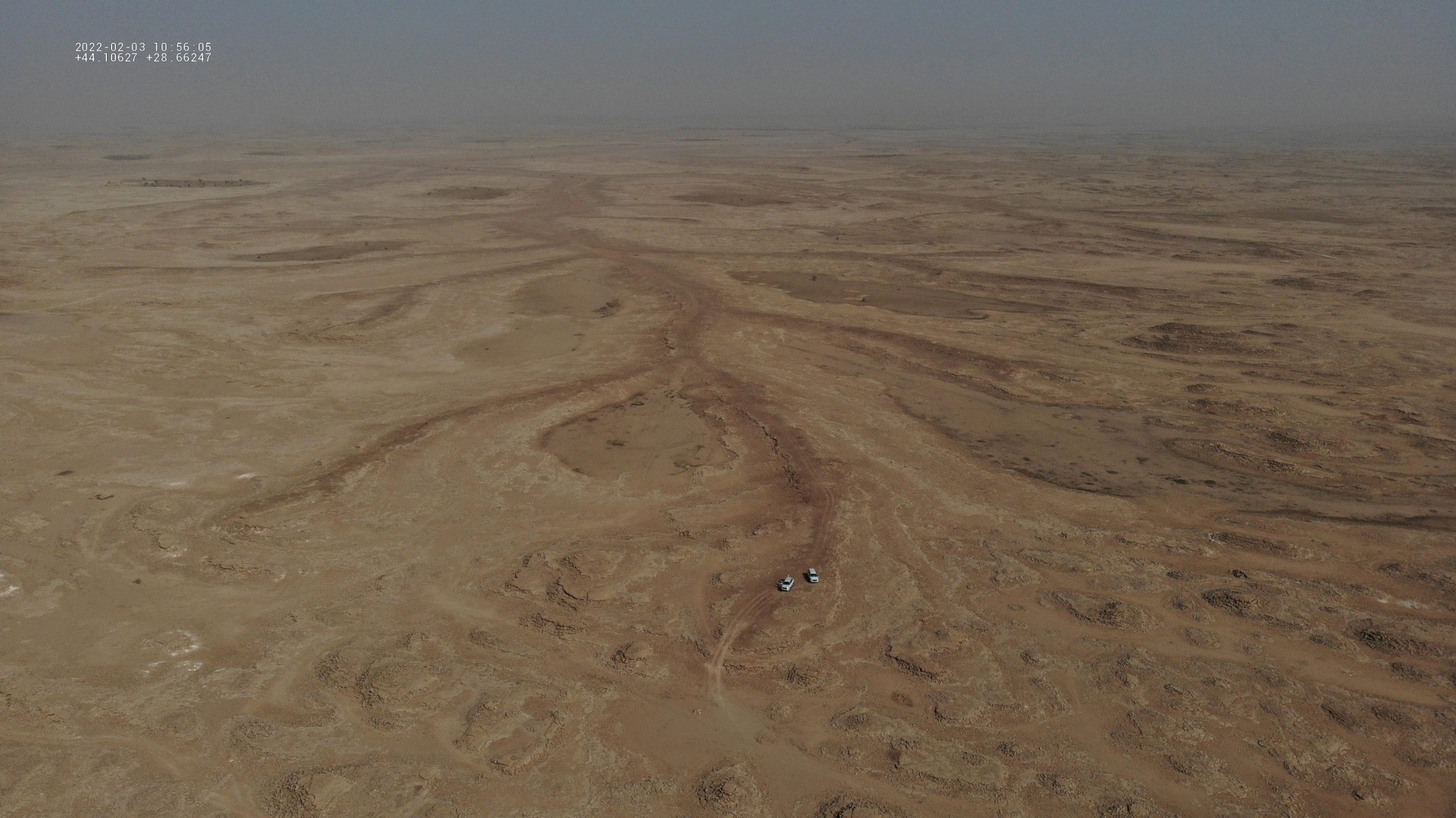
An international team of researchers, including scientists from UNIGE, has discovered that the Arabian Peninsula’s desert was once shaped by a massive lake and a network of rivers.
The Rub’ al-Khali, or Empty Quarter, is one of the largest deserts on Earth, covering nearly 650,000 square kilometers across the Arabian Peninsula, primarily in Saudi Arabia. Its towering sand dunes, some reaching up to 250 meters high, define it as an extreme and inhospitable environment today. However, it hasn’t always been a barren expanse.
A recent study led by researchers from the University of Geneva (UNIGE), in collaboration with King Abdullah University of Science and Technology (KAUST), Griffith University, the California Institute of Technology, the University of Texas, and the University of the Fraser Valley, reveals that this region once hosted a vast network of lakes and rivers. During wetter climatic periods, the area supported grasslands and savannahs, creating conditions favorable for human habitation and migration.
Published in Communications Earth & Environment, the study highlights how shifting climate cycles dramatically reshaped the landscape and influenced the movements of early human populations. As arid conditions returned, these once-thriving areas were abandoned, underscoring the powerful role of climate in shaping both ecosystems and human history.
‘‘Our work highlights the presence of an ancient lake, which reached its peak around 8,000 years ago, as well as rivers and a large valley shaped by water,’’ explains Abdallah Zaki, first author of the study and a former researcher in the Section of Earth and Environmental Sciences at the UNIGE Faculty of Science and at the California Institute of Technology, currently a distinguished postdoctoral fellow at the Jackson School of Geosciences, University of Texas.
A 42-meter-deep lake
These water sites emerged during the ‘‘Green Arabia’’ period, a time of heavy rainfall that lasted from approximately 11,000 to 5,500 years ago, at the end of the Quaternary era. ‘‘The lake is estimated to have been vast, covering an area of 1,100 m² – almost twice the surface area of Lake Geneva – and reaching a depth of 42 meters. As rainfall increased, the lake eventually overflowed, causing a major flood that carved a 150 km-long valley into the desert floor,’’ explains Sébastien Castelltort, professor of earth surface dynamics in the Section of Earth and Environmental Sciences at the UNIGE Faculty of Science, who led the work with Abdallah Zaki on the UNIGE side.
Based on sediments and landforms traced over 1000 km, scientists believe that the heavy rains feeding these ancient waterholes came from the northward expansion of the African and Indian monsoons. These wet phases, linked to orbital cycles, varied in duration depending on the region: lasting several millennia in the south compared to only a few centuries in the north. They favored the formation of grasslands and savannahs, which in turn facilitated human expansion across the Arabian Peninsula.
Human Impact
‘‘The formation of lake and river landscapes, along with grasslands and savannahs, would have facilitated the expansion of hunting, gathering, and pastoral groups into what is now a dry, barren desert. This is confirmed by abundant archaeological evidence found in the Empty Quarter and along its ancient lake and river systems,’’ says Michael Petraglia, professor at Griffith University’s Australian Research Centre for Human Evolution. 6,000 years ago, the region experienced a sharp decline in rainfall, creating dry, arid conditions that forced these nomadic populations to migrate to more hospitable environments.
These findings underscore the crucial role played by the African monsoon in the rapid transformation of the Arabian Peninsula’s desert landscape, as well as in shaping population movements. This narrative of climate perturbations and human migrations, written in rocks and landscapes, is fundamental to understanding and predicting the possible consequences of current climate change.
Reference: “Monsoonal imprint on late Quaternary landscapes of the Rub’ al Khali Desert” by Abdallah S. Zaki, Antoine Delaunay, Guillaume Baby, Negar Haghipour, Cécile Blanchet, Anne Dallmeyer, Pietro Sternai, Sam Woor, Omar Wani, Hany Khalil, Mathieu Schuster, Michael Petraglia, Florence Sylvestre, Giovan Peyrotty, Mohamed Ali, Frans Van Buchem, Abdulkader M. Afifi and Sébastien Castelltort, 3 April 2025, Communications Earth & Environment.
DOI: 10.1038/s43247-025-02224-1
Never miss a breakthrough: Join the SciTechDaily newsletter.
Follow us on Google and Google News.
1 Comment
“…, from approximately 11,000 to 5,500 years ago, at the end of the Quaternary era.”
The Quaternary is a Period, not an era; the “last half” is known as the Holocene Epoch. Both are members of the Cenozoic Era.