

Mini sand dunes form from bouncing sand on hard surfaces. A new model explains their growth on both Earth and Mars.
A new study led by the University of Southampton, in collaboration with research institutes in France, has revealed how mini sand dunes form on beaches and in deserts.
Although the formation of large desert dunes is well understood, existing theories have not been able to explain how smaller-scale dunes, like those commonly seen on beach holidays, come into being.
The findings, published in the journal PNAS, shed light on how these so-called “proto dunes” form on Earth and may also provide insights into similar formations on Mars and other planets.
Why traditional dune theory falls short
“These are the kind of smaller scale sand bedforms that people would see forming before their eyes on the beach before the wind stops or the waves wash them away,” says Professor Jo Nield from the University of Southampton who led the study.
“The theory of how the large, wavy dunes you might picture in the Sahara Desert form assumes you have near limitless amounts of soft, dry sand which is picked up and deposited by the wind. But this doesn’t account for how these small dunes take shape on moist surfaces like a beach or in hard gravelly areas.”
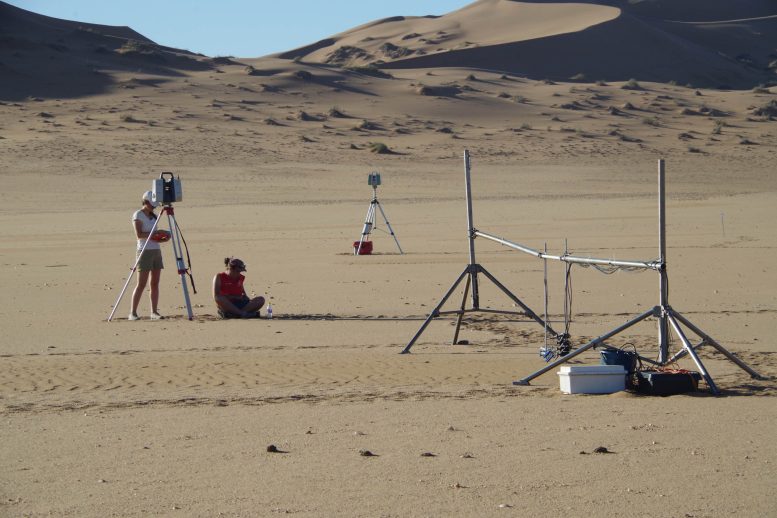
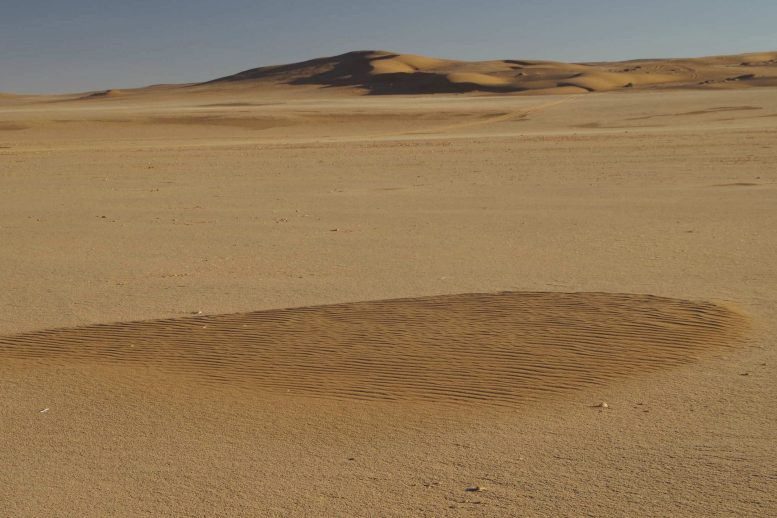
Proto dunes have been challenging to study in detail because they are small, often just a few centimeters tall, and they form and grow quickly, reaching up to six centimeters in height within just 30 minutes. They can also vanish just as rapidly as they appear.
Laser scanning captures dune formation in real time
The international research team, with team members from Southampton, Paris, Oxford, Loughborough, Illinois and Denver, were able to capture how these small dunes form for the first time using high-resolution laser scanning in the Namibian desert.
They found that sand moving on harder, more consolidated surfaces bounces higher and is transported more by the wind. Once it lands on a softer, rippled surface, the sand accumulates.
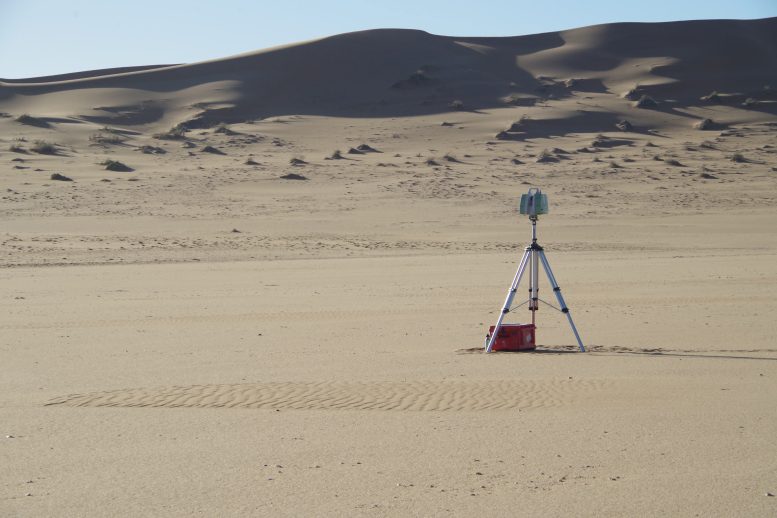
Prof Nield said: “On these surfaces, the sand doesn’t just roll across the land, it jumps up to a meter or so and so there is a gradual transition when grains will feel the change from a consolidated to rippled surface.
“Once bumps start to form, this influences wind patterns, adding further sand and helping the dune to grow, as happens in larger dunes.”
New computer model simulates dune growth
This new theory, coupled with the high-resolution data captured, has been developed by coauthors in Paris to create a computer model of the dynamics at play. Excitingly, the model can accurately reproduce what researchers have observed in their field studies in arid conditions such as Namibia but also in moist conditions in Colorado and Norfolk.
The model also allows the team to tweak different parameters, such as the amount of sand and wind, to understand different scenarios.
The model explains growth and erosion
Prof Philippe Claudin, a co-author on the paper from the French National Centre for Scientific Research (CNRS), said: “The model can replicate almost perfectly what we see in our field data. Interestingly, we see similar patterns in arid areas with gravel and coastal areas where there’s moisture.
“Using the model, we can see that if there are really strong winds, the dunes will get bigger and bigger, whereas if there is not much sand coming in, the proto-dune will erode and disappear.”
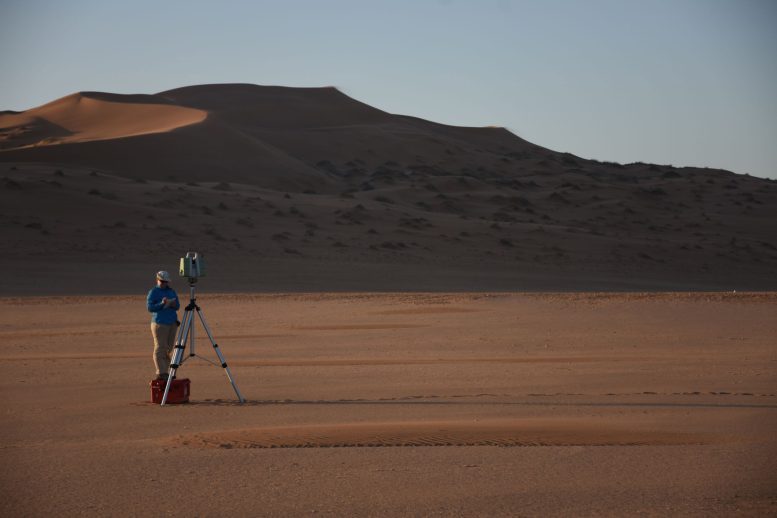
These proto-dunes aren’t unique to Earth. The research team are now looking at how mini dunes form on Mars.
“We are really excited to see how what we’ve learned on Earth could be applied to Mars and to understand similarities and differences between proto-dunes on the two planets,” says Prof Nield.
Reference: “Modeling the dynamics of aeolian meter-scale bedforms induced by bed heterogeneities” by Camille Rambert, Joanna M. Nield, Clément Narteau, Pauline Delorme, Giles F. S. Wiggs, Matthew C. Baddock, Jim Best, Kenneth T. Christensen and Philippe Claudin, 16 May 2025, Proceedings of the National Academy of Sciences.
DOI: 10.1073/pnas.2426143122
The research was funded by the Natural Environment Research Council (NERC) and the National Science Foundation (NSF).
Never miss a breakthrough: Join the SciTechDaily newsletter.
Follow us on Google and Google News.