
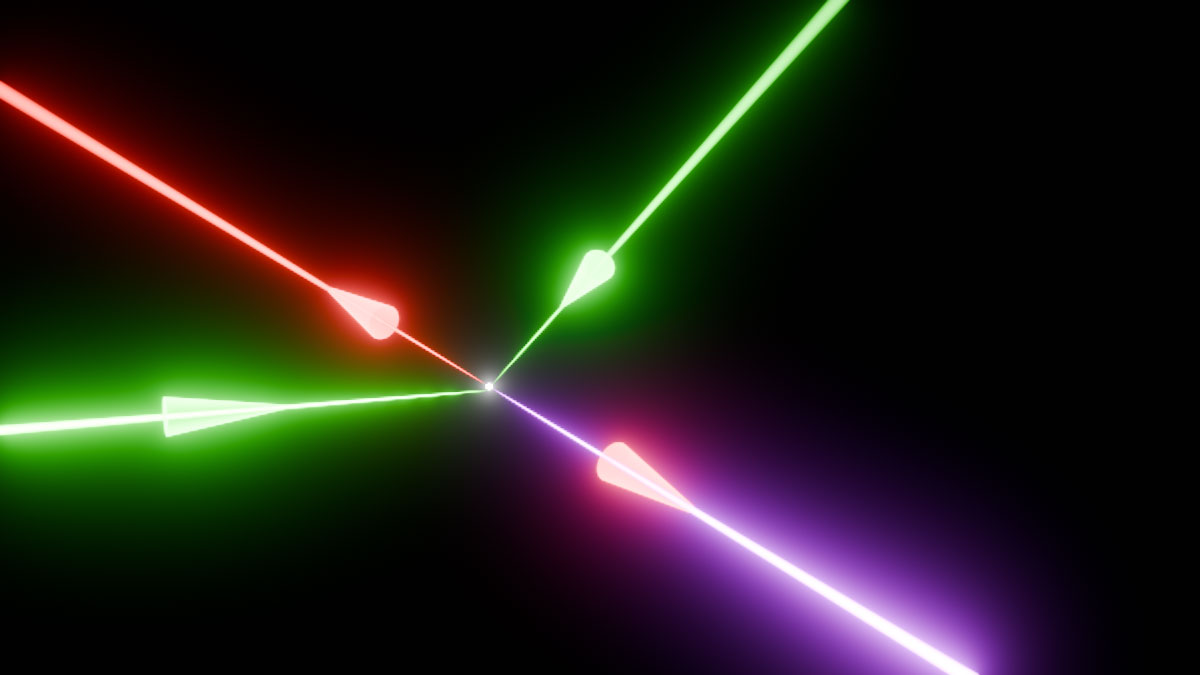
Scientists have created the first real-time 3D simulations of how lasers alter the quantum vacuum.
Using cutting-edge computational modeling, scientists from the University of Oxford, in collaboration with the Instituto Superior Técnico at the University of Lisbon, have successfully produced the first real-time, three-dimensional simulations showing how powerful laser beams can modify the “quantum vacuum.”
Once thought to be completely empty, this vacuum is now understood through quantum physics to be filled with fleeting pairs of virtual electrons and positrons.
The team’s simulations vividly capture a strange and long-theorized effect in quantum physics called vacuum four-wave mixing. According to this phenomenon, when three laser pulses are precisely focused, their combined electromagnetic fields can polarize the virtual particles within the vacuum.
This interaction causes photons to scatter off one another like billiard balls, resulting in the creation of a fourth beam of light in what researchers describe as a “light from darkness” process. These simulated events may provide a new way to explore untested areas of physics at extremely high energy levels.
“This is not just an academic curiosity—it is a major step toward experimental confirmation of quantum effects that until now have been mostly theoretical,” said study co-author Professor Peter Norreys, Department of Physics, University of Oxford.
A New Era of Ultra-Intense Lasers
The work arrives just in time as a new generation of ultra-powerful lasers starts to come online. Facilities such as the UK’s Vulcan 20-20, the European ‘Extreme Light Infrastructure (ELI)’ project, and China’s Station for Extreme Light (SEL) and SHINE facilities are set to deliver power levels high enough to potentially confirm photon-photon scattering in the lab for the first time. Photon-photon scattering has already been selected as one of three flagship experiments at the University of Rochester’s OPAL dual-beam 25 PW laser facility in the United States.
The simulations were carried out using an advanced version of OSIRIS, a simulation software package that models interactions between laser beams and matter or plasma.
Lead author Zixin (Lily) Zhang, a doctoral student at Oxford’s Department of Physics, said: “Our computer program gives us a time-resolved, 3D window into quantum vacuum interactions that were previously out of reach. By applying our model to a three-beam scattering experiment, we were able to capture the full range of quantum signatures, along with detailed insights into the interaction region and key time scales. Having thoroughly benchmarked the simulation, we can now turn our attention to more complex and exploratory scenarios—including exotic laser beam structures and flying-focus pulses.”
From Theory to Experiment
Crucially, these models provide details that experimentalists depend on to design precise, real-world tests, including realistic laser shapes and pulse timings. The simulations also reveal new insights, including how these interactions evolve in real time and how subtle asymmetries in beam geometry can shift the outcome.
According to the team, the tool will not only assist in planning future high-energy laser experiments but could also help search for signs of hypothetical particles such as axions and millicharged particles—potential candidates for dark matter.
Study co-author Professor Luis Silva (at the Instituto Superior Tecnico, University of Lisbon and Visiting Professor in Physics at the University of Oxford) added: “A wide range of planned experiments at the most advanced laser facilities will be greatly assisted by our new computational method implemented in OSIRIS. The combination of ultra-intense lasers, state-of-the-art detection, cutting-edge analytical and numerical modeling are the foundations for a new era in laser-matter interactions, which will open new horizons for fundamental physics.”
Reference: “Computational modelling of the semi-classical quantum vacuum in 3D” by Zixin Zhang, Ramy Aboushelbaya, Iustin Ouatu, Elliott Denis, Abigail James, Robin J. L. Timmis, Marko W. Von Der Leyen, Peter A. Norreys, Rui Torres, Thomas Grismayer and Luis O. Silva, 5 June 2025, Communications Physics.
DOI: 10.1038/s42005-025-02128-8
Never miss a breakthrough: Join the SciTechDaily newsletter.
Follow us on Google and Google News.
8 Comments
Once thought to be completely empty, this vacuum is now understood through quantum physics to be filled with fleeting pairs of virtual electrons and positrons. This is not just an academic curiosity—it is a major step toward experimental confirmation of quantum effects that until now have been mostly theoretical.
Very good!
Oxford Physicists Simulate Quantum “Light from Darkness” for the First Time. Please ask the Oxford Physicists to think deeply:
1. If there were no artificial simulations, where could the Light in the Darkness come from?
2. Does topological stimulation require God?
3. Can something possibly evolve from Inviscid, incompressible, and isotropic Darkness?
Please ask the Oxford Physicists to think deeply:
Can something possibly evolve from Inviscid, incompressible, and isotropic Darkness?
Please ask physicists and mathematicians to think together:
Is it possible for something to evolve from an inviscid, uniformly incompressible, and isotropic Darkness?
When we pursue the ultimate truth of all things, the space in which our bodies and all things exist may itself be the final and deepest puzzle we need to explore. This is not only the pursuit of physics, but also the most magnificent exploration of the origin of the universe by human reason.
Based on the Topological Vortex Theory (TVT), space is an uniformly incompressible physical entity, and space-time vortices are the products of topological phase transitions at critical points in space. They create all things and shape the world through spin and self-organization. Topological vortices are point defects in spacetime. Point defects not only affect thermodynamic processes, but are also the core of dynamic processes.
In today’s physics, some so-called peer-reviewed journals—including Physical Review Letters, Nature, Science, and others—stubbornly insist on and promote the following:
1. Even though θ and τ particles exhibit differences in experiments, physics can claim they are the same particle. This is science.
2. Even though topological vortices and antivortices have identical structures and opposite rotational directions, physics can define their structures and directions as entirely different. This is science.
3. Even though two sets of cobalt-60 rotate in opposite directions and experiments reveal asymmetry, physics can still define them as mirror images of each other. This is science.
4. Even though vortex structures are ubiquitous—from cosmic accretion disks to particle spins—physics must insist that vortex structures do not exist and require verification. Only the particles that like God, Demonic, or Angelic are the most fundamental structures of the universe. This is science.
5. Even though everything occupies space and maintains its existence in time, physics must still debate and insist on whether space exists and whether time is a figment of the human mind. This is science.
6. Even though space, with its non-stick, incompressible, and isotropic characteristics, provides a solid foundation for the development of physics, physics must still insist that the ideal fluid properties of space do not exist. This is science.
and go on.
Is this the counterintuitive science they widely promote? What are the shames? Contemporary physics and so-called peer-reviewed publications (including Physical Review Letters, Science, Nature, etc.) stubbornly believe that two sets of counter rotating cobalt-60 are two mirror images of each other, constructing a more shocking pseudoscientific theoretical framework in the history of science than the “geocentric model”. This pseudo scientific framework and system have seriously hindered scientific progress and social development.
For nearly a century, physics has been manipulated by this pseudo scientific theoretical system and the interest groups behind it, wasting a lot of manpower, funds, and time. A large amount of pseudo scientific research has been conducted, and countless pseudo scientific papers have been published, causing serious negative impacts on scientific and social progress, as well as humanistic development.
Physics should be vigilant: True progress lies in inclusion and synthesis, not in negation and severance. Topological Vortex Theory (TVT) provides us with a vivid metaphor: a stable, absolute background (the stage), together with dynamic, relative excited states (the actors), jointly constitute the rich and diverse physical universe. Acknowledging the foundational status of absolute space is not a regression in history; it is about retrieving the indispensable cornerstone for building a more complete and profound theory of the universe.
——Excerpted from https://t.pineal.cn/blogs/4921/On-the-Dialectical-Unity-of-Absolute-Space-and-Relative-Space.
Congratulations on this stunning simulation. The experiment of ‘light from darkness’ is a beautiful confirmation of a deep quantum principle.
I was particularly struck by the description of the three laser pulses ‘polarizing’ the virtual particles in the vacuum. This implies something more profound than simple scattering: it suggests the interaction is actively ‘modifying the properties of the vacuum itself’, turning it into a temporary, non-linear optical medium.
My question is: Could your simulation framework be used to explore this idea further? That is, beyond the creation of the fourth photon, could this ‘vacuum four-wave mixing’ be modeled as a way to temporarily ‘engineer’ the vacuum? For instance, could it induce a measurable, local change in the vacuum’s refractive index or other fundamental properties, effectively creating a new, temporary ‘relational geometry’ in that tiny region of space?
It seems this work opens a new door for using controlled laser interactions not just to create particles, but to actively ‘shape’ the vacuum’s structure itself.
Thank you for this groundbreaking work.
Is thos how the Death Star destroys planets?
TVT challenges traditional views of spacetime, proposing the dissolution of absolute space and the hierarchical structure of relative space, thereby promoting a paradigm shift from Cartesian extensive entities to topological connective entities. The development of the Topological Vortex Theory (TVT) reflects a progression from concrete physical phenomena to abstract mathematical modeling and, ultimately, to interdisciplinary unification.
——Excerpted from https://t.pineal.cn/blogs/4569/An-Overview-of-the-Development-of-Topological-Vortex-Theory-TVT.