
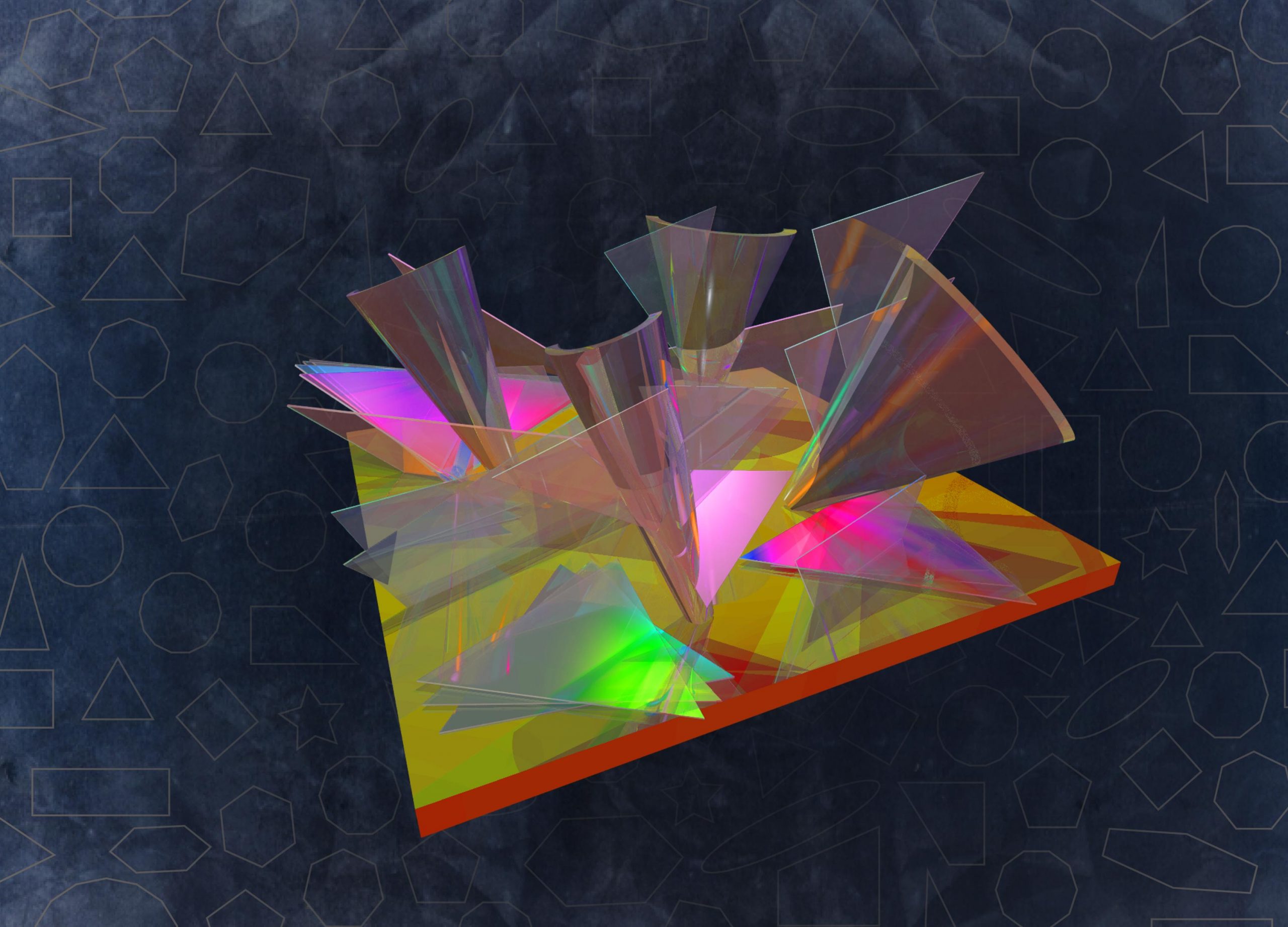
Physicists at the University of Bath in the UK observe modified energy landscapes at the intersection of 2D materials.
In 1884, Edwin Abbott wrote the novel Flatland: A Romance in Many Dimensions as a satire of Victorian hierarchy. He imagined a world that existed only in two dimensions, where the beings were 2D geometric figures. The physics of such a world is somewhat akin to that of modern 2D materials, such as graphene and transition metal dichalcogenides, which include tungsten disulfide (WS2), tungsten diselenide (WSe2), molybdenum disulfide (MoS2) and molybdenum diselenide (MoSe2).
Modern 2D materials consist of single-atom layers, where electrons can move in two dimensions but their motion in the third dimension is restricted. Due to this ‘squeeze’, 2D materials have enhanced optical and electronic properties that show great promise as next-generation, ultrathin devices in the fields of energy, communications, imaging, and quantum computing, among others.
Typically, for all these applications, the 2D materials are envisioned in flat-lying arrangements. Unfortunately, however, the strength of these materials is also their greatest weakness – they are extremely thin. This means that when they are illuminated, light can interact with them only over a tiny thickness, which limits their usefulness. To overcome this shortcoming, researchers are starting to look for new ways to fold the 2D materials into complex 3D shapes.
In our 3D universe, 2D materials can be arranged on top of each other. To extend the Flatland metaphor, such an arrangement would quite literally represent parallel worlds inhabited by people who are destined to never meet.
Twisted WS₂ Sheets Form a New Landscape
Now, scientists from the Department of Physics at the University of Bath in the UK have found a way to arrange 2D sheets of WS2 (previously created in their lab) into a 3D configuration, resulting in an energy landscape that is strongly modified when compared to that of the flat-laying WS2 sheets. This particular 3D arrangement is known as a ‘nanomesh’: a webbed network of densely packed, randomly distributed stacks, containing twisted and/or fused WS2 sheets.
Modifications of this kind in Flatland would allow people to step into each other’s worlds. “We didn’t set out to distress the inhabitants of Flatland,” said Professor Ventsislav Valev who led the research, “But because of the many defects that we nanoengineered in the 2D materials, these hypothetical inhabitants would find their world quite strange indeed.
“First, our WS2 sheets have finite dimensions with irregular edges, so their world would have a strangely shaped end. Also, some of the sulfur atoms have been replaced by oxygen, which would feel just wrong to any inhabitant. Most importantly, our sheets intersect and fuse together, and even twist on top of each other, which modifies the energy landscape of the materials. For the Flatlanders, such an effect would look like the laws of the universe had suddenly changed across their entire landscape.”
Dr. Adelina Ilie, who developed the new material together with her former PhD student and post-doc Zichen Liu, said: “The modified energy landscape is a key point for our study. It is proof that assembling 2D materials into a 3D arrangement does not just result in ‘thicker’ 2D materials – it produces entirely new materials. Our nanomesh is technologically simple to produce, and it offers tunable material properties to meet the demands of future applications.”
Professor Valev added: “The nanomesh has very strong nonlinear optical properties – it efficiently converts one laser color into another over a broad palette of colors. Our next goal is to use it on Si waveguides for developing quantum optical communications.”
PhD student Alexander Murphy, also involved in the research, said: “In order to reveal the modified energy landscape, we devised new characterization methods and I look forward to applying these to other materials. Who knows what else we could discover?”
Reference: “Doubly‐Resonant Enhancement of Second Harmonic Generation from a WS2 Nanomesh Polymorph with a Modified Energy Landscape” by Alexander W. A. Murphy, Zichen Liu, Andrey V. Gorbach, Adelina Ilie and Ventsislav K. Valev, 10 May 2021, Laser & Photonics Reviews.
DOI: 10.1002/lpor.202100117
Never miss a breakthrough: Join the SciTechDaily newsletter.
Follow us on Google and Google News.
2 Comments
… I don’t like it, I just LOVE it………………………………………………………………………………………………………………………………………………………………………………………………………………………………………………………..
… could one use ultra sound in order to control particles being sprayed on already existing layers, …