
Close Menu
    Facebook X (Twitter) Instagram
    SciTechDaily
    • Biology
    • Chemistry
    • Earth
    • Health
    • Physics
    • Science
    • Space
    • Technology
    Facebook X (Twitter) Pinterest YouTube RSS
    SciTechDaily
    Home»Space»Parker Solar Probe Is Alive After Closer Encounter With The Sun
    Space

    Parker Solar Probe Is Alive After Closer Encounter With The Sun

    By Sarah Frazier, NASA's Goddard Space Flight CenterNovember 8, 2018No Comments3 Mins Read
    Facebook Twitter Pinterest Telegram LinkedIn WhatsApp Email Reddit
    Share
    Facebook Twitter LinkedIn Pinterest Telegram Email Reddit
    Parker Solar Probe Reports Good Status After Close Solar Approach
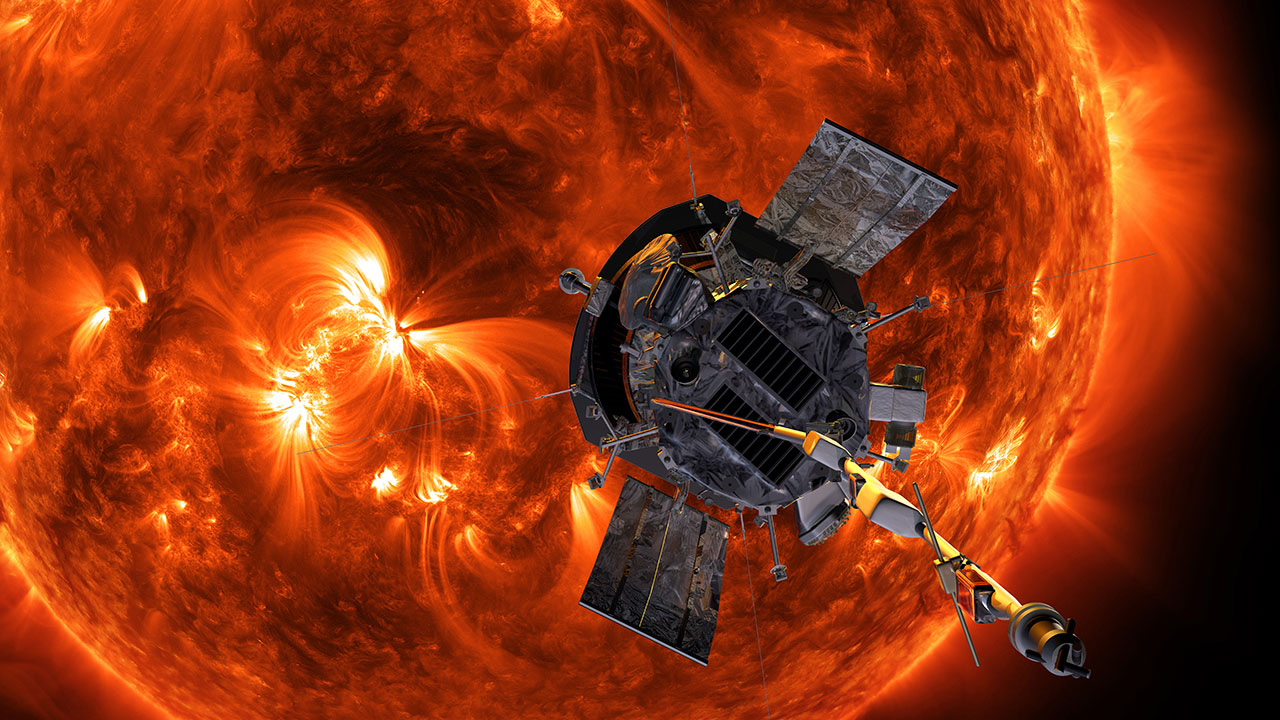
    Illustration of Parker Solar Probe approaching the Sun. Credit: ​NASA/Johns Hopkins APL/Steve Gribben

    Parker Solar Probe is alive and well after skimming by the Sun at just 15 million miles (24 million kilometers) from our star’s surface. This is far closer than any spacecraft has ever gone — the previous record was set by Helios B in 1976 and broken by Parker on October 29 — and this maneuver has exposed the spacecraft to intense heat and solar radiation in a complex solar wind environment.

    “Parker Solar Probe was designed to take care of itself and its precious payload during this close approach, with no control from us on Earth — and now we know it succeeded,” said Thomas Zurbuchen, associate administrator of NASA’s Science Mission Directorate at the agency headquarters in Washington. “Parker is the culmination of six decades of scientific progress. Now, we have realized humanity’s first close visit to our star, which will have implications not just here on Earth, but for a deeper understanding of our universe.”

    Mission controllers at the Johns Hopkins University Applied Physics Lab received the status beacon from the spacecraft at 4:46 p.m. EST on November 7, 2018. The beacon indicates status “A” — the best of all four possible status signals, meaning that Parker Solar Probe is operating well with all instruments running and collecting science data and, if there were any minor issues, they were resolved autonomously by the spacecraft.

    At its closest approach on November 5, called perihelion, Parker Solar Probe reached a top speed of 213,200 miles per hour, setting a new record for spacecraft speed. Along with new records for the closest approach to the Sun, Parker Solar Probe will repeatedly break its own speed record as its orbit draws closer to the star and the spacecraft travels faster and faster at perihelion.


    On November 5, 2018, Parker Solar Probe achieved its first close approach to the Sun, called perihelion, a maneuver that exposed the spacecraft to intense heat and solar radiation. Credit: NASA/JHUAPL

    At this distance, the intense sunlight heated the Sun-facing side of Parker Solar Probe’s heat shield, called the Thermal Protection System, to about 820 degrees Fahrenheit. This temperature will climb up to 2,500 F as the spacecraft makes closer approaches to the Sun — but all the while, the spacecraft instruments and systems that are protected by the heat shield are generally kept in the mid-80s F.

    Parker Solar Probe’s first solar encounter phase began on October 31, and the spacecraft will continue collecting science data through the end of the solar encounter phase on November 11. It will be several weeks after the end of the solar encounter phase before the science data begins downlinking to Earth.

    Never miss a breakthrough: Join the SciTechDaily newsletter.
    Follow us on Google and Google News.

    Astronomy Parker Solar Probe
    Share. Facebook Twitter Pinterest LinkedIn Email Reddit

    Related Articles

    5 Years, 430,000 MPH, and Counting: How NASA’s Parker Solar Probe Is Making History

    Voyage to the Sun: NASA’s Parker Solar Probe Completes 16th Close Approach

    Cataclysm in the Cosmos: Princeton Researchers Unmask the Violent Origins of the Geminids Meteor Shower

    NASA Mourns Passing of Visionary Heliophysicist Eugene Parker – Namesake of Parker Solar Probe

    Powerful Telescopes Trained on Parker Solar Probe’s Latest Swing Around the Sun

    Parker Solar Probe Captures Stunning New Images of Venus – Faint Glow Detected From the Planet’s Surface

    Spacecraft Enters the Sun’s Blistering Hot Corona for the First Time in History

    Parker Solar Probe: For the First Time in History, a Spacecraft Has Touched the Sun

    A “Living Catalog” of Solar Stream Interactions

    Leave A Reply Cancel Reply

    • Facebook
    • Twitter
    • Pinterest
    • YouTube

    Don't Miss a Discovery

    Subscribe for the Latest in Science & Tech!

    Trending News

    Largest-Ever Study Finds Medicinal Cannabis Ineffective for Anxiety, Depression, PTSD

    250-Million-Year-Old Egg Solves One of Evolution’s Biggest Mysteries

    Living With Roommates Might Be Changing Your Gut Microbiome Without You Knowing

    Century-Old Cleaning Chemical Linked to 500% Increased Risk of Parkinson’s Disease

    What if Your Memories Never Happened? Physicists Take a New Look at the Boltzmann Brain Paradox

    One of the Universe’s Largest Stars May Be Getting Ready To Explode

    Scientists Discover Enzyme That Could Supercharge Ozempic-Like Weight Loss Drugs

    Popular Sweetener Linked to DNA Damage – “It’s Something You Should Not Be Eating”

    Follow SciTechDaily
    • Facebook
    • Twitter
    • YouTube
    • Pinterest
    • Newsletter
    • RSS
    SciTech News
    • Biology News
    • Chemistry News
    • Earth News
    • Health News
    • Physics News
    • Science News
    • Space News
    • Technology News
    Recent Posts
    • A Simpler Path to Super-Resolution: Scientists Reinvent Microscopy
    • Scientists Uncover Hidden Genetic Cause of Diabetes in Babies
    • Amazonian Chocolate Could Become the Next Superfood, Scientists Say
    • Challenging the Narrative: New Study Shows U.S. Life Expectancy Is Rising Across All States
    • Mystery Illness Kills 5 in Burundi As Doctors Scramble for Answers
    Copyright © 1998 - 2026 SciTechDaily. All Rights Reserved.
    • Science News
    • About
    • Contact
    • Editorial Board
    • Privacy Policy
    • Terms of Use

    Type above and press Enter to search. Press Esc to cancel.