
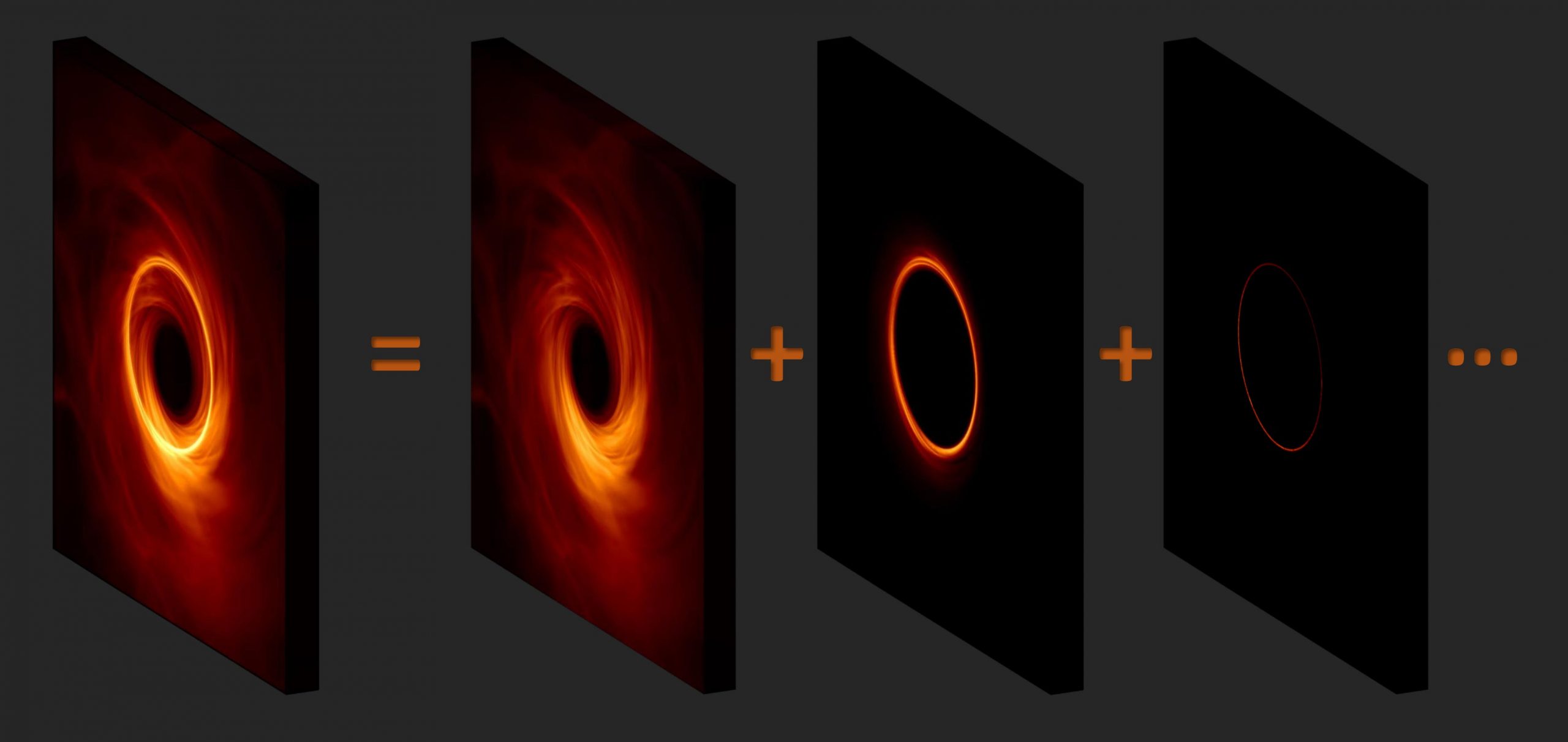
Last April, the Event Horizon Telescope (EHT) sparked international excitement when it unveiled the first image of a black hole. Today, a team of researchers have published new calculations that predict a striking and intricate substructure within black hole images from extreme gravitational light bending.
“The image of a black hole actually contains a nested series of rings,” explains Michael Johnson of the Center for Astrophysics | Harvard and Smithsonian (CfA). “Each successive ring has about the same diameter but becomes increasingly sharper because its light orbited the black hole more times before reaching the observer. With the current EHT image, we’ve caught just a glimpse of the full complexity that should emerge in the image of any black hole.”
Because black holes trap any photons that cross their event horizon, they cast a shadow on their bright surrounding emission from hot infalling gas. A “photon ring” encircles this shadow, produced from light that is concentrated by the strong gravity near the black hole. This photon ring carries the fingerprint of the black hole—its size and shape encode the mass and rotation or “spin” of the black hole. With the EHT images, black hole researchers have a new tool to study these extraordinary objects.
Black holes cast a shadow on the image of bright surrounding material because their strong gravitational field can bend and trap light. The shadow is bounded by a bright ring of light, corresponding to photons that pass near the black hole before escaping. The ring is actually a stack of increasingly sharp subrings, and the n-th subring corresponds to photons that orbited the black hole n/2 times before reaching the observer. This animation shows how a black hole image is formed from these subrings and the trajectories of photons that create the image. Credit: Center for Astrophysics | Harvard & Smithsonian
“This is an extremely exciting time to be thinking about the physics of black holes,” says Daniel Kapec, Member in the School of Natural Sciences at the Institute for Advanced Study. “Einstein’s theory of general relativity makes a number of striking predictions for the types of observations that are finally coming within reach, and I think we can look forward to lots of advances in the coming years. As a theorist, I find the rapid convergence between theory and experiment especially rewarding, and I hope we can continue to isolate and observe more universal predictions of general relativity as these experiments become more sensitive.”
The research team included observational astronomers, theoretical physicists, and astrophysicists.
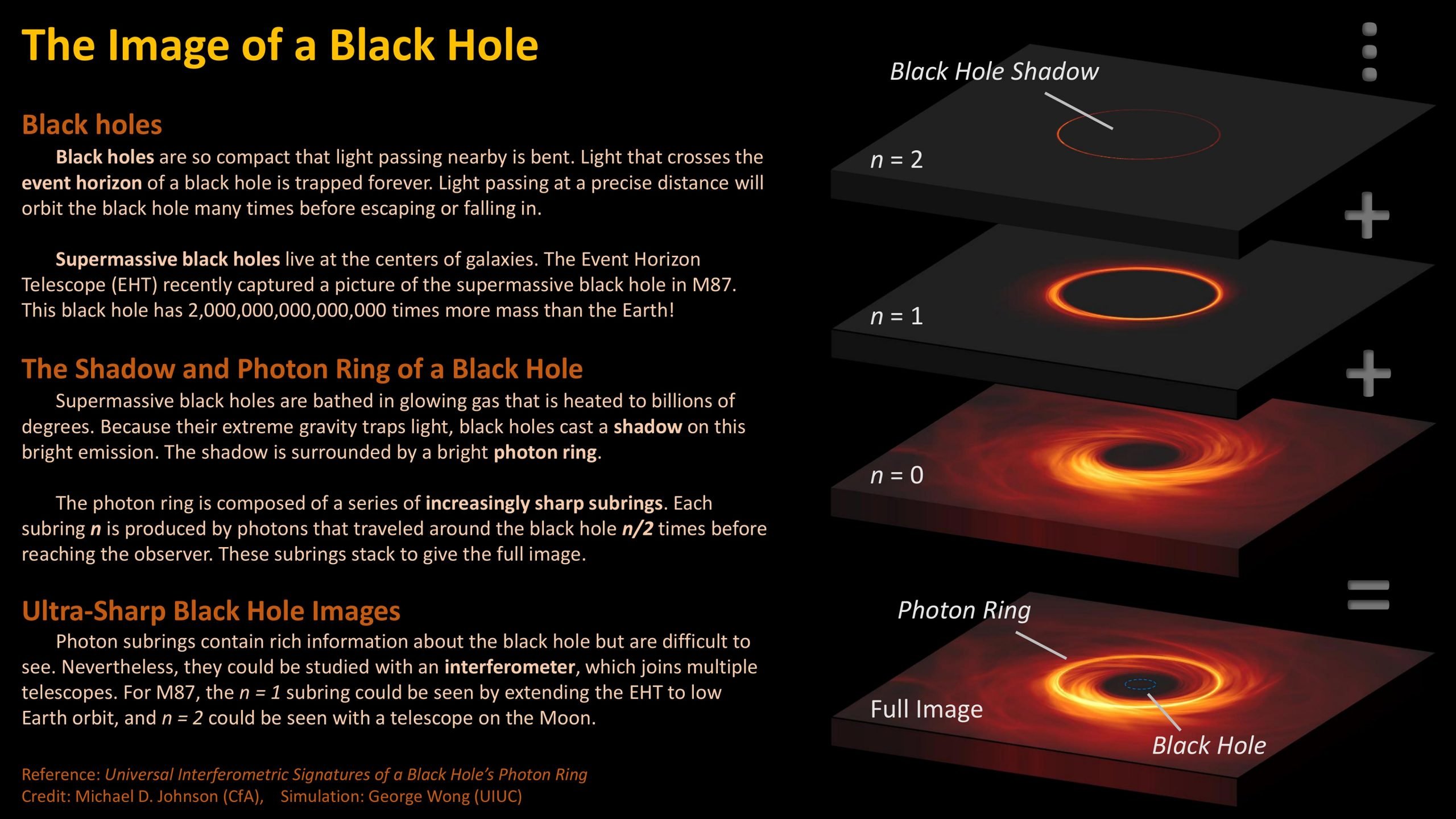
“Bringing together experts from different fields enabled us to really connect a theoretical understanding of the photon ring to what is possible with observation,” notes George Wong, a physics graduate student at the University of Illinois at Urbana-Champaign. Wong developed software to produce simulated black hole images at higher resolutions than had previously been computed and to decompose these into the predicted series of sub-images. “What started as classic pencil-and-paper calculations prompted us to push our simulations to new limits.”
The researchers also found that the black hole’s image substructure creates new possibilities to observe black holes. “What really surprised us was that while the nested subrings are almost imperceptible to the naked eye on images—even perfect images—they are strong and clear signals for arrays of telescopes called interferometers,” says Johnson. “While capturing black hole images normally requires many distributed telescopes, the subrings are perfect to study using only two telescopes that are very far apart. Adding one space telescope to the EHT would be enough.”
“Black hole physics has always been a beautiful subject with deep theoretical implications, but now it has also become an experimental science,” says Alex Lupsasca from the Harvard Society of Fellows. “As a theorist, I am delighted to finally glean real data about these objects that we’ve been abstractly thinking about for so long.”
The results were published in Science Advances and are available here (PDF).
Reference: “Universal interferometric signatures of a black hole’s photon ring” by Michael D. Johnson, Alexandru Lupsasca, Andrew Strominger, George N. Wong, Shahar Hadar, Daniel Kapec, Ramesh Narayan, Andrew Chael, Charles F. Gammie, Peter Galison, Daniel C. M. Palumbo, Sheperd S. Doeleman, Lindy Blackburn, Maciek Wielgus, Dominic W. Pesce, Joseph R. Farah and James M. Moran, 18 March 2020, Science Advances.
DOI: 10.1126/sciadv.aaz1310
This research was supported by grants from the National Science Foundation, the United States Department of Energy, the Gordon and Betty Moore Foundation, the John Templeton Foundation, the Jacob Goldfield Foundation, and NASA.
Never miss a breakthrough: Join the SciTechDaily newsletter.
Follow us on Google and Google News.
1 Comment
If I understand that correctly, these subrings – which has been discussed but not described as nicely before – becomes ever closer to the hole but also gets narrower as n increases. IIRC the ‘photon ring’, when they orbit indefinitely, is still at 3 times the event horizon radius for a stationary hole. But real holes are spinning, and then the photon ring creep ever closer to the event horizon until you get max allowed spin (at local universal speed limit) for extremal holes when ring and horizon meet.
Too bad super massive black holes are unlikely to be extremal.