
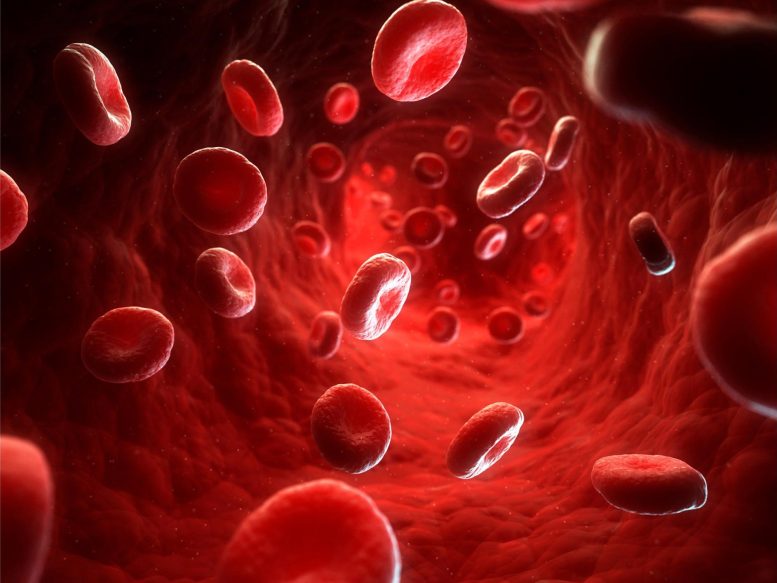
Aarhus University researchers discovered large protein particles in Lupus patients’ blood that could be key to diagnosing and treating autoimmune diseases earlier. Their findings suggest a new diagnostic tool could be ready within 5-10 years.
Autoimmune diseases – i.e. diseases where our own immune system damages the body – are growing, but we know little about what triggers them.
Researchers are now a step closer to finding an explanation. With the help of a new technique, researchers from Aarhus University have succeeded in identifying the particles in the blood that determine the development of autoimmune diseases. They have discovered that patients with the autoimmune disease Systemic Lupus Erythematosus (also called SLE or Lupus), form a previously unknown type of protein particle in the blood and that this particle is so large it finds its way into the vascular wall where it causes damage. The disease is potentially life-threatening and can e.g. cause blood clots and inflammation of the joints and organs.
Particles Measured in Nanometers
“We can see that the patients have an elevated proportion of the large particles in the blood. Because of their size, these are distributed right at the edge of the blood vessel, where they can potentially end up in the vessel wall and create inflammation,” explains Postdoc Kristian Juul-Madsen from the Department of Biomedicine at Aarhus University.
He is the lead author of a recently published study that describes how the researchers were able to utilize a new technique enabling them to follow specific protein particles in the patient’s blood sample and measure their size in nanometers. By doing this, it becomes clear that the scope and structure of the particles are crucial for the development of the disease.

“We connect the protein particles with small metal particles, which fluoresce strongly when illuminated by a laser. We can follow the process on a screen and this has led us to discover that the Lupus patients have a much higher concentration of the very large particles,” explains Kristian Juul-Madsen.
“The technique makes it possible to identify something rare but absolutely crucial for the development of the disease in patients with Lupus. We imagine that there is a critical level that you must remain below in order to avoid the disease,” he says.
Early diagnosis of the disease is important because treatment can reduce symptoms and prevent organ damage. Therefore, it is also extremely interesting in a clinical context for researchers to be able to take a blood sample and already five minutes later have an answer as to whether the patient is on the way to developing Lupus or is already ill.
Blood Samples Already Collected
The study of Lupus patients has been established in collaboration with the Department of Rheumatology at Aarhus University Hospital, where Leading Registrar Anne Margrethe Troldborg, who is also an assistant professor at the Department of Biomedicine, has gathered one of the most extensive Lupus cohorts in Denmark. Her work with Lupus patients has given the researchers a head start, as blood samples from patients and control groups had already been collected – work which would otherwise take several years.
Expectations are for the new technique to be available as a diagnostic tool in the clinic at Aarhus University Hospital within 5-10 years.
Patented Technology
The discovery of the pathogenic particles provides a better understanding of why the disease occurs. In the longer term, it will hopefully help to prevent the development of Lupus and improve the researchers’ knowledge of hereditary and other factors. Together with Professor Thomas Vorup-Jensen, Kristian Juul Madsen has patented the technology, which they call NIP-Q (Nanoscale Immunoactive Protein Quantification).
Initially, the patent only applies to analyses of the protein that occurs in patients with Lupus, but the research team has an expectation that the technique can also be used to detect other inflammatory diseases such as rheumatoid arthritis.
“In the research community, there is focus on how inflammatory diseases lead to the release of DNA in the blood, and that the process can to a certain extent activate the immune system. But we have gained a completely new insight by producing a size analysis of the blood’s components. It’s deeply fascinating to see how we can utilize the new technique to find a correlation between particle size and the immune response ” says Thomas Vorup-Jensen.
He explains that it is often difficult for medical doctors to make a precise diagnosis and monitor the development of an autoimmune disease. This can make decisions about medication and measuring its effect difficult.
“Nevertheless, the costs of autoimmune diseases continue to increase, both as a result of their increasing incidence and in step with the development of new expensive medicines. Better measurement methods are therefore necessary in order to be able to regulate treatments in a way that is responsible both in terms of healthcare and health economics,” says Thomas Vorup-Jensen.
Reference: “Characterization of DNA–protein complexes by nanoparticle tracking analysis and their association with systemic lupus erythematosus” by Kristian Juul-Madsen, Anne Troldborg, Thomas R. Wittenborn, Mads G. Axelsen, Huaying Zhao, Lasse H. Klausen, Stefanie Luecke, Søren R. Paludan, Kristian Stengaard-Pedersen, Mingdong Dong, Holger J. Møller, Steffen Thiel, Henrik Jensen, Peter Schuck, Duncan S. Sutherland, Søren E. Degn and Thomas Vorup-Jensen, 27 July 2021, Proceedings of the National Academy of Sciences.
DOI: 10.1073/pnas.2106647118
The Research Results
- The study is an experimental analysis of protein structure, both in a pure form and in comparison with blood samples collected from Lupus patients. On the basis of the experimentally-based values for the protein size (hydrodynamic radius), theoretical calculations were carried out on the distribution of protein particles in the blood by known vessel diameters and blood pressure. The study also involves experiments on mice.
- The study was conducted in a collaboration between researchers at Aarhus University, Aarhus University Hospital, the University of Copenhagen and the National Institutes of Health, Maryland, USA.
- The study is supported by the Aarhus University Research Foundation, the Novo Nordisk Foundation and the Lundbeck Foundation.
- The research group has submitted a patent application for the invention with Aarhus University as owner.
Never miss a breakthrough: Join the SciTechDaily newsletter.
Follow us on Google and Google News.