
Researchers found friction can occur without contact, driven by magnetic dynamics, and does not always increase with load. The effect could enable controllable, wear-free technologies.
Researchers at the University of Konstanz have identified a new type of sliding friction that occurs without any physical contact. Instead of surfaces rubbing together, the resistance to motion comes entirely from collective magnetic behavior. Their results indicate that friction does not always rise steadily with increasing load, as predicted by Amontons’ law—one of the oldest and most widely used empirical laws in physics—but can reach a clear peak when magnetic order inside the system becomes frustrated.
For over 300 years, Amontons’ law has connected friction directly to load, reflecting the familiar idea that heavier objects are harder to move. For instance, pushing a heavy couch requires much more effort than sliding a lightweight chair.
This effect is usually explained by tiny surface deformations under load, which increase the number of microscopic contact points and therefore boost friction. In most everyday situations, these changes are minor and do not alter the internal structure of the materials. However, it remains uncertain whether the same law applies when motion causes major internal rearrangements, such as in magnetic materials, where sliding can change the magnetic order itself.
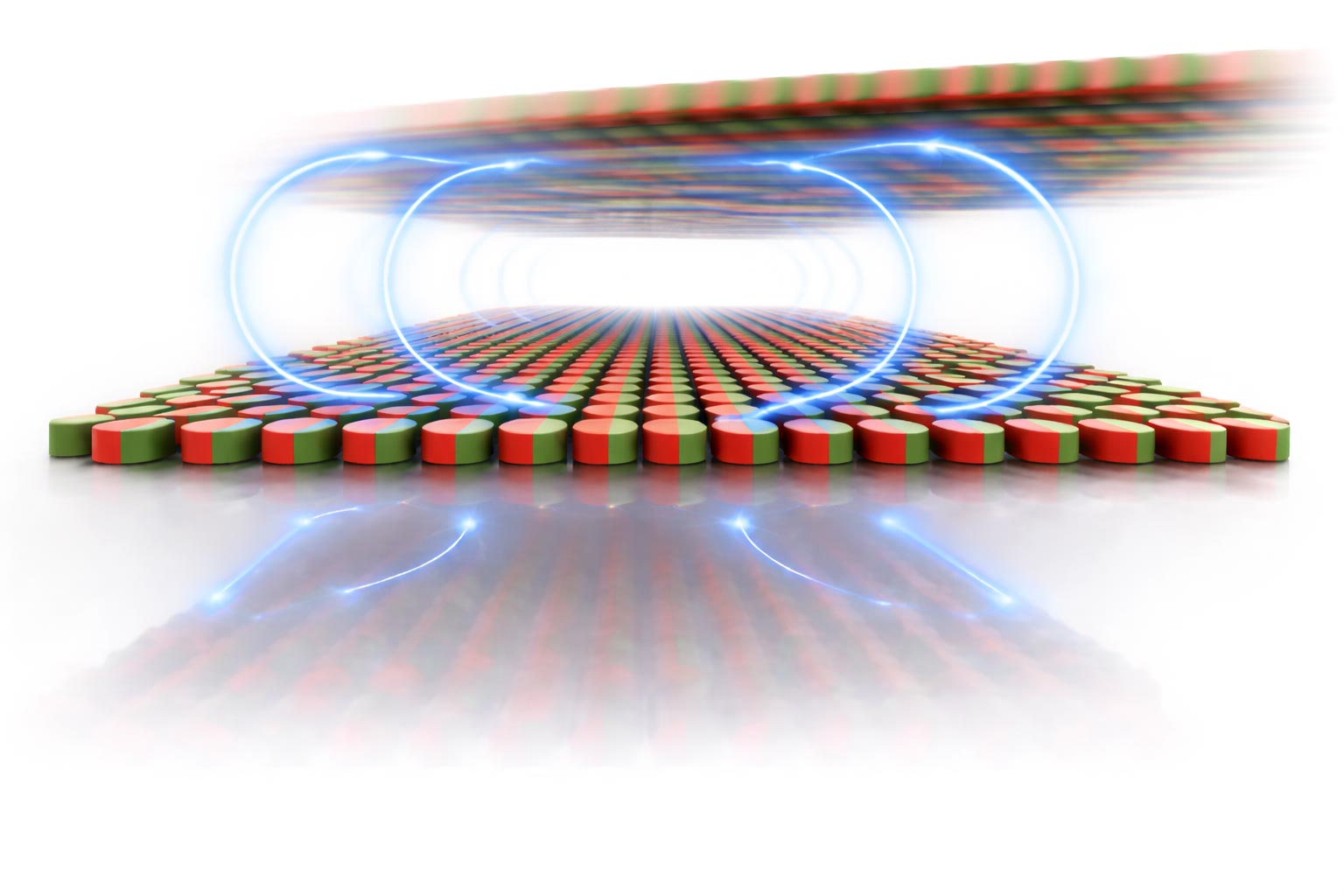
To investigate this question, the researchers designed a tabletop experiment with a two-dimensional array of freely rotating magnetic elements positioned above a second magnetic layer. The two layers never touch, yet their magnetic interaction still produces a measurable friction force. By adjusting the distance between them, the team was able to control the effective load while observing how the magnetic structure evolved during motion.
Magnetic Coupling and Dynamic Reconfiguration
“By changing the distance between the magnetic layers, we could drive the system into a regime of competing interactions where the rotors constantly reorganize as they slide,” says Hongri Gu, who carried out the experiments.
The results revealed that friction is lowest when the layers are either very close or far apart. At intermediate distances, however, competing magnetic forces become dominant. The upper layer favors an antiparallel alignment of magnetic moments (parallel, but pointing in opposite directions), while the lower layer prefers a parallel arrangement. This mismatch creates an unstable state.
As the layers move past each other, the magnets repeatedly switch between these opposing configurations in a hysteretic manner (that means the current state depends on its history). This repeated switching increases energy loss and leads to a strong peak in friction.
“From a theoretical perspective, this system is remarkable because friction does not originate from a physical surface contact but from the collective dynamics of magnetic moments,” explains Anton Lüders, who developed the theoretical description. The competing magnetic interactions naturally lead to hysteretic reorientations during motion and, as a result, to a friction force that varies non monotonically with load. In this sense, the breakdown of Amontons’ law is not an anomaly but a direct consequence of magnetization dynamics during sliding.
Friction Without Contact or Wear
“What is remarkable is that friction here arises entirely from internal reorganization,” adds Clemens Bechinger, who supervised the project. “There is no wear, no surface roughness, and no direct contact. Dissipation is generated solely by collective magnetic rearrangements.”
Because the physics behind this effect does not depend on scale, the findings extend beyond the large experimental setup. Similar behavior could appear in atomically thin magnetic materials, where even small movements can alter magnetic order. This opens new possibilities for studying and controlling magnetism through friction measurements.
Over time, this research could lead to frictional systems that can be tuned without causing wear. By using magnetic hysteresis, friction might be adjusted remotely and reversibly, supporting ideas such as friction-based metamaterials, adaptive damping systems, and contactless control devices.
Potential uses include micro and nanoelectromechanical systems, where wear limits performance, as well as magnetic bearings, vibration control technologies, and ultrathin magnetic materials. More broadly, magnetic friction provides a new way to study collective spin behavior through mechanical measurements, linking the fields of tribology and magnetism in a novel way.
Reference: “Non-monotonic magnetic friction from collective rotor dynamics” by Hongri Gu, Anton Lüders and Clemens Bechinger, 18 March 2026, Nature Materials.
DOI: 10.1038/s41563-026-02538-1
Never miss a breakthrough: Join the SciTechDaily newsletter.
Follow us on Google and Google News.
3 Comments
THANKS
It is just magnetic interaction. Calling it friction is misleading. Will they call the gravitational force between Earth and Sun a ‘frictional force’?
In my opinion, both gravity and electromagnetism are finite and conserved. There is a limit to the magnetic energy available for interaction and so the observed phenomenon.
I only skimmed, but didn’t see where the energy is going. Is there heat emission?