

By miniaturizing THz spectroscopy to a chip-scale platform, James McIver’s lab has uncovered a promising new method for controlling quantum materials.
Under certain conditions, two-dimensional (2D) materials can exhibit remarkable quantum states, including superconductivity and unusual types of magnetism. Scientists and engineers have long sought to understand why these phases appear and how they might be controlled.
A new study published in Nature Physics has identified a previously unnoticed characteristic that may shed light on the origins of these mysterious quantum behaviors.
By applying an advanced terahertz (THz) spectroscopy method, researchers discovered that small stacks of 2D materials, common in laboratories worldwide, can naturally create structures known as cavities. These cavities trap light and electrons within extremely small regions, which can significantly alter how they interact and behave.
“We’ve uncovered a hidden layer of control in quantum materials and opened a path to shaping light–matter interactions in ways that could help us both understand exotic phases of matter and ultimately harness them for future quantum technologies,” said James McIver, assistant professor of physics at Columbia and lead author of the paper.
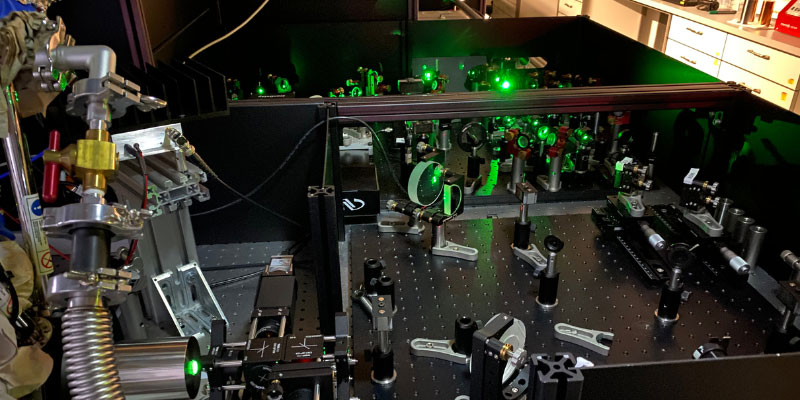
A Discovery Born in Hamburg
The discovery began in Hamburg, when McIver was a group leader at the Max Planck Institute for the Structure and Dynamics of Matter (MPSD), one of the institutions that make up the Max Planck-New York Center on Nonequilibrium Quantum Phenomena. Researchers at the Center, which also includes Columbia, the Flatiron Institute, and Cornell University, are interested in what happens when stable systems are thrown out of balance.
The McIver lab turns to light. “2D materials, with their fascinating macroscopic properties, often behave like black boxes. By shining light on them, we can literally shed light on the hidden behavior of their electrons, revealing details that would otherwise remain unseen,” said Gunda Kipp, a PhD student at MPSD working with the McIver group and first author of the publication. The challenge is that the wavelengths of light needed to probe 2D materials are much larger than the materials themselves, which are typically smaller than a human hair.
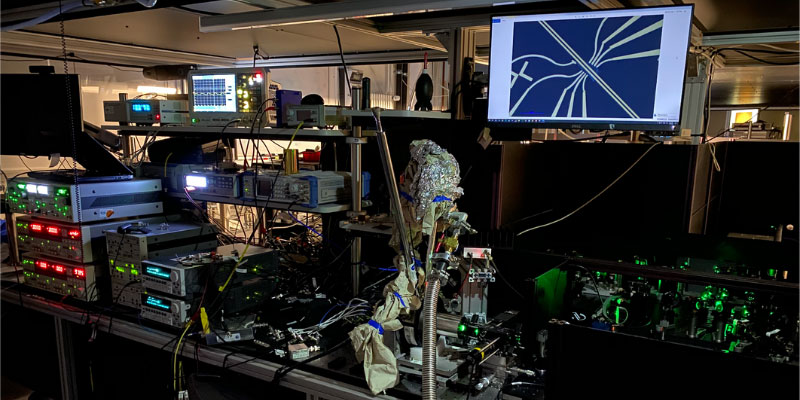
To address this size mismatch, the team scaled things way down with a chip-sized spectroscope that confines THz light—the range where enigmatic quantum phenomena are thought to occur—from 1 mm down to just 3 micrometers. This lets the team visualize the behavior of electrons in 2D systems. They began experiments with graphene to test how well the spectroscope could measure optical conductivity in a well-studied material.
They saw unexpected standing waves.
Hybrid Light-Matter Waves
“Light can couple to electrons to form hybrid light–matter quasiparticles. These quasiparticles move as waves and, under certain conditions, they can become confined, much like the standing wave on a guitar string that produces a distinct note,” explained MPSD postdoctoral fellow and co-first-author Hope Bretscher.
In the case of the guitar, the string’s fixed ends define the boundaries for the standing wave; holding your fingers on the strings shortens the wave at which a string can vibrate, changing the note it produces. In optics, a similar effect can be achieved with two mirrors, which trap light between them and create a confined standing wave inside what is known as a cavity. When a material is placed between the mirrors, the light reflected back and forth will interact with it, potentially changing its properties.
But mirrors may be optional.
“We found that the material’s own edges already act as mirrors,” said Kipp. With their THz spectroscope, they observed that excited streams of electrons reflect off the edges to form a type of hybrid light-matter quasiparticle called a plasmon polariton.
The McIver lab studied a device made up of multiple layers, each of which can act as a cavity separated by a few tens of nanometers. The plasmons that form in each layer can, in turn, interact—often strongly. “It’s like connecting two guitar strings; once linked, the note changes,” said Bretscher. “In our case, it changes drastically.”
Understanding and Designing Quantum Behavior
The next question is what exactly determines the frequencies of the vibrating quasiparticles and how strongly the light and material interact. “With co-author and MPSD postdoctoral fellow Marios Michael, we developed an analytical theory that only needed a handful of geometric sample parameters to match the observations of our experiments,” said Kipp. “With just a click of a button, our theory can extract the properties of a material and will help us design and tailor future samples to obtain specific properties. For example, by tracking resonances as functions of carrier density, temperature, or magnetic field, we may uncover the mechanisms driving different quantum phases.”
While the published work captured plasmons, the new chip-scale THz spectroscope should be able to observe other kinds of quasiparticles oscillating within a wide variety of 2D materials. The team is already at work measuring new samples in both Hamburg and New York.
“This whole project was a bit of a serendipitous discovery. We didn’t expect to see these cavity effects, but we’re excited to use them to manipulate phenomena in quantum materials going forward,” said Bretscher. “And now that we have a technique to see them, we’re intrigued to learn how they might be affecting other materials and phases.”
Reference: “Cavity electrodynamics of van der Waals heterostructures” by Gunda Kipp, Hope M. Bretscher, Benedikt Schulte, Dorothee Herrmann, Kateryna Kusyak, Matthew W. Day, Sivasruthi Kesavan, Toru Matsuyama, Xinyu Li, Sara Maria Langner, Jesse Hagelstein, Felix Sturm, Alexander M. Potts, Christian J. Eckhardt, Yunfei Huang, Kenji Watanabe, Takashi Taniguchi, Angel Rubio, Dante M. Kennes, Michael A. Sentef, Emmanuel Baudin, Guido Meier, Marios H. Michael and James W. McIver, 20 October 2025, Nature Physics.
DOI: 10.1038/s41567-025-03064-8
Never miss a breakthrough: Join the SciTechDaily newsletter.
Follow us on Google and Google News.
3 Comments
Two-dimensional (2D) materials can exhibit remarkable quantum states.
WHY?
Please ask researchers to think deeply:
Are the remarkable quantum states of two-dimensional (2D) materials bestowed by God?
The differences in the rotational direction of vortices and antivortices can induce rich topological phase transition behaviors, while their translational characteristics can reveal propagation patterns through knot theory. Loops and knots, as important topological invariants, provide key theoretical tools for analyzing the dynamical behaviors of vortex-antivortex pairs. These results not only deepen the theoretical understanding of topological defect dynamics but also lay a theoretical foundation for applied research in related fields such as optical vortices and quantum condensed matter physics.
——Excerpted from https://t.pineal.cn/blogs/4853/Rotational-and-Translational-Characteristics-of-Topological-Vortices-and-Antivortices-Based.
Based on the Topological Vortex Theory (TVT), space is an uniformly incompressible physical entity. Space-time vortices are the products of topological phase transitions of the tipping points in space, are the point defects in spacetime. Point defects do not only impact the thermodynamic properties, but are also central to kinetic processes. They create all things and shape the world through spin and self-organization.