

UT researchers have made rare measurements of exotic nuclear decay that reshape how scientists think heavy elements form in extreme cosmic events.
You can’t have gold without the decay of an atomic nucleus, yet the details behind that transformation have long been difficult to confirm. Researchers in nuclear physics at UT have now reported three key findings in a single study that clarify important parts of this process. Their work offers new guidance for developing models that explain how stars create heavy elements and may improve predictions about the behavior of exotic, short-lived nuclei found across the universe.
The Physics of Bling
Elements such as gold and platinum form only in environments with extreme energy, including collapsing stars, explosive stellar events, or collisions between dense remnants. During the rapid neutron-capture process (or r-process for short), an atomic nucleus absorbs neutrons so quickly that it becomes unusually heavy and eventually decays into more stable forms.
As it moves across the nuclide chart, this r-process pathway passes through regions where the dominant behavior is beta decay of the original nucleus, followed by the release of two neutrons. Because these nuclei are extremely hard (and in some cases impossible) to create and measure directly, scientists rely on theoretical models that must be tested through carefully controlled experiments.
To gain clearer insight into this sequence of events, a team that included UT Graduate Students Peter Dyszel and Jacob Gouge, Professor Robert Grzywacz, Associate Professor Miguel Madurga, and Research Associate Monika Piersa-Silkowska collaborated with researchers from several institutions. Using data analysis techniques developed by Research Assistant Professor Zhengyu Xu, they focused their work on large quantities of indium-134.
“These nuclei are hard to make and require a lot of new technology to synthesize in sufficient quantities,” Grzywacz explained.
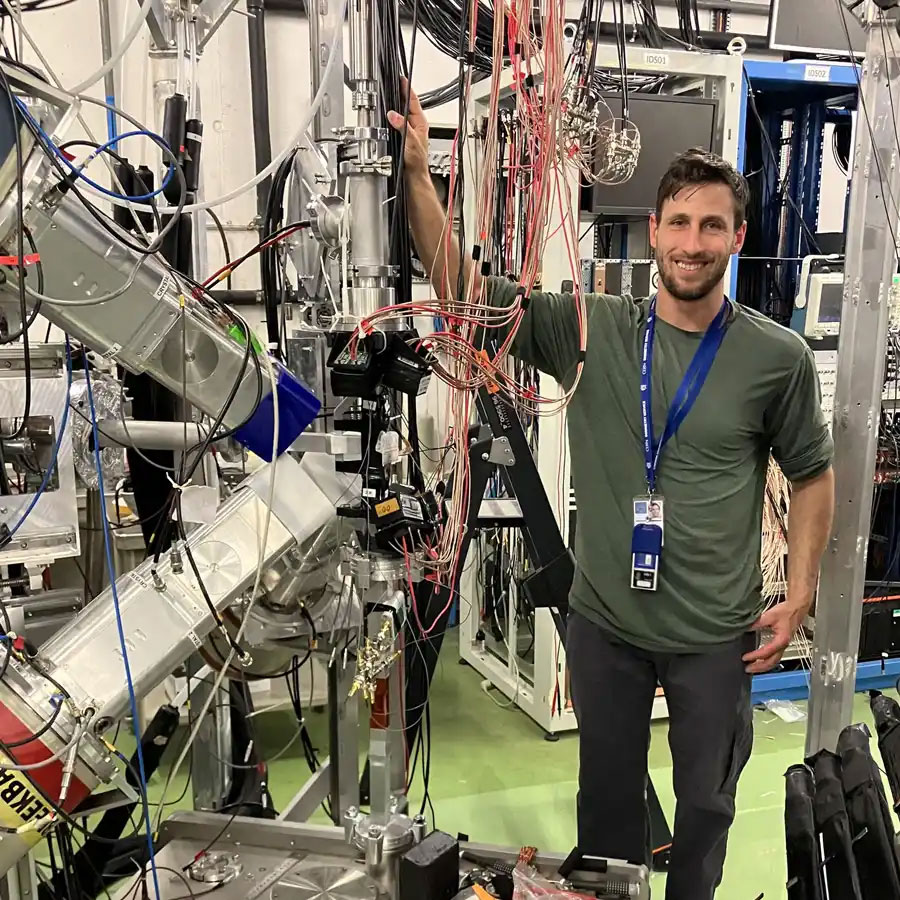
The ISOLDE Decay Station at CERN met the challenge by providing plenty of indium-134 nuclei, as well as sophisticated laser separation technology to make sure they were pristine. When indium-134 decays, it populates excited states in tin-134, tin-133, and tin-132. Using a neutron detector funded by the National Science Foundation Major Research Instrumentation program and built at UT, scientists made three important discoveries. At the top of the list, they made the first measurement of neutron energies for beta-delayed two-neutron emission.
The two-neutron emission is the biggest deal,” Grzywacz said.
Beta-delayed two-neutron emission occurs only in exotic nuclei, those that are short lived and unstable. The two-neutron separation energy is very small, but in this experiment it was enough to be measured.
“The reason this is hard is because neutrons like to bounce around. It’s hard to tell if it’s one or two,” Grzywacz explained. In earlier attempts, “no one measured energies,” so this approach “opens a completely new field.”
This is the first study detailing the two-neutron emission for a nucleus that follows the r-process path, opening the door for clearer models about how stellar events can create elements like gold.
Tin Never Forgets
A second discovery was the first observation of a long-sought single-particle neutron state in tin-133. Grzywacz explained that “tin is in an excited state. (It) has to cool off. It can spit out a neutron, or, with enough energy, it can spit out two neutrons. It should always spit two neutrons, but it doesn’t.”
He said the traditional view is that tin “boils off” neutrons to cool down, becoming “an amnesiac nucleus,” with no memory of beta decay.
“We say the tin doesn’t forget,” Grzywacz said. “This ‘shadow’ of indium doesn’t completely disappear. The memory is not erased.”
In this experiment, state-of-the-art neutron detectors identified this elusive state, indicating that a better theoretical framework is needed to understand why sometimes one neutron is emitted and sometimes two are.
“People were searching for it for 20 years and we found it,” Grzywacz said. “Those two neutrons allowed us to see this state.”
He explained that this newly observed state is an intermediate step in the two-neutron emission process. It’s also the last elementary excitation in the tin-133 nucleus, completing the picture and helping make calculations more accurate.
Better calculations and modeling are tied to the third discovery this research brought to light—the observation of a non-statistical population of this newly observed state. Grzywacz explained that the decay process is relatively clean, so everything is separate with no neighboring states.
“You’re not making split-pea soup,” he said. “Still, in most cases, it behaves like split-pea soup. Somehow, this statistical mechanism happens. Why is it statistical, even though it shouldn’t be and why in our cast it isn’t”?
The results indicate that as you travel across the nuclear landscape, farther from stability and into the realm of exotic nuclei like Tennessine, the old models don’t hold and new ones are needed.
The Pursuit of Curiosity
The need for new models to explain nuclear origins and structure presents a tremendous opportunity for graduate students like Dyszel. He joined Grzywacz’s group in 2022 and was the first author on the Physical Review Letters paper outlining the three discoveries. His to-do list on this experiment was a long one, from constructing physical pieces to interpreting the results. He built frames for the neutron tracking detectors and assembled them in the experimental setup. He set up the required electronics and made beta detectors. He ran test measurements, helped with software for data acquisition, made corrections for optimal timing resolution, and analyzed the experimental data. With all that, Dyszel’s work was still part of a multi-person effort.
“The success of this work is due in part to my colleagues and collaborators, whose guidance and constructive input were crucial,” he said.
A native of Jacksonville, Florida, Dyszel came to UT after finishing a bachelor’s in physics at the University of North Florida. His road to PRL authorship actually began in a general chemistry course when he first learned about beta decay. Intrigued by the thought that nuclear transformations could generate elements with a whole set of different properties, he thought he’d go for a bachelor’s in chemistry.
“It was not until I started my bachelor’s degree that I had stepped foot into a physics class, which instantaneously drove me towards a degree in physics,” he explained. “I’ve always been interested in understanding how the world works, and physics has been, and continues to be, the path I want to follow in pursuit of that curiosity.”
Reference: “First β-Delayed Two-Neutron Spectroscopy of the r-Process Nucleus In134 and Observation of the i13/2 Single-Particle Neutron State in Sn133” by P. Dyszel, R. Grzywacz, Z. Y. Xu, N. Kitamura, M. Karny, A. Korgul, M. Madurga, S. Neupane, A. Algora, A. Algora, A. N. Andreyev, M. Araszkiewicz, R. A. Bark, J. Benito, N. Bernier, M. J. G. Borge, M. Caballero, P. Chuchala, T. E. Cocolios, C. Costache, J. G. Cubiss, H. DeWitte, J. E. Escher, D. Fernandez-Ruiz, A. Fijalkowska, L. M. Fraile, H. O. U. Fynbo, J. Gouge, J. L. Herraiz, A. Illana, P. M. Jones, D. S. Judson, P. Kamińska, T. Kawano, K. Kolos, M. Labiche, R. Lică, M. Llanos-Expósito, G. G. DeLorenzo, N. Marginean, I. Michelon, C. Mihai, E. Nácher, C. Neacsu, J. S. Nielsen, B. Olaizola, J. N. Orce, C. A. A. Page, R. D. Page, J. Pakarinen, A. Perea, M. Piersa-Siłkowska, Zs. Podolyák, J. S. Prieto, M. Rajabali, J. Shaw, A. I. Sison, K. Solak, M. Stryjczyk, O. Tengblad, P. G. T. Vicente, N. Warr, J. Wilson, Z. Yue and S. Zajda, 8 October 2025, Physical Review Letters.
DOI: 10.1103/l24v-5m31
Never miss a breakthrough: Join the SciTechDaily newsletter.
Follow us on Google and Google News.
3 Comments
Physicists Observe a Nuclear “Memory” Thought Impossible. The results indicate that as you travel across the nuclear landscape, farther from stability and into the realm of exotic nuclei like Tennessine, the old models don’t hold and new ones are needed.
VERY GOOD.
Please ask physicists to think deeply:
1. What do you think is the basis for the impossibility?
2. Is Physical Review Letters a publication that respects science?
3. If your observations can change the world, what is impossible?
Contemporary physics are sure they are right when working with a system they believe is wrong – they are gonna have a hard time getting out of their rut. The key difference between TVT and traditional physics (e.g., Newtonian mechanics, relativity, quantum mechanics) lies in its perspective on describing the universe. TVT emphasizes the ideal fluid properties and topological structure of space, rather than focusing solely on the direct interactions of particles and forces. This perspective offers a new paradigm for understanding the structure of the universe. Its core predictions (e.g., cosmic-scale vortex networks) have been confirmed across multiple disciplines. For example:
Topological structures, such as vortices, are prevalent in nature and science across a wide range of length scales, ranging from macroscopic cosmic strings (1), mesoscale liquid crystals (2, 3) and ferromagnets (4), nanoscale ferroelectrics and superconductor/superfluid Bose-Einstein condensate states (5, 6), down to the atomic nucleus (7).
——Excerpted from https://www.science.org/doi/10.1126/sciadv.adu6223.
Compromise with pseudoscience and pseudo academic publications is to commit a crime against scientific progress and human advancement. Incommensurability is a core concept introduced by American philosophers of science Thomas Kuhn and Paul Feyerabend to describe the incomparability between successive paradigms during scientific revolutions. This theory emphasizes the fundamental differences between paradigms in their linguistic systems, taxonomic categories, and value judgments, which prevent them from being directly compared or translated through a common standard. In his work The Structure of Scientific Revolutions, Kuhn used this concept alongside “paradigm” to construct a discontinuous model of scientific development.
Topological vortex theory (TVT) not only provides a solid mathematical description for exotic excitations in low-dimensional spacetime but also plays a central role in connecting physical laws across different dimensions. The study of topological vortices and dimensional evolution not only deepens our understanding of nature’s fundamental laws but also prompts us to rethink the very nature of the most basic concepts: “spacetime” and “matter.”
——Excerpted from https://scitechdaily.com/microscope-spacecrafts-most-precise-test-of-key-component-of-the-theory-of-general-relativity/#comment-910609.
Trifling quibble for the writer – Saying activity is difficult with the word, ‘hard’ – may be confused with modulus.
VERY GOOD. How should we understand the modulus?
In Topological vortex theory (TVT), a microscopic topological vortex is characterized by its winding number in spacetime, which is a topological invariant [6]. We introduce a complex scalar field Ψ(𝐫,t), which is not the primitive wavefunction but an order parameter field for the topological state of the underlying vortex field [7].
1)Phase θ(r,t): Describes the distribution of topological charge density of the vortex. A 2π-integer multiple change of phase around a singularity corresponds to a non-trivial topological charge.
2)Modulus Squared |Ψ(r,t)|²: Is proportional to the energy density or “vortex intensity” of the vortex, and corresponds statistically to the probability density in quantum mechanics.
——Excerpted from https://scitechdaily.com/microscope-spacecrafts-most-precise-test-of-key-component-of-the-theory-of-general-relativity/#comment-911110.